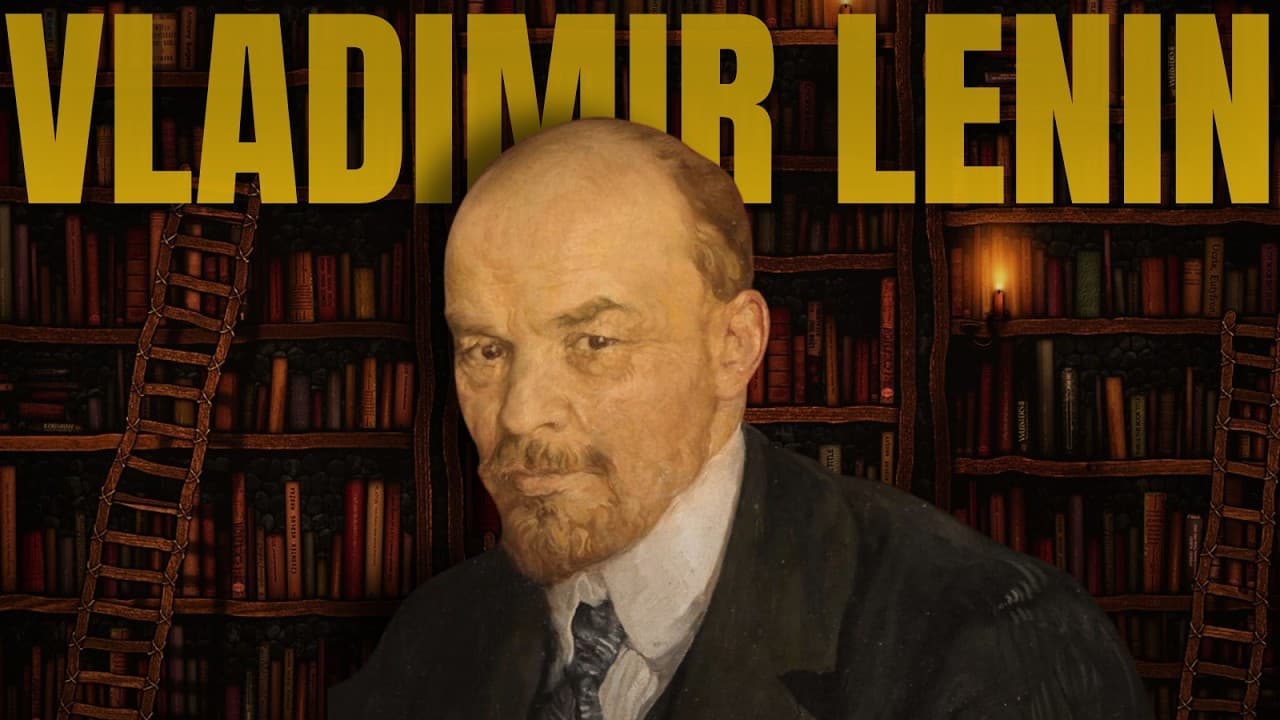
All of Vladimir Lenin's Philosophy
Complete Philosophy
Chapters
- 0:00:00Chapter 01: What Is to Be Done?
- 0:12:55Chapter 02: Simbirsk and the Making of a Revolutionary
- 0:22:23Chapter 03: The Execution of Alexander Ulyanov
- 0:30:17Chapter 04: Becoming a Marxist: Exile, Study, Organization
- 0:40:17Chapter 05: The Vanguard Party: Consciousness from Outside
- 0:51:02Chapter 06: Bolsheviks and Mensheviks: The 1903 Split
- 1:02:16Chapter 07: Imperialism: The Highest Stage of Capitalism
- 1:11:28Chapter 08: The State as Instrument of Class Rule
- 1:21:46Chapter 09: 1917: From February to October
- 1:32:15Chapter 10: The Seizure of Power
- 1:40:58Chapter 11: Civil War, Terror, and Survival
- 1:50:42Chapter 12: The New Economic Policy: One Step Back
- 1:57:26Chapter 13: The Testament and the Final Struggle
- 2:06:56Chapter 14: Death and the Lenin Cult
- 2:15:10Chapter 15: The Most Consequential Thinker of the Twentieth Century
Full Transcript
Chapter 01: What Is to Be Done?
What is to be done? This question defined Lenin's entire intellectual and political project. It was not merely the title of his most influential pamphlet, published in 1902. It was the question that separated Vladimir Lenin from every other socialist of his generation, the question that transformed Marxism from a theory of historical development into a theory of revolutionary action, the question whose answer reshaped the twentieth century.
The Marxists of the Second International, the great socialist parties of Western Europe, believed that capitalism would collapse under the weight of its own contradictions. They believed that the working class would spontaneously develop revolutionary consciousness through its experience of exploitation. They believed that history was moving inevitably toward socialism, that the task of socialists was to organize, to educate, to wait for the objective conditions to ripen. Karl Kautsky in Germany, the pope of Marxism, assured them that capitalism was digging its own grave, that the working class was growing stronger every day, that patient work within the system would eventually produce the transformation.
Lenin asked: What if this is wrong? What if the workers, left to themselves, develop only trade union consciousness? What if capitalism, far from collapsing, proves capable of reform, of adaptation, of extending its life indefinitely through concessions? What if the spontaneous development of the labor movement produces not revolutionaries but reformists, workers who seek higher wages and shorter hours within the existing system rather than the overthrow of capitalism itself?
This was not a theoretical quibble. Lenin had observed the Russian labor movement firsthand in St. Petersburg in the eighteen nineties. He had seen workers strike for better conditions, organize for legal protections, demand reforms from the Tsarist state. He had seen that their spontaneous activity, however militant, remained trapped within the logic of capitalism. They fought for improvements, not transformation. They sought justice within the system, not the abolition of the system. Trade union consciousness, Lenin concluded, was the natural, spontaneous consciousness of the working class under capitalism. It was also insufficient for revolution.
Revolutionary consciousness, Lenin argued, required something different. It required Marxist theory, scientific understanding of capitalism as a system, comprehension of historical development and class struggle. It required the ability to see beyond immediate grievances to ultimate goals, beyond economic demands to political power. And theory, Lenin insisted, was not something workers would develop spontaneously through their economic struggles. Theory was a product of intellectuals, of sustained study, of engagement with the entire history of human thought. Revolutionary consciousness, therefore, had to be brought to the working class from outside the economic struggle.
This conclusion led Lenin to his answer to the question of what is to be done. The answer was the vanguard party. A disciplined organization of professional revolutionaries who possess Marxist theory, who understand the historical situation scientifically, who can analyze the balance of forces and choose the moment to act. A party that would not simply reflect the spontaneous mood of the masses but would lead them, that would raise their consciousness, that would organize their power and direct it toward revolution. A party structured according to democratic centralism, with free debate before decisions and unified action afterward. A party of dedicated individuals who made revolution their profession, their life's work, who studied theory, who mastered conspiracy, who could survive repression and seize opportunities.
This idea transformed Marxism. Marx had written that the emancipation of the working class must be the work of the working class itself. Lenin did not reject this principle, but he complicated it profoundly. The working class would make the revolution, yes, but it would need the party to lead it. The masses would be the force, but consciousness would come from outside. Organization, Lenin insisted, was the weapon that could transform possibility into actuality, that could turn the working class from a class in itself into a class for itself, that could make revolution when the objective conditions ripened.
Critics saw danger in this formulation. Rosa Luxemburg, the brilliant Polish-German revolutionary, warned that Lenin's organizational theory risked substituting the party for the class, the Central Committee for the party, the leader for the Central Committee. She worried that democratic centralism would become centralism without democracy, that the professional revolutionaries would become a new ruling caste. She argued for spontaneity, for trust in the creative power of the masses, for organizational forms that grew organically from struggle rather than being imposed from above.
Lenin dismissed these concerns. In the conditions of Tsarist autocracy, with its secret police and its censorship and its repression, loose organization meant no organization. Spontaneity meant defeat. The party had to be hard, disciplined, centralized, or it would be crushed. This was not a matter of preference but of necessity, not ideology but practical politics.
Yet Luxemburg's warnings contained a prophetic element. The vanguard party theory did risk substitutionism. It did concentrate power. It did create the organizational preconditions for what would later emerge. Whether one sees continuity or rupture between Lenin and Stalin, between the vanguard party and the totalitarian state, the seeds of the problem were present in the answer to the question: What is to be done?
But Lenin's ideas did not remain on paper. They seized state power in the largest country on earth. They inspired revolutions across Asia, Africa, and Latin America. They created a new form of political organization that shaped the twentieth century. They produced outcomes Lenin did not intend, consequences that remain bitterly contested a century later. To understand the world we inherited, one must understand Lenin. To understand Lenin, one must begin with his question and his answer. What is to be done? Organize. Build the party. Bring consciousness to the workers. Prepare for the moment when history makes revolution possible. And when that moment arrives, seize it.
This was not merely organizational advice. It was a philosophy of history transformed into a theory of action. It rejected both fatalism and adventurism. It rejected the idea that revolution would happen automatically and the idea that revolutionaries could make it happen through will alone. It argued that revolution required the conjunction of objective conditions and subjective factors, of historical crisis and organized force, of mass discontent and revolutionary leadership. The party was the instrument that could unite these elements, that could turn possibility into reality.
Lenin believed that capitalism, especially in its imperialist stage, created the conditions for revolution. It concentrated workers in factories. It immiserated them through exploitation. It embroiled nations in wars. It generated crises. But these conditions, however favorable, would not automatically produce revolution. They produced only the possibility of revolution. Actuality required consciousness, organization, leadership. It required the vanguard party.
This theory explains why Lenin could be simultaneously deterministic and voluntaristic, why he could believe that capitalism was doomed and yet insist that revolutionaries must organize, must act, must seize the moment. History created opportunities, but human beings, organized and conscious, had to grasp them. The party was the hand that grasped.
The question What is to be done? was originally posed by the Russian writer Nikolai Chernyshevsky in his novel of the same title, published in eighteen sixty-three. Chernyshevsky's novel depicted the new people, the radical intellectuals of the eighteen sixties who rejected traditional society and devoted themselves to the transformation of Russia. Lenin read the novel as a teenager and was profoundly influenced by it. By adopting Chernyshevsky's title for his own pamphlet, Lenin was claiming a tradition, connecting himself to the revolutionary intelligentsia that had emerged in the previous generation.
But Lenin's answer differed from Chernyshevsky's. The populists of the eighteen seventies and eighties, inspired by Chernyshevsky, had believed that revolutionary intellectuals should go to the people, should merge with the peasantry, should spark a peasant revolution against the autocracy and capitalism. Lenin, by contrast, was a Marxist. He believed that the working class, not the peasantry, was the revolutionary class. He believed that capitalism, despite its evils, was historically progressive, that Russia had to pass through a capitalist stage before socialism became possible. And he believed that the working class needed not just agitation but consciousness, not just rebellion but theory.
What is to be done? was written in emigration, in the years after Lenin's release from Siberian exile, during the period when he was building the organizational infrastructure for Russian Marxism. It was a polemic, directed against economists within the Russian Social Democratic movement who wanted to focus on economic struggles and legal reform rather than building a revolutionary party. It was harsh, uncompromising, sectarian. It crystallized Lenin's organizational vision and established his reputation as a master of political strategy.
Yet the pamphlet was also more than a manual of organization. It was a statement of Lenin's fundamental conviction that ideas matter, that theory is a material force, that consciousness can change the world. The professional revolutionaries Lenin envisioned were not conspirators in the traditional sense, not terrorists or assassins. They were organizers and propagandists, educators and agitators. Their weapon was not the bomb but the newspaper, not violence but ideas. The party would create consciousness, and consciousness would make revolution possible.
This belief in the power of ideas, in the necessity of theory, in the role of intellectuals in revolutionary transformation, distinguished Lenin from more mechanical Marxists who saw revolution as an automatic product of economic development. For Lenin, economics created the conditions, but politics and ideas determined the outcome. The party was the political instrument that could guide history, that could ensure that the conditions for revolution produced actual revolution.
Chapter 02: Simbirsk and the Making of a Revolutionary
Vladimir Ilyich Ulyanov was born on April twenty-second, eighteen seventy, in Simbirsk, a provincial town on the Volga River in central Russia. The town was quiet, traditional, unremarkable. It had churches and government buildings, merchants and officials, a small educated class and a large peasant population. It was not a place that seemed destined to produce revolutionaries. Yet it produced Lenin.
His father, Ilya Nikolaevich Ulyanov, was a man of the eighteen sixties, the era of the Great Reforms when Tsar Alexander II emancipated the serfs and modernized Russia's institutions. Ilya Nikolaevich had risen from humble origins, the son of a former serf, to become a school inspector, a state servant dedicated to expanding education in the provinces. He was a reformer who believed in progress, in enlightenment, in the possibility of improving Russia through gradual change within the system. He was devoted to his work, serious, responsible, loyal to the autocracy that employed him. In recognition of his service, he was eventually granted hereditary nobility, a remarkable achievement for someone of his background.
Lenin's mother, Maria Alexandrovna, was better educated than most women of her generation. She came from a family of doctors and landowners, people who had sufficient means to value learning. She was cultured, strong-willed, the emotional center of the family. She would later prove remarkably resilient in the face of tragedy, holding the family together when disaster struck.
The Ulyanov household was comfortable, secure, intellectual. The children were encouraged to read, to study, to excel. There were six children who survived infancy: Anna, Alexander, Vladimir, Olga, Dmitri, and Maria. They were taught languages, mathematics, literature. They read Russian classics, European philosophy, scientific works. The atmosphere was serious but not oppressive, disciplined but loving.
Vladimir was a precocious child, intense, competitive, argumentative. He excelled at school, winning prizes and medals. He loved chess and enjoyed beating opponents. He had a sharp tongue and little patience for fools. He was not particularly likeable as a child, not warm or charming, but he was brilliant and driven. His teachers recognized his abilities. His father had high hopes for him. Nothing in his early years suggested that he would become a revolutionary. He seemed destined for a conventional career, perhaps as a lawyer or professor, certainly as a loyal subject of the Tsar.
The Ulyanov family was not radical. Ilya Nikolaevich was a state servant who believed in the system. Maria Alexandrovna was religious, attending church regularly. The children were raised to respect authority, to work hard, to succeed within the established order. If the family had any political inclinations, they were liberal rather than revolutionary, reformist rather than radical. They believed that Russia could and should modernize, that education and progress would eventually transform the country, that change should come through gradual improvement rather than violent upheaval.
Simbirsk itself was a bastion of traditional values. The Orthodox Church was strong. The provincial nobility dominated society. The peasants, though formally emancipated since eighteen sixty-one, remained poor and powerless. Revolutionary movements like the People's Will, which had assassinated Alexander II in eighteen eighty-one, operated in the capitals and major cities but had little presence in places like Simbirsk. The town was quiet, conservative, stable.
Yet this stability was deceptive. Beneath the surface of provincial respectability, Russia was changing. Capitalism was developing, creating a new industrial working class. Universities were producing educated young people who questioned traditional values. Revolutionary ideas, suppressed but not eliminated, circulated in underground circles. The autocracy responded to challenges with repression, driving opposition underground and radicalizing moderates. The very reforms that Ilya Nikolaevich dedicated his life to implementing created new expectations that the system could not fulfill.
In this context, even comfortable, loyal, respectable families like the Ulyanovs could produce revolutionaries. It required only a catalyst, something to shatter the illusion that the system was just and reformable, something to reveal that no amount of education or progress or service would make Russia truly free. For Vladimir Ulyanov, that catalyst was the execution of his older brother.
Alexander Ulyanov, three years older than Vladimir, was brilliant, studious, serious. He studied natural sciences at St. Petersburg University, winning prizes and gaining recognition for his research on animal organisms. He seemed destined for an academic career. But in the repressive atmosphere of the eighteen eighties, under Alexander III, even brilliant students became radicalized. The People's Will had been crushed after the assassination of Alexander II, but the spirit of revolt persisted among young intellectuals. Alexander fell in with a group of students who planned to assassinate Alexander III on the sixth anniversary of his father's murder.
The plot was amateurish, doomed from the start. The conspirators were inexperienced, their plans poorly conceived. They were arrested before they could strike. Alexander was tried, convicted, and sentenced to death. He refused to ask for clemency, insisting on taking full responsibility for his actions. On May twentieth, eighteen eighty-seven, he was hanged in the Schlüsselburg Fortress near St. Petersburg. He was twenty-one years old.
The news shattered the Ulyanov family. Ilya Nikolaevich had died the previous year of a brain hemorrhage, suddenly and prematurely. Now Maria Alexandrovna lost her eldest son to the hangman. The family's comfortable position in Simbirsk society evaporated. They were the family of a terrorist. Neighbors shunned them. Friends abandoned them. The respectable life that Ilya Nikolaevich had worked so hard to build collapsed.
For seventeen-year-old Vladimir, the execution of his beloved older brother was transformative. He was suddenly confronted with the reality that the Russian state murdered its opponents, that loyalty and service meant nothing, that no amount of education or achievement would protect you if you challenged the autocracy. His father had dedicated his life to improving Russia through service to the Tsar, and the Tsar had hanged his son. The lesson was clear: the system could not be reformed. It had to be overthrown.
But Vladimir did not immediately become a revolutionary. That transformation took time, required study, needed intellectual foundations. In the immediate aftermath of Alexander's execution, Vladimir was simply a grieving brother, an expelled student, a young man whose future had suddenly become uncertain. He had been preparing to attend Kazan University when Alexander was arrested. After the execution, he was admitted but then expelled within months for participating in a student protest. He was placed under police surveillance and exiled to the family estate at Kokushkino.
It was during this period of forced isolation, of exile from normal life, that Vladimir began his serious self-education. He read voraciously, systematically, intensely. He read history, philosophy, economics, political theory. He read Chernyshevsky's What Is to Be Done?, the novel that had inspired a generation of revolutionaries. He read works by populist theorists who advocated peasant socialism. And he began his serious engagement with Marx and Engels.
Chapter 03: The Execution of Alexander Ulyanov
The execution of Alexander Ulyanov was not simply a family tragedy for Vladimir. It was a political education, a revelation about the nature of the Russian state and the impossibility of reform. Alexander's path to the scaffold illuminated the choices facing young Russian intellectuals in the repressive eighteen eighties and shaped Vladimir's entire subsequent development.
Alexander had been a dutiful son, a brilliant student, a scientist with a promising future. He studied zoology at St. Petersburg University and conducted original research on segmented worms, work that earned him a gold medal from the university. His professors expected great things from him. He seemed to embody his father's hopes: an educated, talented young man who would contribute to Russia's modernization through science and learning.
But St. Petersburg in the eighteen eighties was a place where even the most apolitical student encountered political reality. The autocracy of Alexander III was deeply repressive. After the assassination of Alexander II in eighteen eighty-one by members of the People's Will, the new tsar had launched a campaign of reaction that crushed revolutionary organizations, censored publications, restricted universities, and drove dissent underground. Students found themselves under constant surveillance. Any expression of independent thought could lead to expulsion or worse.
In this atmosphere, political consciousness developed even among those who had come to the capital to study science. Alexander Ulyanov, the serious, studious scientist, became involved with a group of students who revived the tactics of the People's Will. They formed a conspiracy to assassinate Alexander III. The plot was timed for March thirteenth, eighteen eighty-seven, the sixth anniversary of Alexander II's assassination. They planned to throw bombs at the tsar's carriage as he traveled along Nevsky Prospekt.
The conspiracy was penetrated by the police before it could be executed. The plotters were arrested, their bomb-making materials seized. Alexander and four others were charged with terrorism and brought to trial. The proceedings revealed the depth of their radicalization and the desperation that had driven them to embrace violence. Alexander did not deny his role. He defended his actions eloquently, arguing that terrorism was a legitimate response to tyranny, that violence was justified when all peaceful avenues for change were blocked.
His statement to the court became famous: For a man with only a spark of honesty and concern for his fellowmen, with any conception of human dignity, there is only one possible course, to fight this regime however he can. He insisted that he felt no regret, that he was prepared to die for his beliefs. He refused to request clemency from the tsar, knowing that such a request would require renouncing his principles. His mother pleaded with him to appeal for mercy. He refused. He would die with dignity, on his own terms.
The trial concluded swiftly. Alexander and four co-conspirators were sentenced to death. The others involved received lesser sentences. On May twentieth, eighteen eighty-seven, the five condemned men were hanged at Schlüsselburg Fortress. Alexander was twenty-one years old. His accomplices were similarly young. They died believing that their sacrifice would inspire others, that terrorism would spark a revolutionary movement, that their deaths would not be in vain.
For Maria Alexandrovna, traveling to St. Petersburg to see her son one last time and to collect his body afterward, the experience was devastating. She had already lost her husband the previous year. Now she lost her eldest son to the executioner. She watched as the respectable position her husband had worked so hard to achieve crumbled around her. Former friends refused to acknowledge them. Doors that had been open closed. The children's futures, once bright, became uncertain.
Vladimir learned of his brother's arrest while preparing for his final examinations at gymnasium in Simbirsk. He learned of the execution shortly after finishing those examinations with top honors. The contrast was stark: personal achievement meant nothing when the state could murder your brother. Vladimir's immediate response was anger, grief, determination. But it was not yet political clarity. That would come through reading, through study, through working out intellectually what his brother had tried to accomplish through action.
Years later, Lenin would reflect on the difference between his path and Alexander's. Alexander had turned to terrorism, to individual violence, to the tactics of the People's Will. This was the tradition of the revolutionary populists, who believed that assassination could spark popular revolt, that dramatic gestures could inspire the masses. Vladimir would conclude that this path was futile. Terrorism substituted individual heroism for mass organization. It allowed the state to portray revolutionaries as criminals rather than as representatives of popular discontent. It led to martyrdom rather than victory.
Marx offered an alternative. Instead of terrorism, mass organization. Instead of individual heroism, class struggle. Instead of assassination, revolution. The working class, not the revolutionary intelligentsia, was the agent of historical transformation. Capitalism itself, through its development and its contradictions, created the conditions for its own overthrow. The task was not to terrorize the state but to organize the working class, to raise its consciousness, to prepare it for revolutionary action when conditions ripened.
This Marxist perspective allowed Vladimir to honor Alexander's sacrifice while rejecting his methods. Alexander had been right about the need to fight the autocracy. He had been wrong about how to do it. Vladimir would find a different path, a path that led through Marx and through the working class rather than through bombs and assassinations. But he would never forget that the state had murdered his brother, that the system was fundamentally unjust, that reform was impossible and revolution necessary.
The execution of Alexander Ulyanov thus became the foundational trauma of Lenin's life, the event that pushed him toward revolution and shaped his entire political consciousness. It personalized the abstract analysis Marx provided. When Lenin wrote about the state as an instrument of class domination, he was writing about the state that hanged his brother. When he wrote about the necessity of smashing the existing state apparatus, he was writing about the necessity of destroying the system that produced that execution. Theory and biography converged. The personal became political in the most direct possible way.
Chapter 04: Becoming a Marxist: Exile, Study, Organization
After his expulsion from Kazan University in eighteen eighty-seven and his internal exile to the family estate, Vladimir Ulyanov embarked on a systematic self-education that transformed him into a Marxist revolutionary. This transformation was not sudden or emotional but gradual and intellectual, the product of sustained study and careful reflection on the lessons of his brother's death and Russia's revolutionary tradition.
At Kokushkino, the family estate where he was confined, Vladimir had access to a substantial library that had belonged to his uncle. He read Russian literature, European philosophy, radical texts that circulated in manuscript. He read Chernyshevsky's What Is to Be Done?, the novel that had inspired a generation of revolutionaries. He read works by populist theorists who advocated peasant socialism. And he began his serious engagement with Marx and Engels.
Capital was revelatory. Marx's dense, systematic analysis of capitalism provided Vladimir with a framework for understanding not just economics but history, politics, and society. Marx demonstrated that capitalism was a system governed by laws, that exploitation was structural rather than accidental, that the working class had a historical role to play in overthrowing the system that oppressed it. This was not moral outrage, though Marx certainly felt outrage. It was scientific analysis, or so it claimed. It revealed the inner workings of capitalism and pointed toward its eventual supersession by a higher form of social organization.
For Vladimir, fresh from the trauma of his brother's execution, Marx offered something populist terrorism could not: a theory of historical development that made revolution seem not just desirable but inevitable, not just a moral imperative but a historical necessity. The working class would make the revolution because capitalism created the working class, concentrated it in factories, disciplined it through industrial labor, taught it to act collectively. The revolutionary intelligentsia did not need to terrorize the state. They needed to connect with this rising class, to educate it, to organize it, to prepare it for its historical mission.
This discovery led Vladimir to break decisively with the populist tradition that had inspired his brother. The populists believed that Russia could skip capitalism, that the peasant commune could serve as the basis for a socialist society, that the peasantry was the revolutionary class. Lenin concluded that this was romantic nonsense. Russia was already capitalist. Capitalism was developing, creating factories and workers, destroying traditional peasant life. This development was historically progressive despite its human costs. It laid the foundations for socialism. The task was not to prevent capitalism but to push through it, not to preserve peasant traditions but to organize the new working class that capitalism was creating.
In eighteen eighty-eight, Vladimir was allowed to return to Kazan but was still barred from university. He joined a Marxist study circle and began to develop a reputation as an exceptionally well-read and sharp-minded young man. He argued passionately, sometimes abrasively, against populist ideas. He insisted on the primacy of the working class and the necessity of accepting capitalism as a stage of historical development. His arguments were rigorous, his knowledge impressive, his certainty absolute.
In eighteen ninety-one, after years of his mother's petitioning, Vladimir was finally allowed to take the law examinations at St. Petersburg University as an external student. He passed brilliantly, finishing first in his class despite having studied entirely on his own. This achievement opened the possibility of a legal career, but Vladimir had no intention of becoming a conventional lawyer. He practiced briefly in Samara, taking on mostly minor cases, but his real energies went into revolutionary activity.
He continued his study of Marx, reading everything available in Russian translation and some works in German. He wrote his first major work, an analysis of capitalist development in Russian agriculture that challenged populist claims about the peasant commune. He established connections with other Marxists, both the older generation of pioneers like Georgi Plekhanov who had founded the Emancipation of Labor group in exile, and his own generation of young revolutionaries.
In eighteen ninety-three, Vladimir moved to St. Petersburg, ostensibly to practice law but actually to engage in revolutionary work. The capital had a significant labor movement. Workers were striking, organizing, demanding reforms. The conditions seemed ripe for Marxist propaganda and agitation. Vladimir threw himself into this work, writing leaflets, teaching in workers' circles, making connections with labor activists. He was systematic, disciplined, indefatigable. He approached revolutionary work the way he approached everything else: with intense focus and determination.
It was in St. Petersburg that Vladimir met Nadezhda Krupskaya, who would become his wife and lifelong collaborator. Krupskaya was herself involved in revolutionary work, teaching in workers' schools and distributing illegal literature. She was dedicated, intelligent, and as committed to the cause as Vladimir. Their relationship was based on shared political conviction as much as on personal affection. They would work together for the rest of Lenin's life, Krupskaya serving as secretary, organizer, comrade, and partner.
In December eighteen ninety-five, Vladimir and several other members of the St. Petersburg League of Struggle for the Emancipation of the Working Class were arrested. The police had been monitoring their activities and struck just as they were preparing to launch an illegal newspaper. Vladimir was imprisoned for fourteen months, then sentenced to three years of exile in Siberia. Krupskaya was arrested separately and also sentenced to exile. They married in Siberia in eighteen ninety-eight.
The Siberian exile, from eighteen ninety-seven to nineteen hundred, was remarkably productive for Vladimir. He was allowed to receive books and journals. He wrote extensively, including his first major work, The Development of Capitalism in Russia, a detailed empirical study demonstrating that capitalism was indeed developing in the Russian countryside and creating a rural proletariat. This was directed against populist economists who still believed in the peasant commune. Vladimir marshaled statistics, analyzed data, built an argument that was both theoretical and empirical. The book established his reputation as a serious Marxist theorist.
But exile also imposed isolation. In Siberia, far from the centers of revolutionary activity, Vladimir could study and write but could not organize. The movement was developing without him. New debates were emerging. A tendency called economism was gaining influence, arguing that socialists should focus on economic struggles and legal reforms rather than building a revolutionary party. Vladimir saw this as a dangerous retreat from revolutionary politics, a capitulation to the spontaneity of the labor movement.
When his exile ended in nineteen hundred, Vladimir left Russia for Western Europe. He would spend most of the next seventeen years in emigration, in Switzerland, Germany, England, France, Austria, returning to Russia only briefly during the nineteen oh-five revolution. This emigration was necessary because repression in Russia made sustained revolutionary work impossible. But it was also frustrating. Vladimir was a man of action forced to work at a distance, a revolutionary organizer separated from the class he wanted to organize, a political leader conducting his struggle through newspapers and pamphlets rather than through direct engagement with workers and events.
Yet this period of emigration was crucial for the development of Lenin's ideas and for the building of the Bolshevik party. It was in emigration that Vladimir would write What Is to Be Done?, that he would split the Russian Social Democratic Labor Party into Bolsheviks and Mensheviks, that he would develop his theory of imperialism and the state, that he would prepare himself and his organization for the revolutionary opportunities that would eventually arrive. The years of exile and emigration tempered him, sharpened his ideas, created the instrument he would eventually use to seize power.
Chapter 05: The Vanguard Party: Consciousness from Outside
In nineteen oh-two, Vladimir Lenin published What Is to Be Done? Burning Questions of Our Movement under the pseudonym he would use for the rest of his life. The pamphlet was ostensibly a contribution to internal debates within Russian Social Democracy, but it became something more: the foundational text of Leninism, the clearest statement of Lenin's organizational theory, the document that established the concept of the vanguard party.
The immediate context was the controversy over economism. Certain Russian Marxists, influenced by the revisionism of Eduard Bernstein in Germany, argued that socialists should focus on the economic struggle of workers, on improving wages and conditions through trade unions and legal reform, rather than on building an illegal revolutionary party. They believed that political consciousness would emerge spontaneously from economic struggles, that workers would become revolutionaries through their own experience of exploitation and resistance.
Lenin saw this as a fundamental error, a betrayal of revolutionary Marxism. He argued that the spontaneous development of the working-class movement led not to revolutionary consciousness but to trade union consciousness. Workers would naturally fight for better wages, shorter hours, improved conditions. This was militancy, but it was not revolution. It remained within the logic of capitalism, accepting the system while demanding improvements within it. Trade union consciousness was reformist consciousness, an adaptation to capitalism rather than a challenge to its existence.
Revolutionary consciousness, by contrast, required understanding capitalism as a system, comprehending the class nature of the state, grasping the necessity and possibility of revolutionary transformation. This understanding came not from economic struggles alone but from Marxist theory. And Marxist theory was not something workers would develop spontaneously. It was the product of intellectuals, of people who had the education and leisure to study philosophy, economics, history. The bourgeois intellectuals Marx and Engels had created Marxism, not workers. Revolutionary consciousness therefore had to be brought to the working class from outside its immediate economic struggles.
This did not mean that workers could not become revolutionary theorists. Many did. But they became theorists not through their economic activity as workers but through their engagement with Marxist theory, through a process of education that took them beyond their immediate experience. The point was that revolutionary consciousness required theoretical work, systematic study, engagement with ideas. It required the party.
Lenin's conception of the party was distinctive. He rejected the model of mass parties like the German Social Democratic Party, with its hundreds of thousands of members, its legal status, its parliamentary representatives, its newspapers and organizations operating openly. Such parties were impossible in the conditions of Tsarist autocracy, where any open revolutionary organization would be immediately crushed. But Lenin also believed that loose, democratic organizational forms were politically mistaken even where they were legally possible. The party should be a vanguard, not a mass. It should be composed of professional revolutionaries, people who dedicated their lives to the cause, who made revolution their full-time work, who possessed both theoretical understanding and practical skills in organization and conspiracy.
Democratic centralism was the organizational principle Lenin advocated. The phrase has become notorious, often reduced to simply centralism, but Lenin genuinely believed in both elements. Democratic meant free debate within the party, the ability to argue positions, to criticize policies, to struggle over theoretical and strategic questions. Centralism meant that once decisions were made through democratic processes, all members were bound to implement them, that the party acted as a unified force, that discipline and coordination were maintained.
In the conditions of illegality, this required strict organization. Cells rather than mass meetings. Compartmentalization to limit damage from arrests. Professional revolutionaries who could evade police surveillance, maintain conspiracies, and coordinate action across regions. The party would be small, tightly organized, disciplined. It would be the general staff of the revolution, the organized consciousness of the working class.
Critics immediately spotted the dangers in this formulation. Rosa Luxemburg, the brilliant Polish-German Marxist, warned that Lenin's organizational model subordinated the spontaneity and creativity of the masses to the control of the party leadership. She argued that revolutionary consciousness emerged from mass struggle itself, that the party should facilitate and learn from these struggles rather than directing them from above. She worried that democratic centralism would become bureaucratic centralism, that the professional revolutionaries would become detached from the working class they claimed to represent, that the party would substitute itself for the class.
Luxemburg's warnings proved prescient. The vanguard party model did create organizational forms that could degenerate into bureaucratic dictatorship. The centralism often overwhelmed the democracy. The professional revolutionaries did become a layer separate from ordinary workers. The claim to represent the class became the claim to rule in its name. Whether these outcomes were inherent in Lenin's model or resulted from specific historical circumstances remains debated, but the dangers Luxemburg identified were real.
Lenin, however, believed that these risks were necessary. In Tsarist Russia, loose organization meant no organization. Spontaneity meant defeat. The labor movement, left to itself, had shown its limitations during the economic boom of the eighteen nineties. Workers had struck, organized, fought militantly, but had not developed revolutionary politics. They had not challenged the Tsarist state. They had not understood capitalism as a system requiring overthrow. Only the party, armed with theory and organized for revolutionary action, could lead the workers beyond trade union consciousness to revolutionary consciousness.
Moreover, Lenin argued that the vanguard was not separate from the class but the advanced detachment of the class. The party was composed of the most conscious, most dedicated workers and intellectuals who had committed themselves to revolution. It represented not an external force imposing on the class but the class's own most developed consciousness organized for action. The party led, but it led in the direction the class needed to go, toward its own emancipation.
This claim, of course, raises the question: How does the party know what the class needs? Lenin's answer was Marxist theory, scientific analysis of capitalism and class struggle. The party understood the objective situation, the balance of forces, the possibilities for revolutionary action. It did not simply reflect the current mood of the workers, which might be reformist or even reactionary. It understood the historical interests of the working class, its ultimate goal of emancipation. It could therefore lead even when leadership meant going against the current, opposing the spontaneous inclinations of the moment in favor of revolutionary preparation.
This distinction between the immediate consciousness of workers and their historical interests would become crucial and controversial. It allowed the party to claim legitimacy even when workers did not support it, to justify acting in the name of the class even against the expressed wishes of actual workers. It opened the door to substitutionism, to the party substituting itself for the class, claiming to represent workers better than workers represented themselves. Whether Lenin intended this outcome or whether it represented a perversion of his ideas remains contested. But the theoretical architecture that made it possible was present in What Is to Be Done?
The pamphlet also emphasized the role of the revolutionary newspaper. Lenin argued that a consistent, nationwide newspaper could serve as a collective organizer, unifying scattered local struggles, raising the political consciousness of readers, creating a network of correspondents and distributors who would form the nucleus of the party. Iskra, the newspaper Lenin had founded in nineteen hundred before writing What Is to Be Done?, was the model. Through Iskra, Lenin built influence within Russian Social Democracy, established his positions, created a faction loyal to his organizational vision.
What Is to Be Done? was therefore not just a theoretical text but a practical intervention, part of Lenin's campaign to control Russian Social Democracy and establish his organizational principles as the basis for party building. It succeeded in crystallizing a position, in giving clear form to Lenin's ideas, in creating the intellectual foundation for what would become Bolshevism. It also created the basis for a split.
Chapter 06: Bolsheviks and Mensheviks: The 1903 Split
In nineteen oh-three, the Russian Social Democratic Labor Party held its Second Congress, first in Brussels and then, after police pressure forced a move, in London. The Congress was supposed to unify Russian Marxists, to create a genuine party organization that would coordinate revolutionary work across the empire. Instead, it produced a split that would shape Russian and world history: the division between Bolsheviks and Mensheviks.
The split is often misunderstood. It was not primarily about ideology or ultimate goals. Both Bolsheviks and Mensheviks were Marxists who believed in the overthrow of capitalism and the creation of a socialist society. Both opposed the Tsarist autocracy and supported democratic revolution in Russia. Both believed that the working class was the revolutionary class. The differences concerned organization, strategy, and the tempo of revolution.
The immediate cause of the split was a debate over party membership. Lenin proposed that a member of the party should be someone who not only accepted the party program and paid dues but also personally participated in one of the party organizations. Julius Martov, Lenin's former close collaborator and friend, proposed a looser definition: a member was anyone who accepted the program, paid dues, and gave regular personal assistance under the direction of one of the party organizations.
The difference sounds technical, even trivial. But it reflected profound disagreement about what kind of party Russian Social Democracy should be. Lenin wanted a narrow party of active revolutionaries, a disciplined vanguard. Martov wanted a broader party that could include sympathizers and supporters who were not full-time revolutionaries, a party that could grow into a mass organization once legal conditions allowed.
Martov's position won on the membership question. But Lenin won on the composition of the editorial board of Iskra and the Central Committee, partly because some delegates had left the Congress before these votes. Lenin's faction, having received the majority on these organizational questions, adopted the name Bolsheviks, from the Russian word for majority. Martov's faction became the Mensheviks, from the word for minority. The names stuck despite being misleading, as the Mensheviks often had majority support within the party in subsequent years.
But the split went deeper than the tactical maneuvering at the Congress. It reflected two different visions of revolutionary politics in Russia. The Mensheviks believed that Russia had to pass through a bourgeois democratic stage before socialism became possible. Capitalism needed to develop fully. The working class needed to grow and mature. Democratic institutions needed to be established. The immediate task was therefore to support the bourgeois revolution against Tsarism, to help create the conditions for eventual socialist revolution in the more distant future. The Mensheviks favored cooperation with liberal parties, legal work where possible, and a more gradualist approach.
The Bolsheviks, while acknowledging that the immediate revolution in Russia would be bourgeois democratic rather than socialist, believed that the bourgeoisie was too weak and compromised to lead its own revolution. The working class, allied with the peasantry, would have to lead the democratic revolution. This would create a democratic dictatorship of workers and peasants, a transitional regime that would complete the bourgeois tasks, sweep away feudal remnants, redistribute land, and establish democratic freedoms. Only after this democratic revolution consolidated could socialist revolution become possible.
This difference in strategy reflected different assessments of the Russian bourgeoisie and different levels of revolutionary impatience. The Mensheviks trusted that history would unfold according to the stages Marx had outlined: feudalism, capitalism, socialism. Each stage had to be completed before the next could begin. The Bolsheviks believed that in backward Russia, where capitalism was developing late and unevenly, the stages could telescope, the workers could take the lead in the bourgeois revolution, and the transition to socialism could be accelerated.
Personality also played a role. Lenin was hard, uncompromising, sectarian. He believed in organizational discipline, in ideological clarity, in sharp demarcation from opponents. He saw politics as a form of war requiring unified command. Martov was more conciliatory, more democratic, more willing to accommodate different views within the party. Lenin believed that Martov's approach led to softness, to compromises that weakened revolutionary resolve. Martov believed that Lenin's approach led to authoritarianism, to the suppression of dissent, to the substitution of the party leadership for the party membership.
The split was personally painful for both men. They had been close friends and collaborators. They had worked together on Iskra, sharing the hard years of emigration and revolutionary work. The break embittered them both. Lenin would never again trust easily or form close friendships outside his immediate circle. He became more isolated, more reliant on his own judgment, more willing to stand alone if necessary.
The split also weakened Russian Social Democracy. Instead of a unified party, there were now two factions, both claiming to represent true Marxism, both competing for influence among Russian workers and intellectuals. The split consumed energies that might have gone into revolutionary work. It created animosities that would persist for years. Many observers at the time thought the split was a disaster, evidence of Lenin's sectarianism and inability to work cooperatively with others.
But Lenin saw it differently. He believed that clarity was more important than unity, that a small, disciplined, ideologically coherent party was more effective than a large, divided, confused organization. He believed that the split was necessary to establish the correct organizational principles and revolutionary strategy. He was willing to be in the minority if being in the majority required compromising on essential questions.
History would vindicate Lenin's organizational approach, at least in the narrow sense that the Bolshevik party proved capable of seizing power in nineteen seventeen when the Mensheviks did not. Whether this vindication was worth the costs, whether the organizational forms that enabled the Bolshevik seizure of power also enabled subsequent authoritarianism, whether Lenin's victory was ultimately a tragedy rather than a triumph, these questions remain open. But the split of nineteen oh-three established the organizational template that would carry Lenin and his followers to power.
The period after nineteen oh-three was frustrating for Lenin. The split marginalized him within Russian Social Democracy. Many party members saw him as a splitter, a sectarian who put organizational fetishism above unity and effectiveness. The nineteen oh-five revolution, when it came, caught him by surprise in exile. He returned to Russia in November nineteen oh-five, after the worst was over, and found that events had outrun his theories. Workers had formed soviets, councils that exercised real power in factories and neighborhoods. The soviets were spontaneous organs, not party creations, and they demonstrated the revolutionary capacity of workers acting on their own initiative. This was precisely the spontaneity Lenin had criticized in What Is to Be Done?, yet it had proved more effective than party organization.
Lenin adjusted his views. He recognized the soviets as important revolutionary organs. He acknowledged that revolutionary situations produced forms of organization that theory had not predicted. But he did not abandon his fundamental conviction that the party was necessary, that consciousness required organization, that revolutionaries had to lead rather than simply follow the masses. The nineteen oh-five revolution confirmed for Lenin that revolution was possible in Russia, that workers could act with tremendous energy and courage. But the revolution's defeat also confirmed that energy and courage were not enough. Without organization, without a party to coordinate action and press for seizure of power, revolutionary upsurges would be crushed.
The years after nineteen oh-five were dark times for Russian revolutionaries. Repression intensified. The Tsarist government regained its footing and struck back hard against opposition. Many revolutionaries were arrested, exiled, executed. Others fled abroad or retreated into private life. The party organizations largely disintegrated. The labor movement declined. It seemed that the revolutionary wave had crested and that Russia was entering a prolonged period of reaction.
Lenin persevered. He continued to write, to organize, to maintain the Bolshevik faction even when it seemed to have no immediate prospects. He engaged in philosophical debates, writing Materialism and Empirio-criticism in nineteen oh-nine to defend philosophical materialism against revisionist tendencies within the party. He fought over strategy and tactics, insisting on the necessity of illegal work even when legal opportunities seemed to make underground organization obsolete. He was sectarian, difficult, often isolated. But he maintained the organizational continuity that would prove crucial when revolutionary opportunities returned.
Chapter 07: Imperialism: The Highest Stage of Capitalism
In nineteen sixteen, with Europe engulfed in the catastrophe of the First World War, Lenin completed one of his most important theoretical works: Imperialism: The Highest Stage of Capitalism. Written in Switzerland during his second emigration, the pamphlet provided a Marxist analysis of the war and explained why Lenin believed that revolution had become possible even in backward countries like Russia.
The context was the collapse of the Second International. In August nineteen fourteen, when war broke out, the great socialist parties of Europe had abandoned internationalism and supported their respective governments. German socialists voted for war credits. French socialists joined the government of national defense. Only small minorities in each country opposed the war. The majority of socialists, including figures like Karl Kautsky whom Lenin had once revered as the keeper of Marxist orthodoxy, justified support for the war through various arguments about defensive war and national survival.
For Lenin, this betrayal was profound. The Second International had proclaimed that workers have no country, that class solidarity transcends national boundaries, that socialists would oppose any imperialist war with strikes and revolution. Yet when the test came, nationalism triumphed over socialism. The leaders of the Second International, Lenin concluded, had become opportunists, servants of their national bourgeoisies, betrayers of the working class. This betrayal required explanation. How had the revolutionary parties of Europe become complicit in imperialist slaughter?
Lenin's answer was his theory of imperialism. He argued that capitalism had entered a new stage, fundamentally different from the competitive capitalism Marx had analyzed. This new stage was characterized by five essential features: the concentration of production and capital leading to monopolies, the merger of bank capital with industrial capital creating finance capital, the export of capital rather than merely the export of goods, the formation of international capitalist monopolies dividing the world among themselves, and the territorial division of the world among the great powers completed.
This monopoly capitalism, Lenin argued, was imperialist capitalism. The great powers competed for colonies, for spheres of influence, for control of raw materials and markets. This competition was not accidental or policy-driven but structural, inherent in the development of capitalism itself. As capitalism developed, competition among firms led to concentration and monopoly. Monopolies needed new markets, new investment opportunities, new sources of raw materials. They turned to colonial expansion and eventually to war as means of redividing an already divided world.
The First World War was therefore not an aberration but a product of imperialism. It was a war over the redivision of the world, a clash between imperialist powers for colonies and dominance. The German bourgeoisie wanted a larger share of colonies and challenged British and French imperial dominance. The British and French sought to maintain their empires and crush the German challenge. Neither side represented progress or democracy. Both were imperialist, both sought conquest and domination, both were willing to sacrifice millions of workers in pursuit of profit.
Lenin drew several crucial political conclusions from this analysis. First, socialists should not support either side in the imperialist war. The position of revolutionary defeatism meant hoping for and working toward the defeat of one's own government, because defeat would weaken the ruling class and create revolutionary opportunities. Lenin advocated turning the imperialist war into a civil war, using the crisis of the war to launch revolutionary attacks on the bourgeoisie.
Second, imperialism had created a labor aristocracy in the advanced capitalist countries. The super-profits extracted from colonies allowed capitalists to bribe sections of the working class with higher wages, better conditions, and political rights. These bribed workers, represented by the reformist leaders of the Second International, had a stake in imperialism and opposed revolution. This explained why the most developed capitalist countries had the most reformist labor movements, why the German and British workers were not revolutionary despite having the strongest unions and socialist parties.
Third, and most importantly for Lenin's project, imperialism meant that revolution was possible in the weakest link of the imperialist chain rather than in the most developed countries. Marx had expected socialist revolution to occur first in the advanced capitalist countries where the working class was largest and most organized. But if the advanced countries had bribed labor aristocracies that opposed revolution, then revolution might break out first in less developed countries where imperialism had created instability and where workers and peasants had not been bought off. Russia, as a relatively backward country in the imperialist system, could be the site of the first successful socialist revolution.
This theory revolutionized Marxist strategy. It meant that socialists did not need to wait for capitalism to fully develop in their own countries before attempting revolution. It meant that the world revolution might begin in the periphery rather than the core. It opened the possibility that Lenin's own Bolshevik party, operating in backward Russia, might lead the first successful workers' revolution. The theory thus served Lenin's political purposes even as it provided a genuine analysis of twentieth-century capitalism.
Critics have questioned various aspects of Lenin's theory. The connection between monopoly and imperialism, while real, was more complex than Lenin suggested. The dating of imperialism's emergence as a stage of capitalism was debatable, as imperial expansion predated the monopoly capitalism of the early twentieth century. The claim that imperialism was the highest, final stage of capitalism, that it was moribund and decaying, proved false, as capitalism adapted and developed further. The theory of the labor aristocracy, while identifying a real phenomenon of privileged workers in advanced countries, overstated the bribery thesis and ignored other factors in reformism.
But Lenin's work captured something important about twentieth-century capitalism. The great powers were indeed competing for imperial control. The war was indeed connected to this competition. Capitalism was indeed becoming more concentrated and monopolistic. Finance capital was indeed playing an increasingly important role. Lenin's analysis, whatever its limitations, provided revolutionaries with a framework for understanding the war and for advocating revolutionary opposition to it.
The pamphlet was written in nineteen sixteen but not published until nineteen seventeen, after the February Revolution. By then, events were moving faster than theory. Russia was in revolution. Lenin's ideas about imperialism and revolutionary defeatism were no longer academic questions but immediate political challenges. The war had created the crisis Lenin had predicted. The question was whether revolutionaries could transform that crisis into revolution.
For Lenin, Imperialism was not just an economic analysis. It was a political weapon. It explained why the Second International had collapsed. It justified the Zimmerwald Left's opposition to the war. It showed that revolution was possible in Russia. It connected the immediate struggle against the war to the larger struggle against capitalism. It transformed a catastrophic war into a revolutionary opportunity. When Lenin returned to Russia in April nineteen seventeen, he carried these ideas with him, ready to apply them to the situation he would find.
Chapter 08: The State as Instrument of Class Rule
In the summer of nineteen seventeen, as Russia teetered between the February Revolution and what would become the October Revolution, Lenin retreated to Finland to escape arrest by the Provisional Government. While in hiding, he wrote one of his most important theoretical works: The State and Revolution. The book was never finished, cut short by the October events that called Lenin back to Petrograd to lead the insurrection. But what he completed became the foundational text of Marxist state theory, a systematic exposition of the Marxist understanding of political power.
The State and Revolution engaged with a core question of revolutionary politics: What should socialists do with state power? The reformists of the Second International, especially after the war's betrayal, argued that socialists should work within existing states, winning elections, passing reforms, gradually transforming capitalism through legislative action. They envisioned socialism as the culmination of democratic reforms, the peaceful transition from capitalism achieved through parliament and law.
Lenin attacked this position root and branch. He argued that the state was not a neutral apparatus that could be used for any purpose depending on who controlled it. The state was, in Marx and Engels's formulation, an instrument of class domination. It arose historically when societies divided into classes with irreconcilable interests. The economically dominant class needed a mechanism to maintain its dominance over the exploited classes. That mechanism was the state, with its police and army and bureaucracy and laws, all serving to protect property relations and enforce the rule of the exploiting class.
Under capitalism, therefore, the state was a bourgeois state, serving the interests of the capitalist class. Its democratic forms, where they existed, masked its class character. Universal suffrage, parliamentary institutions, civil liberties, these were real achievements won through working-class struggle. But they did not change the fundamental nature of the state as an instrument of class rule. The bourgeoisie tolerated democracy as long as it did not threaten property relations. When workers threatened to use democratic institutions to challenge capitalism, the bourgeoisie would dispense with democracy, as history repeatedly demonstrated.
This analysis led Lenin to a crucial conclusion: the existing state apparatus could not be taken over by the working class and used for socialist transformation. It had to be smashed, broken up, destroyed. The standing army, the police, the bureaucracy, all the institutions that enforced bourgeois rule, had to be dismantled. In their place, workers would create new institutions based on different principles.
Lenin's model was the Paris Commune of eighteen seventy-one. The Commune had abolished the standing army and replaced it with armed workers. It had abolished the police and the bureaucracy. It had made all officials elected and recallable, paying them workers' wages rather than bureaucratic salaries. It had abolished the separation between legislative and executive functions, uniting the making and enforcement of laws in a single body. These measures, Lenin argued, broke the old state apparatus and began to create a new form of political organization, a workers' state.
The workers' state would not be a state in the traditional sense. It would be, in Marx's phrase, a semi-state, already beginning to wither away. Because the working class was the vast majority, its rule required far less machinery of repression than bourgeois rule. The dictatorship of the proletariat, the form the workers' state would take, meant democracy for the vast majority and repression only for the former exploiters. It meant armed workers replacing professional armies. It meant elected and recallable officials replacing career bureaucrats. It meant the simplification of administrative functions so that ordinary people could perform them, rather than requiring specialized training and expertise.
Lenin acknowledged that the state would not disappear immediately after revolution. As long as classes existed, as long as the former bourgeoisie resisted, as long as the danger of capitalist restoration remained, the workers would need state power to defend their revolution. But this state would be different from previous states in that it was already dying, already simplifying its functions, already preparing for its own extinction. When classes finally disappeared, when exploitation ended, when the entire society consisted of workers managing production and distribution themselves, the need for any state would vanish. The state would wither away.
This vision was utopian in the literal sense: it described a society fundamentally different from any that had existed. But it was also practical in that it provided guidance for revolutionary action. Revolutionaries should not seek to control the existing state but to destroy it. They should not aim to reform bourgeois democracy but to replace it with soviet democracy, the democracy of workers' councils that had emerged spontaneously in nineteen oh-five and nineteen seventeen. They should not build a new bureaucracy but create forms of organization that would eventually make all bureaucracy unnecessary.
The State and Revolution is notable for its radical democratic vision. Lenin imagined a society where everyone participated in administration, where officials were truly servants of the community rather than a privileged caste, where the armed people replaced professional armies. This vision contrasts sharply with what actually developed in Soviet Russia under Lenin and especially under Stalin: a massive bureaucracy, a powerful secret police, a one-party dictatorship that suppressed working-class democracy in the name of defending it.
The gap between Lenin's vision in The State and Revolution and the reality of Soviet power raises profound questions. Was the vision unrealistic, a fantasy that could never be implemented? Were the circumstances, civil war and economic collapse and capitalist encirclement, so dire that the vision had to be abandoned for survival? Or was there something in Lenin's theory itself, in the vanguard party concept or the dictatorship of the proletariat or the justification of repression of class enemies, that made the degeneration inevitable?
Different scholars answer these questions differently. Some emphasize the emergency conditions that forced Lenin's government to adopt authoritarian measures. The Civil War required centralized command. Economic collapse required authoritarian control over resources. The isolation of the revolution, the failure of expected revolutions in Germany and elsewhere, meant that Soviet Russia had to build socialism in one country under siege. These circumstances, not Lenin's theories, produced the authoritarianism.
Others emphasize continuities between Lenin's vision and the Stalinist outcome. The dictatorship of the proletariat, even in Lenin's formulation, meant repression of former exploiters. The vanguard party meant that the party rather than workers' councils would make real decisions. The ban on factions within the party, adopted in nineteen twenty-one, eliminated internal democracy. The suppression of opposition parties, justified as temporary emergency measures, became permanent. The Cheka, the secret police, developed into a massive apparatus of terror. These developments, critics argue, were implicit in Lenin's theories and in the organizational forms the Bolsheviks created.
The debate cannot be resolved definitively. What is clear is that The State and Revolution articulated a vision of radical democracy, of popular power, of the withering away of the state. This vision inspired revolutionaries across the world. It suggested that socialism meant not just economic transformation but political liberation, not just nationalization of industry but popular participation in all aspects of social life. Whether this vision was betrayed or proved impossible, whether it was Stalinist distortion or Leninist illusion, it represented the most radical democratic aspiration of twentieth-century revolutionary thought.
Lenin never finished The State and Revolution. The final chapter on revolutionary experience in nineteen oh-five and nineteen seventeen remained unwritten. Events overtook theory. In October nineteen seventeen, the Bolsheviks seized power. Lenin found himself not writing about revolution but making it. The relationship between his theory and his practice, between the vision articulated in The State and Revolution and the reality created by Bolshevik rule, would become one of the central questions of twentieth-century political history.
Chapter 09: 1917: From February to October
Nineteen seventeen was the year that transformed Lenin from exile and theorist into revolutionary leader and head of state. It was the year when the theories developed over decades were put to the test of revolutionary practice. It was the year when the organizational forms Lenin had built, the Bolshevik party, proved capable of seizing power in the Russian Empire. And it was the year when decisions made in the urgency of revolutionary struggle would shape not just Russia but the entire twentieth century.
The year began with Lenin still in Zurich, still in emigration, still separated from Russia by world war and state borders. He was pessimistic about the immediate prospects. In January nineteen seventeen, speaking to young Swiss socialists, he said that his generation might not live to see the coming revolution, that the decisive battles might be fought by the youth. Within weeks, revolution erupted in Petrograd.
The February Revolution was spontaneous, a massive popular uprising driven by bread shortages, war weariness, and accumulated grievances against the Tsarist autocracy. Women textile workers went on strike on International Women's Day, February twenty-third. The strike spread. Demonstrations grew. Troops ordered to suppress the protests mutinied instead and joined the demonstrators. Within days, the Tsarist government collapsed. Nicholas II abdicated. Three hundred years of Romanov rule ended not through a carefully planned Bolshevik insurrection but through a popular explosion that caught all revolutionary parties by surprise.
The February Revolution created a situation of dual power. The Duma, the parliamentary body, formed a Provisional Government dominated by liberals and moderate socialists. But simultaneously, workers and soldiers formed soviets, councils that exercised real power in factories, barracks, and neighborhoods. The Petrograd Soviet controlled the garrison and could countermand government orders. The government had formal authority but lacked real power. The Soviet had power but refused to take authority. This unstable situation, Lenin immediately recognized, could not last. One power would eventually subordinate the other. The question was which.
Lenin learned of the February Revolution while in Zurich. His immediate reaction was to return to Russia, but this proved extraordinarily difficult. Russia and Switzerland were separated by warring countries. Traveling through Allied territory was impossible, as Lenin was known as a revolutionary defeatist who opposed the war. Traveling through Germany seemed the only option, but this risked accusations of being a German agent.
Lenin took the risk. He negotiated with German authorities for passage through Germany in a sealed train, agreeing that no German would enter the train car and no Russian would leave it during the journey. The Germans agreed, hoping that Lenin's return would increase revolutionary agitation and weaken Russia's war effort. On April ninth, Lenin and thirty-one other revolutionaries departed Zurich. They crossed Germany, then traveled through Sweden and Finland, arriving at Petrograd's Finland Station on April sixteenth.
Lenin's arrival shocked even his own party. He immediately articulated a position, later formalized as the April Theses, that contradicted the prevailing Bolshevik line. The Bolsheviks in Petrograd, led by Stalin and Kamenev, had adopted a policy of critical support for the Provisional Government and conditional support for the war effort. They believed that Russia was in the bourgeois democratic stage of revolution, that support for the bourgeois government was therefore appropriate, that socialism remained a distant prospect.
Lenin rejected this entirely. He argued that the Provisional Government was imperialist and bourgeois, that it would continue the war, that it would not give land to peasants or power to workers. He argued that the soviets represented an alternative form of power, that they were embryonic organs of the dictatorship of the proletariat. He argued that the Bolsheviks should work for all power to the soviets, should refuse any cooperation with the Provisional Government, should oppose the war without qualification. He argued, most shockingly, that the bourgeois democratic revolution was already complete, that Russia was in transition to socialist revolution, that the proletariat and poor peasants should take power.
The April Theses stunned the Bolshevik leadership. They seemed to abandon orthodox Marxism, which insisted that backward countries like Russia had to pass through capitalism before socialism became possible. They seemed adventurist, prematurely pushing for socialist revolution when objective conditions were not ripe. Even close collaborators like Kamenev opposed Lenin's position, arguing that he had lost touch with Russian realities during his years of emigration.
But Lenin's political instinct proved correct. The mood of workers and soldiers was radical. They had made the February Revolution and were frustrated that it had produced only a bourgeois government that continued the war. The slogan All Power to the Soviets resonated with this mood. It captured the aspiration for deeper transformation, for peace and land and workers' control. Within weeks, Lenin had won the Bolshevik party to his position. The April Theses became party policy.
The months between April and October saw growing radicalization and Bolshevik growth. The Provisional Government, led after July by the socialist Alexander Kerensky, proved incapable of addressing popular demands. It continued the disastrous war, delaying land reform until the convocation of a Constituent Assembly, failing to provide food for cities or relief for workers. The soviets, dominated by Mensheviks and Socialist Revolutionaries, supported the Provisional Government rather than taking power themselves. This created a space for the Bolsheviks, who offered a clear alternative: peace, land, and workers' control through soviet power.
The July Days nearly derailed the Bolshevik rise. Impatient workers and soldiers in Petrograd launched spontaneous demonstrations demanding soviet power. The Bolsheviks, fearing a premature insurrection would be crushed, tried to restrain the movement while also providing leadership. The demonstrations were suppressed. The government accused the Bolsheviks of being German agents and launched repression. Lenin fled to Finland. Trotsky and other Bolshevik leaders were arrested. The party was driven underground. It seemed that the revolutionary moment had passed.
But in late August, General Kornilov attempted a right-wing coup against Kerensky. To defend against Kornilov, Kerensky had to arm workers and release Bolsheviks from prison. The Bolsheviks led the defense of Petrograd, organizing Red Guards and mobilizing workers. Kornilov's coup collapsed. But the episode radicalized soldiers and workers, who now saw the Bolsheviks as defenders of the revolution. Bolshevik membership surged. In September, the Bolsheviks won majorities in the Petrograd and Moscow soviets. Trotsky, released from prison, became chairman of the Petrograd Soviet. The moment was approaching.
Lenin, still in hiding in Finland, pressed for insurrection. He wrote letter after letter to the Bolshevik Central Committee arguing that the moment was ripe, that delay would be fatal, that the party must seize power before the government could crush it. He threatened to resign from the Central Committee and campaign among the party rank and file if the leadership did not act. His urgency reflected both his reading of the situation and his fear that opportunities, once missed, do not return.
The Central Committee hesitated. Kamenev and Zinoviev opposed insurrection, arguing that the party should wait for the Constituent Assembly elections, that a premature coup would provoke civil war, that the Bolsheviks lacked support outside Petrograd and Moscow. Trotsky and others supported insurrection but wanted to time it for the Second All-Russian Congress of Soviets scheduled for late October, so that the seizure of power could be presented as the soviets taking power rather than as a Bolshevik party coup.
The insurrection was planned for late October and was timed to precede the Congress of Soviets. The Petrograd Soviet, under Trotsky's leadership, created a Military Revolutionary Committee ostensibly to defend the revolution against counterrevolution but actually to organize the seizure of power. On October twenty-fourth and twenty-fifth, Red Guards and revolutionary soldiers occupied key points in Petrograd: train stations, telegraph offices, bridges, government buildings. The Winter Palace, seat of the Provisional Government, was stormed on the evening of October twenty-fifth. Kerensky fled. Other ministers were arrested. Power passed to the soviets, which in practice meant to the Bolshevik party that controlled the soviets.
Chapter 10: The Seizure of Power
The October Revolution, as the Bolsheviks called it, or the October Coup, as their opponents named it, remains one of the most debated events in modern history. Was it a genuine popular revolution expressing the will of workers and soldiers? Or was it a party coup that seized power through conspiracy and imposed a dictatorship? The answer depends partly on one's values and partly on how one weighs the evidence.
What is clear is that the Bolsheviks did seize power through organized military action. The October insurrection was not a spontaneous mass uprising like February. It was a carefully planned operation led by the Military Revolutionary Committee, directed by Trotsky, implementing a strategy that Lenin had advocated. Relatively few people participated directly in the seizure of key buildings. The Winter Palace was defended by military cadets and the Women's Battalion of Death, both of which offered minimal resistance. The storming was not the dramatic assault of later Soviet mythology but a gradual infiltration. Casualties were light, fewer than a dozen killed in Petrograd.
But it is also clear that the insurrection succeeded because it had substantial popular support. The Bolsheviks had won majorities in the soviets of both capitals. The slogan Peace, Land, and Bread resonated with workers, soldiers, and peasants. The Petrograd garrison refused to defend the Provisional Government. Workers in the factories supported the Bolsheviks. The insurrection was not imposed on an unwilling population but expressed, however imperfectly, the radicalization of significant sections of Russian society.
The Second Congress of Soviets opened on the evening of October twenty-fifth, as the Winter Palace was being taken. The Mensheviks and right-wing Socialist Revolutionaries, outraged at the Bolshevik insurrection, walked out of the Congress in protest. This walkout was a fatal tactical error. It left the Bolsheviks and their Left Socialist Revolutionary allies in control of the Congress. They could now claim that the Soviet Congress, representing workers and soldiers across Russia, had approved the seizure of power. The legitimacy they sought to establish was soviet legitimacy, not parliamentary but direct, not mediated through representatives to a distant assembly but exercised through councils of delegates from factories and barracks.
The Congress approved decrees that the Bolshevik government immediately promulgated. The Decree on Peace called for immediate negotiations to end the war without annexations or indemnities. The Decree on Land abolished landlord property and transferred land to peasant committees for redistribution. These measures addressed the two most urgent popular demands: end the war and redistribute the land. They were not originally Bolshevik policies, the land decree especially being adapted from the Socialist Revolutionary program, but the Bolsheviks adopted them pragmatically to consolidate support.
The Congress also formed the new government: the Council of People's Commissars, with Lenin as Chairman. The first Soviet government was entirely Bolshevik, as the Left Socialist Revolutionaries initially refused to join, though they would enter the government later. Trotsky became Commissar for Foreign Affairs. Stalin became Commissar for Nationalities. The government's immediate tasks were to consolidate power, end the war, and address the economic crisis.
But power in Petrograd did not mean power throughout Russia. In Moscow, fighting was more intense and lasted nearly a week before the Bolsheviks prevailed. In many provincial towns, power passed peacefully to soviets. In others, the old authorities remained in control. The country was fragmenting into regions under different jurisdictions. The Don Cossacks were organizing resistance. Generals were planning counterrevolution. The national minorities were demanding independence or autonomy. Russia was sliding toward civil war.
The legitimacy of Bolshevik rule immediately came into question. Elections to the Constituent Assembly, planned before the October Revolution, took place in November. The Bolsheviks received about twenty-five percent of the vote, the Socialist Revolutionaries about forty percent, with other parties dividing the remainder. The Bolsheviks had won in the major cities and among soldiers at the front, but they had lost overall. When the Assembly finally convened in January nineteen eighteen, it refused to recognize soviet power and approve Bolshevik decrees. The Bolsheviks dispersed it by force after one day.
The dissolution of the Constituent Assembly was a turning point. It made clear that the Bolsheviks would not subordinate themselves to parliamentary democracy, that they valued soviet power over the popular vote, that they would maintain power by force if necessary. Lenin justified this by arguing that soviets were a higher form of democracy than parliament, that direct representation of workers and peasants through soviets was more democratic than voting for representatives once every few years, that the Assembly reflected the mood of weeks earlier rather than current realities.
These arguments were not entirely cynical. Lenin genuinely believed in soviet democracy as superior to bourgeois parliamentarism. But soviet democracy in practice was rapidly becoming party dictatorship. The soviets were dominated by Bolsheviks. Opposition parties faced increasing repression. Press censorship was imposed. Political freedoms contracted. The Cheka, the secret police, was established in December nineteen seventeen to combat counterrevolution and quickly became an instrument of terror.
The treaty of Brest-Litovsk, signed in March nineteen eighteen, demonstrated how far the Bolsheviks would go to maintain power. Germany demanded vast territorial concessions, including Ukraine, the Baltic provinces, and parts of the Caucasus, in exchange for peace. Many Bolsheviks opposed these terms as a betrayal, a surrender to imperialism. Trotsky tried to delay, advocating neither war nor peace. Lenin insisted on acceptance, arguing that the revolution could not survive renewed German military offensive, that peace at any price was necessary to consolidate soviet power, that revolutionary war was romantic fantasy given the state of the Russian army.
Lenin prevailed, but only after threatening to resign. The treaty was signed, costing Russia a quarter of its population and agricultural land and much of its industrial capacity. But it gave the Bolsheviks breathing space. It ended Russia's participation in World War One. It allowed the government to turn its attention to internal enemies. And it avoided the military defeat that would likely have destroyed soviet power in its infancy.
The Brest-Litovsk treaty broke the coalition with the Left Socialist Revolutionaries, who opposed the peace terms and left the government. From March nineteen eighteen, the Bolsheviks ruled alone. The one-party state had emerged not as an initial intention but as a consequence of political choices made in the crucible of revolutionary struggle. Lenin argued that this was temporary, that once the Civil War ended and counterrevolution was defeated, democratic norms could be restored. But the precedent was set. The Bolsheviks had established their willingness to rule without coalition partners, without parliamentary approval, without popular majorities, relying on the party's will and the soviets' nominal authority.
Chapter 11: Civil War, Terror, and Survival
The Russian Civil War lasted from nineteen eighteen to nineteen twenty-one, though fighting in some regions continued longer. It was a catastrophe that devastated Russia, killed millions, and shaped the Bolshevik regime in ways that would persist long after the fighting ended. The war was fought between the Reds, the Bolsheviks and their supporters, and the Whites, a loose coalition of monarchists, liberals, nationalist separatists, and moderate socialists united only by opposition to Bolshevik rule. Foreign powers intervened on the White side, sending troops and supplies to support counterrevolution.
The Civil War was fought with extraordinary brutality on both sides. The Whites massacred Jews in pogroms and executed suspected Bolshevik sympathizers. The Reds executed class enemies, took hostages, and implemented terror as deliberate policy. The fighting was not just military but social, a war of annihilation between classes and ideologies. Cities starved as peasants hoarded grain. The economy collapsed. Disease spread. Infrastructure crumbled. By nineteen twenty-one, Russia's industrial production had fallen to less than twenty percent of pre-war levels. Millions died from violence, hunger, and typhus.
The Bolsheviks survived against considerable odds. The Whites controlled larger territories and populations. They received support from Britain, France, the United States, and Japan. They had experienced military commanders, many from the Tsarist army. Yet they lost. They lost partly because they were divided, pursuing incompatible goals, unable to unify their efforts. They lost because they restored landlord property in territories they controlled, alienating peasants who had seized land. They lost because their brutality drove uncommitted populations to prefer Bolshevik rule as the lesser evil.
But the Whites lost primarily because the Reds were better organized, more unified, more determined. Trotsky built the Red Army from nothing, conscripting former Tsarist officers and imposing discipline through ruthless means including holding officers' families hostage to ensure loyalty. The Bolshevik party provided political leadership and maintained morale. The Cheka eliminated real and suspected enemies in the rear. The regime mobilized every resource for the war effort, subordinating everything to survival.
This mobilization required economic measures called War Communism. Private trade was abolished. All large and medium industry was nationalized. Grain was requisitioned from peasants by force. Money effectively lost value as the economy moved toward direct allocation of resources. Labor was militarized. Cities were fed through coercion rather than markets. These measures were partly ideological, implementing immediate communism, and partly practical responses to collapse, attempting to control resources when market mechanisms had broken down.
The terror became institutionalized. The Cheka, initially created to combat specific counterrevolutionary threats, became an instrument for eliminating entire classes of people deemed enemies. Felix Dzerzhinsky, the Polish revolutionary who led the Cheka, was personally incorruptible but ruthless in applying violence. The Cheka shot hostages, executed suspected opponents without trial, established concentration camps for class enemies. Lenin supported these measures, arguing that the revolution could not afford mercy, that terror was necessary to intimidate enemies and prevent counterrevolution.
The Red Terror was proclaimed officially in September nineteen eighteen after an assassination attempt on Lenin and the murder of another Bolshevik leader. Thousands were executed in immediate reprisal. The terror continued throughout the Civil War, with estimates of victims ranging from tens of thousands to over a hundred thousand. The exact numbers remain disputed and depend partly on how one defines terror versus ordinary wartime violence. What is clear is that the Bolshevik regime used systematic violence against civilian populations as deliberate policy, justified as class warfare.
Lenin defended the terror without apology. He argued that the bourgeoisie had used violence to establish its rule, that the proletariat was entitled to use violence to defend its revolution, that mercy toward class enemies was treason to the working class. He invoked the French Revolution, arguing that revolutionary terror was a regrettable necessity, comparable to Jacobin terror in seventeen ninety-three. He insisted that Bolshevik terror was more selective, more justified, less arbitrary than White terror, and that in any case, revolution could not be made with white gloves.
The argument was consequentialist: terror was justified by its results, by the survival of the revolution. But this raised profound moral and political questions. Who determined what was necessary? Who defined class enemies? What prevented terror from expanding beyond genuine threats to encompass any opposition? The Cheka developed its own logic, targeting not just active counterrevolutionaries but entire social categories: former nobles, bourgeois, priests, anyone deemed ideologically suspect. The terror became not just a response to specific threats but a method of governance, a way of enforcing conformity and eliminating dissent.
The economic policies of War Communism, combined with the general devastation, created famine conditions in nineteen twenty and nineteen twenty-one. Peasants, whose grain was requisitioned without adequate compensation, reduced sowings. Why grow food that would be confiscated? The reduced harvest combined with drought produced famine, especially in the Volga region. Millions died. The government was slow to acknowledge the crisis and resistant to accepting foreign aid. When aid finally came from the American Relief Administration and other organizations, it saved lives but could not undo the catastrophe.
The Civil War also saw the militarization of labor and the subordination of trade unions to state control. Trotsky advocated the militarization of the entire economy, organizing workers into labor armies, applying military discipline to production. Lenin initially supported this approach but eventually recognized its problems. Workers resented coercion. Productivity fell despite or because of militarization. The debate over trade unions, about whether they should be subordinated to the state or maintain some independence to defend workers' interests, became fierce within the Bolshevik leadership in nineteen twenty.
The most dramatic crisis came in March nineteen twenty-one at Kronstadt. The sailors of the Kronstadt naval base, heroes of the October Revolution, rose in rebellion against Bolshevik rule. They demanded free elections to soviets, freedom of speech and press for workers and peasants, release of political prisoners, economic freedom for peasants. Their slogan was Soviets without Bolsheviks. They wanted the promises of October fulfilled, the dictatorship of the party replaced by genuine soviet democracy.
The Bolsheviks could not tolerate this challenge. Kronstadt was a military threat, controlling the approaches to Petrograd. More dangerously, it was an ideological threat, suggesting that the revolution had betrayed its principles. Trotsky led the assault on Kronstadt. After heavy fighting, the rebellion was crushed. The sailors were killed or imprisoned. The slogan of Soviets without Bolsheviks was silenced by force.
Kronstadt crystallized the tragedy of the revolution. Workers and soldiers who had made the revolution now rebelled against it. The party that claimed to represent the working class found itself shooting workers who demanded democracy. The dictatorship of the proletariat had become the dictatorship of the party, and the party maintained that dictatorship through violence against the proletariat itself. Lenin justified the suppression by arguing that Kronstadt threatened the revolution at a critical moment, that the sailors had become petty bourgeois, that in the conditions of civil war and encirclement, the party could not allow challenges to its authority. But the justifications sounded hollow even to some Bolsheviks.
Chapter 12: The New Economic Policy: One Step Back
The Kronstadt rebellion and the broader economic crisis forced Lenin to acknowledge that War Communism had failed. The peasantry was alienated. Workers were discontented. Production had collapsed. The Bolsheviks had won the Civil War but faced the possibility of losing the peace. Something had to change or the regime would not survive.
In March nineteen twenty-one, at the Tenth Party Congress, Lenin announced a New Economic Policy. The forced requisition of grain would end. Peasants would pay a tax in kind but could sell their surplus on the market. Private trade would be allowed. Small businesses could operate privately. The state would retain control of large industry, finance, and foreign trade, but market mechanisms would be reintroduced for much of the economy. War Communism's attempt at immediate communism was abandoned in favor of a mixed economy combining state ownership of the commanding heights with private enterprise in agriculture and small-scale production.
The NEP was a strategic retreat, Lenin acknowledged frankly. The attempt to move directly to communism had been premature. Russia was too backward, too exhausted, too isolated for such a leap. The working class had been decimated by the Civil War, with many workers returning to villages or joining the Red Army or the bureaucracy. The peasantry, the vast majority of the population, had to be persuaded rather than coerced. The NEP was designed to restore production by giving peasants incentives to grow food and allowing market exchange to resume. It was one step backward to take two steps forward.
The policy was controversial within the party. Left Bolsheviks saw it as a betrayal of socialism, a restoration of capitalism. How could a workers' state permit private trade and profit? How could the dictatorship of the proletariat compromise with petty bourgeois proprietors? Lenin argued that the NEP was not a retreat from socialism but a realistic path toward it. Russia had attempted to storm capitalism's fortress directly and had been repelled. Now it had to undertake a prolonged siege, building economic foundations, accumulating resources, preparing for eventual advance. Socialism could not be decreed; it had to be built on an adequate material base.
The NEP did achieve economic recovery. Peasants responded to incentives and increased production. Private trade revived. Markets reopened. The famine eased. By the mid nineteen twenties, industrial and agricultural production had largely recovered to pre-war levels. A class of NEPmen, private traders and small manufacturers, emerged and became visible, resented symbols of the policy's contradictions. The party had made a revolution to abolish capitalism, and now capitalism was returning, even if in controlled forms.
But the NEP also raised fundamental questions about the nature of the Soviet experiment. If market mechanisms were necessary, what did this say about the feasibility of a planned economy? If peasants had to be given incentives rather than coerced, what did this say about class rule in a peasant country? If private enterprise was more efficient than state industry, what was the point of nationalization? The party tried to maintain that the NEP was temporary, a transitional phase, but how long would this transition last, and what would follow it?
Lenin himself never fully answered these questions because illness cut short his leadership just as the NEP was being implemented. But he indicated in his final writings that he thought the NEP might last for decades, that building socialism in a backward peasant country would be a prolonged historical process, that hasty attempts to force the pace would end in catastrophe. He seemed to recognize that the party's initial expectations had been unrealistic, that the revolution had occurred in unfavorable conditions, that survival rather than triumph was the immediate goal.
The Tenth Party Congress that announced the NEP also banned factions within the party. This decision, taken in the crisis atmosphere after Kronstadt, had enormous long-term consequences. The ban meant that organized opposition within the party was no longer permitted. All party members had to accept the majority line once it was determined. This restriction on internal democracy was justified as temporary, necessary to maintain unity in the face of external threats. But the precedent was set. The party that had relied on factions and debates in its formative years now forbade them. Democratic centralism became increasingly centralized and decreasingly democratic.
The ban on factions combined with the one-party state created the organizational foundation for Stalinist dictatorship. If only one party was legal, and if organized dissent within that party was forbidden, where could criticism be expressed? If the party leadership controlled the party, and the party controlled the state, and no opposition was tolerated, how could error be corrected or abuses checked? Lenin did not intend to create a totalitarian system, but he created institutions and precedents that made such a system possible.
The final years of Lenin's active life saw increasing tension between his vision and the reality that was developing. He grew concerned about the growth of bureaucracy, the increasing separation between the party leadership and the masses, the arbitrary behavior of officials. He proposed creating a Workers' and Peasants' Inspectorate to combat bureaucracy, but the Inspectorate itself became bureaucratic. He worried about Russian chauvinism within the party, about the treatment of national minorities, about the growth of Stalin's power as General Secretary. But he was increasingly powerless to address these concerns.
Chapter 13: The Testament and the Final Struggle
Lenin's first stroke occurred on May twenty-sixth, nineteen twenty-two. He was fifty-two years old and had been under enormous stress for years, enduring the Civil War, surviving an assassination attempt, working relentlessly despite chronic illness. The stroke left him partially paralyzed and unable to work for several months. He recovered partially and returned to limited activity in the fall of nineteen twenty-two, but he was never again the figure he had been. A second stroke in December nineteen twenty-two further weakened him. A third in March nineteen twenty-three left him unable to speak. He would live another ten months in this condition, conscious but unable to communicate effectively, before dying on January twenty-first, nineteen twenty-four.
The period between the first stroke and Lenin's death was marked by his desperate efforts to influence the party's direction and to prevent what he saw as dangerous tendencies from consolidating. He could work only a few hours a day and had to rely on secretaries and trusted associates. He dictated letters and articles on questions he considered urgent. These documents, especially those known collectively as Lenin's Testament, revealed his deep concerns about the party and the state he had created.
The Testament proper, dictated in late December nineteen twenty-two and early January nineteen twenty-three, consisted of letters to the party congress assessing the leadership and proposing organizational changes. Lenin evaluated the six most prominent leaders: Stalin, Trotsky, Zinoviev, Kamenev, Bukharin, and Pyatakov. He found serious faults in all of them. He worried that personal rivalries could split the party and that the division between Stalin and Trotsky was particularly dangerous.
About Stalin, Lenin was especially critical. In his initial dictation, he noted that Stalin had concentrated enormous power as General Secretary and expressed doubt that he would always use that power cautiously. Then, on January fourth, Lenin added a postscript that was devastating: Stalin is too rude, and this defect, though quite tolerable in dealings among us communists, becomes intolerable in the position of General Secretary. Therefore I propose to the comrades to think of a way to remove Stalin from that position and appoint another man more patient, more loyal, more polite and more attentive to comrades, less capricious, etc. This addition transformed a cautious assessment into a call for Stalin's removal.
What had happened? Lenin had learned about the Georgian affair. Stalin, as Commissar for Nationalities, had pushed through a plan for incorporating Georgia and other Caucasian republics into the Soviet Union in a way that Lenin saw as Russian chauvinism. When Georgian Bolsheviks objected, Stalin's agents had been brutal. Lenin, investigating the matter, was appalled. He saw it as evidence that Russian nationalism was reasserting itself within the party, that the bureaucracy was reproducing imperial attitudes, that Stalin was fostering these tendencies. He prepared to denounce Stalin publicly at the Twelfth Party Congress.
But Lenin's third stroke in March intervened. He was silenced before he could carry out his plan. His wife, Krupskaya, and his secretaries held the Testament and tried to ensure it would be read at the Congress after Lenin's death. But Stalin, working with Zinoviev and Kamenev who feared Trotsky more than they feared Stalin, managed to suppress it. The Testament was read to select leaders in nineteen twenty-four but was not published or widely circulated until much later.
The suppression of the Testament was crucial to Stalin's eventual rise. Had Lenin's warning been heeded, had Stalin been removed from the General Secretary position in nineteen twenty-three, Soviet history might have been different. But Lenin's physical incapacity combined with the political dynamics within the leadership prevented his intervention from being effective. The very organizational structures Lenin had created, the concentration of power in the party apparatus, the ban on factions, the one-party state, facilitated Stalin's maneuvering.
Lenin's final writings addressed broader questions about the Soviet future. In articles like On Cooperation and Our Revolution, he grappled with the problem of building socialism in a backward peasant country. He suggested that cooperation, the gradual transformation of peasant farming through voluntary cooperatives supported by state power, might be the path forward. He acknowledged that the October Revolution had occurred in what Marxists considered premature conditions, before capitalism had fully developed. But he argued that this did not mean the revolution was a mistake. Russia had seized a unique opportunity created by the war and the weakness of its ruling class. Now it had to work with what it had, building socialism gradually on the cultural and economic foundations available.
These reflections showed Lenin thinking beyond his earlier revolutionary optimism, recognizing that the transition to socialism would be far more difficult and prolonged than he had imagined in nineteen seventeen. He seemed to be moving toward a more moderate position, emphasizing cultural development and economic gradual progress over revolutionary leaps. Whether this represented a fundamental rethinking or tactical adjustment to circumstances is debated. But the direction suggested less dogmatism, more pragmatism, more awareness of complexity.
Lenin also worried intensely about bureaucracy. The Soviet state had become a massive bureaucratic apparatus employing hundreds of thousands. The party itself had bureaucratized, with decisions made by the leadership and implemented by an apparatus rather than through mass participation. Lenin had always been a believer in organization and discipline, but he now saw that these principles had produced a machine that was rigid, unresponsive, and often arbitrary. He wrote about the need to combat bureaucratism, to simplify administration, to involve workers and peasants in governance. But he had no effective solutions. The bureaucracy was partly a result of taking over the Tsarist state apparatus, but it was also a product of Bolshevik organizational culture and the demands of governing a vast country.
The Georgian affair was Lenin's last political battle, and he lost it. He could not prevent Stalin's advance. He could not reform the bureaucracy. He could not ensure that his warnings would be heeded. His final months were a kind of impotent rage against the system he had created but could no longer control. He recognized dangers but could not forestall them. He tried to communicate his concerns but was physically unable to do so effectively. The revolution, as it developed, was not the revolution he had envisioned.
There is something tragic about Lenin's end. He had spent his life building the party, making the revolution, fighting to preserve it. He had succeeded beyond what had seemed possible, seizing power in a vast empire and defeating counterrevolution. But he had also unleashed forces he could not control. The party dictatorship, the terror, the bureaucracy, the suppression of dissent, all these had emerged on his watch and with his approval. Now, at the end, he saw that these instruments could be used in ways he had not intended, that Stalin was consolidating power in ways that threatened the revolution's principles, that the state they had built was becoming something alien to its original purposes.
Did Lenin recognize that his own theories and practices had contributed to these outcomes? Did he see that the vanguard party concept, the ban on factions, the justification of terror, the one-party state, all created the conditions for Stalin's rise? The evidence suggests some awareness but not full recognition. Lenin blamed individuals like Stalin and structural problems like bureaucracy. He did not fundamentally question the organizational model or the legitimacy of party dictatorship. He wanted a better, more responsive dictatorship, not a different system.
Chapter 14: Death and the Lenin Cult
Lenin died on January twenty-first, nineteen twenty-four, at Gorki, near Moscow. He was fifty-three years old. The cause of death was officially recorded as arteriosclerosis of the brain, though the exact nature of his condition and the effects of the gunshot wounds he had sustained in nineteen eighteen remain subjects of medical speculation. He had lived for ten months in near-total silence after his third stroke, unable to speak, write, or participate in politics, aware but trapped.
His death was announced to the Soviet people with great solemnity. The party leadership proclaimed him the founder of the Soviet state, the greatest revolutionary of the age, the immortal leader whose ideas would guide the Communist movement forever. The funeral was a massive state occasion. His body was brought to Moscow and lay in state in the Hall of Columns, where hundreds of thousands filed past to pay respects. The funeral itself was held in Red Square on January twenty-seventh, in bitter cold.
But then something happened that Lenin himself had explicitly opposed. His body was embalmed and placed in a mausoleum in Red Square for permanent display. Krupskaya and Lenin's sister objected, arguing that Lenin had wanted to be buried simply next to his mother. But the party leadership overruled them. They argued that Lenin belonged to the people, that his body was a revolutionary relic, that preserving it served a political purpose. Stalin, in particular, pushed for the mausoleum, recognizing the propaganda value.
The Lenin cult that developed after his death transformed the revolutionary leader into a secular saint. Cities were renamed for him: Petrograd became Leningrad, Simbirsk became Ulyanovsk. His writings became sacred texts, studied in party schools and quoted as infallible authorities. His image appeared everywhere: posters, statues, icons in the traditional religious sense. The cult of personality Lenin had criticized when directed toward himself was imposed upon him posthumously.
This deification served multiple political purposes. It legitimized the regime by connecting it to Lenin's authority. It created a tradition that could be invoked to justify policy. It gave Stalin and other leaders reflected glory from their association with Lenin. The cult also helped bridge the gap between revolutionary ideals and Soviet reality by suggesting that if things seemed wrong, it was because Stalin or others had betrayed Lenin, not because Lenin's vision itself was flawed.
The question of Lenin's legacy immediately became a site of political struggle. Different factions within the party claimed to represent Lenin's true positions. Stalin presented himself as Lenin's faithful disciple. Trotsky claimed that Stalinism represented a betrayal of Leninism. The Left Opposition argued that Lenin had supported rapid industrialization and world revolution. The Right argued that Lenin's NEP represented his mature position. Each faction quoted Lenin selectively, finding passages that supported its position while ignoring those that supported opponents.
This struggle over Lenin's legacy was not just political maneuvering. Genuine questions existed about what Lenin would have wanted, what lessons should be drawn from his thought and practice, what the revolution's future should be. But the questions could not be answered definitively because Lenin was dead and the circumstances were different. The invocation of Lenin's authority became a substitute for thinking through problems independently.
The truth was that Lenin's positions had evolved and sometimes contradicted themselves. The Lenin of What Is to Be Done?, emphasizing the vanguard party and consciousness from outside, differed from the Lenin of nineteen oh-five acknowledging the creative power of spontaneous workers' councils. The Lenin of State and Revolution envisioning the withering away of the state differed from the Lenin in power building a massive state apparatus. The Lenin who banned factions in nineteen twenty-one seemed different from the Lenin who had participated in factional struggles throughout his career. Which was the real Lenin? All of them, and none of them could be simply extrapolated to answer new questions in changed conditions.
The Lenin cult also obscured the real Lenin. The historical figure, brilliant but flawed, strategic but often wrong, determined but also dogmatic, committed to workers' emancipation but also willing to use terror against them, this complex figure disappeared behind the icon. The cult made Lenin into a mythological figure, perfect and infallible, whose thought was a completed system without contradictions or evolution. This served the regime's need for legitimacy but betrayed the historical reality of a man whose greatness lay partly in his willingness to learn, to adjust, to abandon positions when circumstances demanded.
The relationship between Lenin and Stalin became and remains central to historical debates. Stalin claimed to be implementing Lenin's program. His opponents claimed he was betraying it. The question has divided historians ever since. Those who see continuity point to the terror already present under Lenin, the one-party state, the ban on factions, the suppression of workers' democracy, the cult of the party, the willingness to use violence for political ends. They argue that Stalin simply continued and intensified tendencies already present in Leninism.
Those who see rupture point to Lenin's Testament warning against Stalin, to Lenin's final concerns about bureaucracy and Russian chauvinism, to differences in scale between Lenin's terror and Stalin's, to the forced collectivization and mass industrialization that Stalin pursued against opposition that claimed Lenin's NEP as precedent. They argue that Stalin represented a degeneration or perversion of Leninism, that the totalitarian horror of the nineteen thirties was not implicit in Lenin's vision.
The debate cannot be resolved definitively because it depends partly on normative judgments about what aspects of Lenin's thought and practice were essential and which were contingent. It depends on how one weights Lenin's democratic aspirations against his authoritarian methods, his vision of workers' power against his justification of party dictatorship, his hopes for the withering away of the state against his building of a powerful repressive apparatus.
What seems clear is that Lenin created political forms and practices that could be used for purposes he did not intend. The vanguard party could become a mechanism for elite control. The dictatorship of the proletariat could become simple dictatorship. The justification of terror against class enemies could be extended to anyone defined as an enemy. The ban on factions could eliminate all opposition. The one-party state could become totalitarian. Whether these outcomes were inevitable given Lenin's starting points or whether they represented specific choices made in specific circumstances by specific people is the question that Lenin's legacy leaves unresolved.
Chapter 15: The Most Consequential Thinker of the Twentieth Century
Vladimir Lenin's significance extends far beyond Russia. He was the most consequential political thinker of the twentieth century not because his ideas were the most sophisticated or philosophically profound but because they became realized in practice on a scale that reshaped the world. Leninism, as a body of theory and organizational practice, inspired revolutionary movements across the globe and provided the model for communist parties that seized power in China, Vietnam, Cuba, and dozens of other countries.
The Leninist party model, the vanguard party of professional revolutionaries organized according to democratic centralism, became the standard form of communist organization worldwide. Whether in industrial or agrarian societies, whether in democratic or authoritarian contexts, communists built Leninist parties. These parties disciplined, hierarchical, ideologically committed proved effective at surviving repression and seizing opportunities. They also proved effective at establishing dictatorships.
Lenin's theory of imperialism influenced anti-colonial movements throughout what would become the Third World. His argument that imperialism made revolution possible in backward countries provided theoretical legitimacy for revolutions in China and Vietnam and elsewhere. His emphasis on the national question, on the right of nations to self-determination, resonated with colonized peoples struggling for independence. Marxism-Leninism, as it came to be called, became the ideology of national liberation as much as of class struggle.
The October Revolution itself was the twentieth century's paradigmatic revolutionary event. It demonstrated that revolutionaries could seize state power, that capitalism was not invulnerable, that a different form of society was possible. The fact that what was built in the Soviet Union bore little resemblance to Marx's vision of communism did not diminish the impact of the revolutionary example. For decades, revolutionaries around the world looked to October as proof that change was possible, that the existing order could be overthrown, that a new world could be built.
The Soviet Union under Lenin's leadership and more so under Stalin's established a model of rapid industrialization through state planning that influenced development strategies worldwide. The idea that a backward agrarian country could be transformed into an industrial power through central planning, through state ownership of the means of production, through mobilization of resources for investment rather than consumption, this idea shaped not just communist countries but also nationalist and social democratic governments in the developing world. The Soviet model of development, whatever its human costs, seemed to offer an alternative to capitalist development and a faster path to modernity.
Lenin's influence on Marxist theory itself was profound. He transformed Marxism from primarily a theory of economic development into primarily a theory of political strategy. He made the question of organization central. He connected Marxist theory to the practice of revolution. He created a synthesis of theory and practice that made Marxism relevant to revolutionaries facing concrete political challenges rather than just intellectuals analyzing capitalism. The result was a Marxism more flexible, more strategic, more focused on seizing power than Marx's own thought had been.
But Lenin's legacy is also one of violence, repression, and the corruption of revolutionary ideals. The Soviet system established under his leadership produced the Gulag, the purges, the famines of collectivization. It created a form of society characterized by political terror, economic inefficiency, cultural repression, and the crushing of human freedom. The USSR eventually collapsed in nineteen ninety-one, discredited and unmourned by most of its own citizens. The experiment Lenin initiated failed.
This raises the question: Was the failure inherent in Lenin's vision, or did it result from specific historical circumstances and choices? Those who emphasize inherent problems point to the vanguard party concept that concentrated power, the justification of terror that normalized political violence, the one-party state that eliminated checks on power, the suppression of markets that created economic dysfunction, the claim to scientific knowledge that justified imposing solutions on unwilling populations. They argue that totalitarianism was not an accident but a logical development of Leninist principles.
Those who emphasize circumstances point to Russia's backwardness, the devastation of civil war, the isolation of the revolution, the capitalist encirclement that justified emergency measures. They point to Stalin as an individual who betrayed Lenin's vision, to the specific choices made in the nineteen thirties that need not have followed from the nineteen twenties. They argue that alternative paths existed, that figures like Bukharin or Trotsky might have led the Soviet Union differently, that the tragedy was not inevitable.
The debate continues because both elements were present: authoritarian tendencies in Lenin's thought and practice, and circumstances that pushed toward authoritarianism. Separating the two is difficult, perhaps impossible. What we can say is that Leninism in practice produced outcomes that violated the democratic and emancipatory promises of Marxism, that Lenin's organizational methods and political theories, whatever their effectiveness at achieving power, proved inadequate or dangerous as guides for exercising power justly.
Lenin today remains a figure of intense controversy. For some, he represents the possibility of revolutionary transformation, proof that determined action can change history, a thinker who understood how to make revolution in unfavorable conditions. For others, he represents the catastrophe of twentieth-century communism, a fanatic whose ideas justified totalitarianism, a cautionary tale about revolutionary vanguardism and political violence. These assessments reflect different values and different readings of history, and they are unlikely to be reconciled.
What cannot be denied is Lenin's historical importance. He made the twentieth century's first successful socialist revolution. He created the organizational model that communists worldwide adopted. He transformed Marxism into Marxism-Leninism. He established the Soviet Union that would be one of the twentieth century's superpowers. His ideas influenced billions of people, inspired countless revolutions, shaped the Cold War that dominated global politics for decades. For better or worse, primarily for worse in the judgment of most historians but not all, Lenin changed the world.
The collapse of the Soviet Union and the discrediting of communism as a political project might seem to have relegated Lenin to the past, to make him a historical figure whose ideas are no longer relevant. But Lenin's questions remain relevant even if his answers have failed. How do you organize for fundamental social change? What is the relationship between reform and revolution? How do you build political movements capable of challenging powerful elites? Can consciousness be raised, or must it emerge spontaneously? What is the role of leadership in social movements? These questions persist, and Lenin's engagement with them, however flawed his solutions, remains instructive.
Lenin's fundamental insight was that revolutionary change requires organization, that spontaneity is not enough, that consciousness and strategy matter. This insight was correct even if the specific organizational forms he advocated proved dangerous. His emphasis on the importance of theory, on the need to analyze situations scientifically rather than responding instinctively, contained wisdom even if his theoretical framework was flawed. His recognition that revolutions occur not when objective conditions are perfect but when conjunctural crises create opportunities was acute political analysis.
But Lenin's failures were as instructive as his insights. The vanguard party substituted for the class it claimed to represent. The dictatorship of the proletariat became the dictatorship of the party and eventually of the leader. The justification of temporary terror created permanent repression. The centralization that seemed necessary for effective action eliminated democratic feedback and accountability. The certainty that came from claiming scientific knowledge prevented learning from mistakes and adapting to reality. The willingness to use violence for political ends degraded both means and ends.
The century after Lenin's death has shown that his path to socialism led instead to a different kind of tyranny, that his organizational methods produced bureaucratic authoritarianism, that his revolutionary practice created outcomes he did not intend and would not have wanted. This does not mean that every aspect of his thought was wrong or that nothing can be learned from his example. But it does mean that Leninism, as a practical political program, failed. The experiment is over, the verdict is in, and the verdict is negative.
Yet Lenin himself would have appreciated the irony that his greatest contribution might be negative, that future generations might learn more from his failures than from his successes. He believed in learning from history, in drawing lessons from defeat as well as victory, in adjusting strategy based on results. Applied to his own legacy, this principle suggests that understanding why the revolutionary project failed is crucial for anyone who still believes in the possibility of fundamental social transformation.
What is to be done? Lenin's answer was: organize the vanguard party, seize state power, implement the dictatorship of the proletariat. History has tested this answer and found it wanting. The question remains, but Lenin's answer has been tried and has failed. Future generations seeking to create a more just and equitable world will need to find different answers, to learn from Lenin's courage and determination and strategic intelligence while avoiding his authoritarianism and his faith in revolutionary violence and his belief that a small group of theoretically sophisticated revolutionaries can legitimately rule in the name of the masses. This is Lenin's legacy: a cautionary tale as much as an inspiration, a warning as much as a model, a thinker whose significance lies as much in what he got wrong as in what he got right. The ideas that reshaped the twentieth century did so through catastrophe as much as through liberation. To understand the century, one must understand Lenin. To avoid repeating its tragedies, one must understand why Lenin's revolution ultimately betrayed its own promises.
Sources & Works Cited
- 1.Lenin, V.I.. What Is to Be Done? (Collected Works, Vol. 5) (1902)
- 2.Lenin, V.I.. Imperialism: The Highest Stage of Capitalism (Collected Works, Vol. 22) (1916)
- 3.Lenin, V.I.. The State and Revolution (Collected Works, Vol. 25) (1917)
- 4.Lenin, V.I.. Materialism and Empirio-criticism (Collected Works, Vol. 14) (1909)
- 5.Lenin, V.I.. Philosophical Notebooks (Collected Works, Vol. 38) (1929)
- 6.Lenin, V.I.. The Development of Capitalism in Russia (Collected Works, Vol. 3) (1899)
- 7.Service, Robert. Lenin: A Biography (2000)
- 8.Lih, Lars T.. Lenin Rediscovered: What Is to Be Done? in Context (2008)
- 9.Figes, Orlando. A People's Tragedy: The Russian Revolution, 1891-1924 (1996)
- 10.Fitzpatrick, Sheila. The Russian Revolution (2017)
- 11.Lewin, Moshe. Lenin's Last Struggle (2005)
- 12.Harding, Neil. Lenin's Political Thought: Theory and Practice in the Democratic and Socialist Revolutions (2009)
- 13.Carr, E.H.. The Bolshevik Revolution, 1917-1923 (3 volumes) (1985)
- 14.Sebestyen, Victor. Lenin: The Man, the Dictator, and the Master of Terror (2017)
- 15.Rappaport, Helen. Conspirator: Lenin in Exile (2010)
- 16.Pipes, Richard. The Russian Revolution (1991)
- 17.Anderson, Kevin. Lenin, Hegel, and Western Marxism: A Critical Study (1995)
- 18.Lukacs, Georg. Lenin: A Study on the Unity of His Thought (2009)
- 19.Meyer, Alfred G.. Leninism (1986)