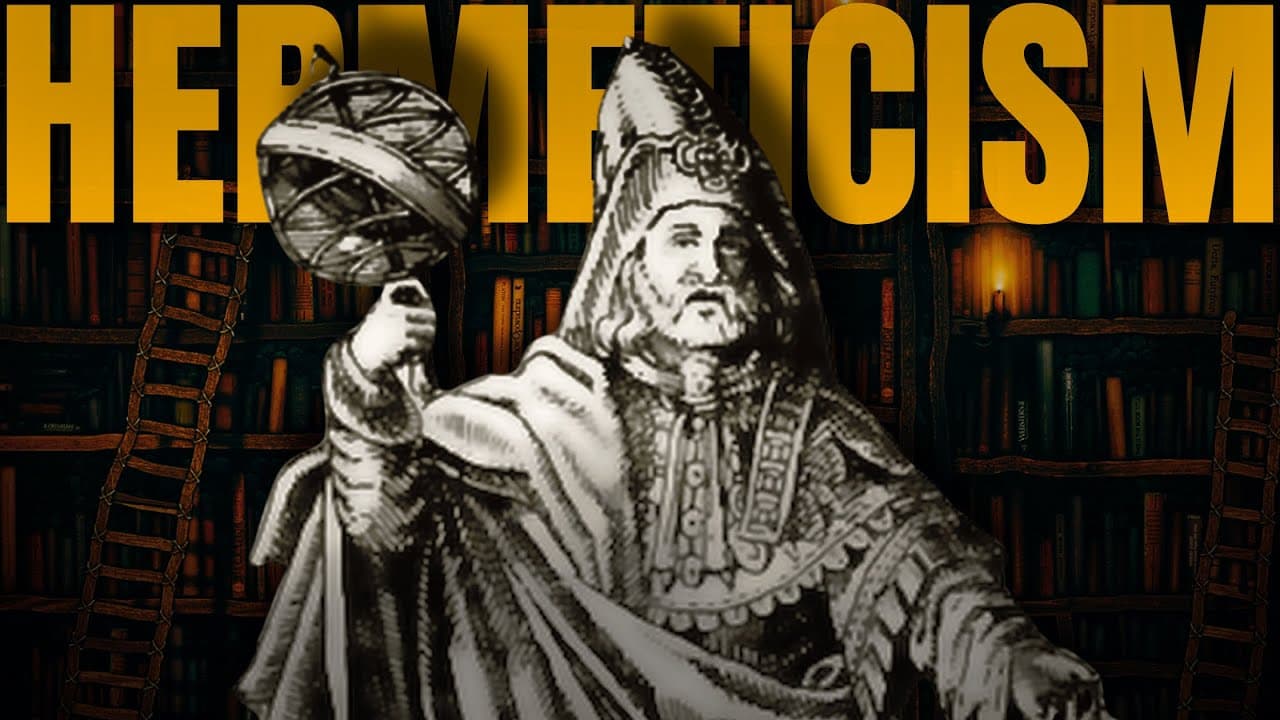
"As Above, So Below"
The Forgotten Wisdom of Hermes Trismegistus
Chapters
- 00:00:00Hermes Trismegistus and the Origins of Ancient Wisdom
- 00:25:16The Corpus Hermeticum and the Divine Mind
- 00:56:13The Emerald Tablet and the Principle of Correspondence
- 01:24:39The Seven Hermetic Principles
- 01:48:35Cosmology, Creation, and the Structure of Reality
- 02:09:41The Human Soul and the Path to Gnosis
- 02:31:15Ethics, Virtue, and Spiritual Transformation
- 02:49:50Hermeticism in Late Antiquity, Philosophy and Religion
- 03:10:23The Renaissance Revival and the Hermetic Tradition
- 03:29:39The Legacy of Hermeticism in Western Thought
Full Transcript
Chapter 01: Hermes Trismegistus and the Origins of Ancient Wisdom
In the cosmopolitan streets of Alexandria during the early centuries of the common era, Greek philosophers, Egyptian priests, Jewish scholars, and adherents of mystery religions exchanged ideas in a cultural melting pot unlike any the ancient world had known. From this ferment of cross-cultural dialogue emerged a body of texts attributed to a figure called Hermes Trismegistus, Hermes the Thrice-Greatest, a syncretic deity combining the Greek god Hermes with the Egyptian god Thoth. These texts, collectively known as the Hermetica, would exert a profound influence on Western philosophy, science, and spirituality for nearly two millennia. They proposed a vision of the cosmos as an interconnected whole, governed by divine intelligence and accessible to human understanding through both rational inquiry and spiritual insight. Hermeticism offered not merely a system of abstract metaphysics but a practical path of transformation, promising that human beings could ascend from material existence to unite with the divine source of all reality. This ancient philosophy would disappear from European consciousness for centuries, only to burst forth with renewed vitality during the Renaissance, shaping the thought of some of the period's most brilliant minds. Understanding Hermeticism requires us to step into a world where philosophy and religion had not yet diverged into separate domains, where knowledge of the natural world was inseparable from spiritual wisdom, and where the boundaries between Greek and Egyptian, rational and mystical, material and divine were constantly being negotiated and redefined.
The figure of Hermes Trismegistus stands at the intersection of multiple cultural traditions. The Greeks identified their god Hermes, messenger of the Olympians and patron of travelers, merchants, and eloquence, with the Egyptian god Thoth, the ibis-headed deity of writing, magic, and wisdom. Thoth was credited in Egyptian tradition with inventing hieroglyphs, establishing religious rites, and recording the judgment of souls in the afterlife. He embodied the power of language and knowledge, serving as scribe to the gods and keeper of divine secrets. When Greek culture encountered Egyptian civilization following Alexander's conquests in the fourth century BCE, this identification became formalized in what scholars call interpretatio graeca, the Greek practice of recognizing foreign deities as local versions of their own gods. But Thoth-Hermes became something more than a simple equation between two pantheons. He evolved into Hermes Trismegistus, a legendary sage who supposedly lived in Egypt's distant past and authored works containing the accumulated wisdom of both civilizations. The epithet Trismegistus, meaning thrice-greatest or three times great, may have derived from Egyptian priestly formulae that emphasized divine power through repetition. This Hermes was imagined not as a mythological deity but as an ancient prophet or priest-king who had achieved such profound understanding that later ages venerated him as a source of primordial revelation.
The historical reality behind Hermes Trismegistus is considerably more complex than the tradition itself suggests. Modern scholarship has established that the Hermetic texts were not written by a single ancient Egyptian sage but were composed by multiple Greek-speaking authors in Egypt, primarily during the first three centuries of the common era. These authors drew on Greek philosophy, particularly Platonism and Stoicism, while incorporating elements of Egyptian religion, Jewish theology, and Persian cosmology. The texts emerged from the vibrant intellectual culture of Roman Egypt, where traditional Egyptian religion coexisted with Greek learning, Gnostic speculation, and early Christian theology. Alexandria, with its famous library and museum, served as the primary center for this cross-cultural synthesis. The city hosted communities of Greek philosophers who studied Plato and Aristotle alongside Egyptian priests maintaining ancient temple traditions, Jewish scholars interpreting Hebrew scriptures in Greek, and diverse religious groups seeking salvation through mystical knowledge. From this milieu came texts presenting themselves as revelations from Hermes, written in Greek but claiming to preserve Egyptian wisdom from before the time of Moses and Plato. These texts created a fictional antiquity that granted them enormous authority. Renaissance scholars, rediscovering them centuries later, believed they were reading the oldest philosophy in the world, predating even the Greek masters they so admired.
The syncretic nature of Hermetic thought reflects the broader religious and philosophical currents of the late Hellenistic and early Roman imperial periods. This era witnessed what scholars call the Second Sophistic, a revival of interest in classical Greek culture, alongside growing enthusiasm for Eastern religions and mystery cults promising personal salvation. Traditional civic religion no longer satisfied many educated people, who sought more immediate connection with the divine and assurance of immortality for the soul. Philosophy itself was becoming increasingly religious, emphasizing not just logical argument but spiritual exercises, contemplation, and moral transformation. Platonism, which had begun as Socratic dialectic in Athens, evolved through Middle Platonism into what would become Neoplatonism, a grand metaphysical system uniting rational philosophy with mystical aspiration. Stoicism taught that divine reason pervaded the cosmos and that human beings could achieve wisdom by aligning themselves with universal nature. Mystery religions like those of Isis, Mithras, and Dionysus offered initiations into sacred knowledge. Gnostic groups taught that the material world was a prison from which the soul must escape through gnosis, or revelatory knowledge. Jewish Hellenism, represented by thinkers like Philo of Alexandria, reinterpreted Hebrew scripture through Greek philosophical categories. Early Christianity was formulating its theology in dialogue with all these traditions. The Hermetic texts participated fully in this intellectual ferment, synthesizing elements from multiple sources into a distinctive vision.
The Hermetic corpus itself divides into two broad categories that scholars term the philosophical Hermetica and the technical Hermetica. The philosophical texts, primarily preserved in the collection known as the Corpus Hermeticum, consist of dialogues and revelatory discourses on theology, cosmology, and spiritual transformation. These are the texts that would captivate Renaissance humanists and later esotericists. They present Hermes as a wise teacher instructing pupils in the nature of God, the structure of the cosmos, and the path by which human beings can achieve gnosis and ascend to divine unity. The technical Hermetica, by contrast, are practical manuals on astrology, alchemy, magic, and medicine. These texts, far more numerous than the philosophical works, provided instructions for manipulating natural and supernatural forces, making talismans, compounding medicines, interpreting celestial omens, and communicating with spiritual entities. While modern readers often distinguish sharply between philosophy and magic, ancient practitioners saw them as complementary. Knowledge of cosmic principles naturally implied the ability to work with those principles. Understanding the correspondences between celestial and terrestrial realms meant one could use that understanding practically. The technical Hermetica applied the cosmological theories of the philosophical texts, translating abstract principles into concrete operations.
The philosophical Hermetica present a coherent worldview, though individual texts show considerable variation in emphasis and terminology. At the heart of Hermetic teaching lies the conviction that the cosmos is a unified living being, pervaded by divine intelligence and structured according to principles that human reason can grasp. God, or the One, is the transcendent source of all existence, utterly beyond human conception yet intimately present throughout creation. The cosmos emanates from this divine source in hierarchical levels, descending from pure intellect through soul and the celestial spheres to the material world. Human beings occupy a unique position in this cosmic hierarchy. We combine material bodies drawn from the four elements with rational souls that participate in divine intelligence. We are microcosms containing within ourselves the entire structure of the macrocosm. This gives us both tremendous dignity and grave responsibility. Through spiritual discipline and philosophical inquiry, we can ascend through the cosmic levels, shedding material encumbrances and reawakening our divine nature. The goal of Hermetic practice is not escape from the world but conscious realization of our true identity as divine beings temporarily inhabiting material form. This realization, called gnosis, transforms our relationship to existence itself.
The historical development of Hermeticism can be traced through several distinct phases, though dating and sequencing individual texts remains controversial. The earliest Hermetic writings probably date to the first century CE, emerging from the same intellectual context that produced Gnostic texts, Jewish apocalyptic literature, and early Christian writings. These texts address fundamental questions about divine transcendence, the origin of evil, the nature of matter, and the possibility of salvation. They show strong Platonic influence, particularly the cosmology of Plato's Timaeus, which describes the creation of the world by a divine craftsman or demiurge. They also incorporate Stoic physics and ethics, drawing on the Stoic concept of logos as divine reason organizing the cosmos. By the second and third centuries, Hermetic texts were being composed that engaged more directly with Neoplatonic philosophy as developed by Plotinus and his successors. These later texts show greater philosophical sophistication and more elaborate metaphysical hierarchies. The technical Hermetica continued to be composed throughout late antiquity, with astrological and alchemical texts being produced well into the Byzantine and Islamic periods. When the western Roman Empire collapsed in the fifth century, knowledge of Greek declined in western Europe, and the philosophical Hermetica disappeared from Latin consciousness. They survived in the Greek-speaking Byzantine world and, significantly, in Arabic translation, where they influenced Islamic philosophy and science.
The Arabic transmission of Hermetic texts deserves particular attention, as it shaped later European reception in crucial ways. Beginning in the eighth century, the Abbasid caliphate sponsored an enormous translation movement in Baghdad, rendering Greek philosophical, scientific, and esoteric texts into Arabic. The Hermetic corpus was extensively translated, studied, and commented upon by Islamic scholars. The Emerald Tablet, perhaps the single most influential Hermetic text, first appears in Arabic sources from this period, attributed to Hermes but of uncertain origin. Arabic philosophers like al-Kindi, al-Razi, and Ibn Sina engaged with Hermetic ideas on the structure of matter, the relationship between celestial and terrestrial phenomena, and the theoretical foundations of alchemy. The Sabians of Harran, a religious community in northern Mesopotamia, were identified by some Islamic writers as followers of Hermes, preserving ancient star worship and philosophical wisdom. Whether or not this identification was accurate, it linked Hermeticism with living religious practice rather than just textual tradition. When Latin Christians began translating Arabic works in the twelfth century, Hermetic texts entered western Europe primarily through this Arabic channel. The Emerald Tablet, for instance, became known to medieval Europeans through Latin translations of Arabic versions. This transmission route meant that Hermetic ideas arrived in medieval Europe already integrated with Islamic Neoplatonism, astrology, and alchemy, shaped by centuries of Arabic commentary.
Medieval Latin Christendom had limited direct access to Hermetic texts but was nonetheless influenced by Hermetic ideas mediated through other sources. Translations of Arabic works on astrology, alchemy, and magic frequently cited Hermes as an authority. The influential medical work Picatrix, translated from Arabic in thirteenth-century Spain, contains extensive Hermetic material on celestial magic and astrological talismans. Medieval alchemical texts regularly invoked Hermes as the founder of their art, and the Emerald Tablet circulated as a fundamental alchemical scripture. Thomas Aquinas, the great scholastic philosopher, mentioned Hermes Trismegistus in his writings, acknowledging him as an ancient wise man who had glimpsed monotheistic truth before Christ. However, the full Corpus Hermeticum remained unknown to medieval scholars. They could not read Greek, and no complete Latin translation existed. Hermetic philosophy thus exerted influence primarily at the margins of medieval thought, in the domains of magic and alchemy that official theology treated with suspicion. The technical Hermetica found eager readers among those seeking practical knowledge of natural and supernatural operations, while the philosophical vision of cosmic unity and human divinity remained largely inaccessible. This situation changed dramatically in the fifteenth century.
The recovery and translation of Hermetic texts during the Italian Renaissance created what historians have called a Hermetic moment in European intellectual history. In fourteen sixty-three, an agent of Cosimo de Medici, ruler of Florence, acquired a Greek manuscript containing fourteen tractates of the Corpus Hermeticum. Cosimo immediately commissioned his court philosopher, Marsilio Ficino, to translate them into Latin, interrupting Ficino's work on Plato's dialogues because he was elderly and wanted to read the Hermetic texts before he died. This interruption itself reveals the immense prestige Hermes commanded. Ficino and his contemporaries believed they were reading divine revelation granted to an Egyptian prophet who lived before Moses, making Hermetic wisdom older than Hebrew scripture and Greek philosophy. The texts seemed to confirm Christian truth through independent ancient testimony, showing that pagan wisdom at its highest recognized the Trinity, creation from nothing, and the Incarnation. Renaissance humanists embraced Hermeticism as prisca theologia, the ancient theology that had been granted to humanity in its earliest ages and from which all later philosophy derived. Hermes, along with Moses, Zoroaster, Orpheus, and Pythagoras, formed a chain of ancient wisdom culminating in Plato and ultimately fulfilled in Christianity.
This belief in Hermetic antiquity shaped Renaissance thought in profound ways. If Hermes had known truths about God and cosmos that classical philosophers like Plato had later expressed in different form, then ancient wisdom confirmed rather than contradicted Christian revelation. Philosophy, magic, and religion could be unified within a single sacred tradition. The Renaissance recovery of Hermeticism coincided with renewed interest in Neoplatonism, Jewish Kabbalah, and Christian mysticism. Thinkers like Giovanni Pico della Mirandola synthesized these various traditions, arguing that beneath apparent diversity lay fundamental unity. Pico's famous Oration on the Dignity of Man drew on Hermetic anthropology, presenting human beings as created without fixed nature so that we might freely shape ourselves and ascend to union with God. This Hermetic optimism about human potential contrasted sharply with the Augustinian emphasis on original sin and human depravity that had dominated medieval theology. Renaissance Hermetists celebrated human creative power, our ability to understand and manipulate nature, and our destiny to become divine through knowledge and virtue. This vision animated the artistic, scientific, and magical projects of the Renaissance, from Ficino's astral medicine to Giordano Bruno's cosmic philosophy to the Rosicrucian manifestos of the early seventeenth century.
The prestige of Hermeticism collapsed in sixteen fourteen when the classical scholar Isaac Casaubon demonstrated through philological analysis that the Corpus Hermeticum could not have been written in remotest antiquity. Casaubon showed that the texts' Greek style, philosophical vocabulary, and theological concepts clearly dated them to the early Christian era rather than predynastic Egypt. They were not pristine revelations from before Moses and Plato but products of the Hellenistic synthesis between Greek and Egyptian culture. This revelation destroyed the historical foundation of Renaissance Hermeticism. If the texts were not ancient, they lost their authority as independent confirmation of Christian truth and source of primordial wisdom. Scholarly interest in Hermeticism waned dramatically. The texts came to be seen as historical curiosities, examples of religious syncretism and late antique mysticism but without philosophical significance. This negative reassessment lasted for centuries. Only in the twentieth century did scholars begin to appreciate Hermetic philosophy on its own terms, regardless of its date, recognizing it as a sophisticated synthesis of Platonic, Stoic, and Egyptian thought that addresses perennial questions about cosmic order, human nature, and spiritual transformation.
Understanding Hermeticism today requires balancing several perspectives simultaneously. We must recognize the texts as products of a specific historical context while appreciating their philosophical substance and later influence. We must distinguish the ancient Hermetica from medieval Arabic developments, Renaissance Christian interpretations, and modern esoteric appropriations. We must acknowledge both the philosophical and technical strands of the tradition, understanding how abstract cosmology connected to practical application. And we must appreciate how Hermetic ideas, whether or not we accept their truth claims, have shaped Western thought in lasting ways. The Hermetic principle that humanity is a microcosm reflecting the macrocosm has informed everything from Renaissance natural magic to contemporary holistic medicine. The vision of the cosmos as an interconnected living whole has influenced ecological thinking and systems theory. The emphasis on direct experiential knowledge rather than mere bookish learning resonates with phenomenology and existentialism. The conviction that matter and spirit form a continuum rather than an absolute dualism has shaped alternatives to Cartesian metaphysics. Hermeticism, in short, remains philosophically live even after we have abandoned belief in its historical claims.
The figure of Hermes Trismegistus, though mythical, represents something real and significant: the human aspiration to unified knowledge that integrates observation of nature, rational inquiry, spiritual insight, and practical wisdom. The ancient authors who wrote under his name sought to articulate a comprehensive worldview that would make sense of both physical and metaphysical reality, that would explain the origins of the cosmos and the destiny of the soul, that would show how knowledge and virtue enable transformation. They believed that truth was one even if approached through multiple paths. They held that the same principles governed the movements of stars and the thoughts of minds, that correspondences linked every level of reality, that understanding these connections was both intellectually satisfying and existentially transformative. Whether we share these convictions or not, we can recognize in them a perennial philosophical impulse: the drive to achieve synoptic understanding that unifies disparate domains of experience into coherent vision. Hermeticism offered one influential answer to the question of how to integrate knowledge into wisdom.
As we explore the Hermetic tradition in what follows, we will examine the major texts and teachings that comprise this philosophical system. We will consider the cosmological vision presented in the Corpus Hermeticum, the famous dictum of the Emerald Tablet, the seven principles articulated in later Hermetic synthesis, and the spiritual path of gnosis and regeneration that transforms the human practitioner. We will trace Hermetic influence through late antiquity, its transmission through Islamic civilization, its Renaissance revival, and its legacy in modern Western esotericism. Throughout this exploration, we will approach Hermeticism as serious philosophy deserving careful attention rather than dismissing it as mere mysticism or occultism. The texts reward close reading. They raise important questions about divine transcendence and immanence, the relationship between thought and reality, the connection between knowledge and ethics, and the possibility of human transformation. By engaging these questions thoughtfully, we can appreciate why Hermeticism has fascinated so many across so many centuries, and why its vision of cosmic unity and human potential continues to speak to contemporary seekers of wisdom.
Chapter 02: The Corpus Hermeticum and the Divine Mind
The Corpus Hermeticum, the central collection of philosophical Hermetic texts, consists of eighteen tractates or libelli presenting dialogues and revelatory discourses attributed to Hermes Trismegistus. These texts, composed in Greek during the second and third centuries of the common era, offer profound meditations on the nature of divinity, the structure and origin of the cosmos, the constitution of human beings, and the path to spiritual knowledge and transformation. While each tractate possesses its own character and emphasis, together they articulate a coherent philosophical and religious vision that synthesizes Platonic metaphysics, Stoic physics and ethics, and Egyptian religious sensibility into something genuinely new. The Corpus Hermeticum addresses the fundamental questions that preoccupied late antique philosophy: What is the relationship between the One and the Many? How did the cosmos arise from primordial unity? What is the nature of matter, and why does evil exist? What are human beings, and what is our proper relationship to the divine? Can we achieve salvation, and if so, how? These questions animate not just Hermeticism but the entire philosophical culture of the early imperial period, from Plutarch and Philo through the Middle Platonists to Plotinus and the Neoplatonists. The Hermetic texts provide one distinctive set of answers that both participated in and influenced the larger conversation.
The first tractate of the Corpus Hermeticum, known as the Poimandres or Divine Pymander, stands as the most famous and influential text in the collection. The title Poimandres means Shepherd of Men or possibly Mind of Sovereignty, referring to the divine intelligence that reveals itself to Hermes in the text. The tractate presents itself as a visionary revelation in which Hermes receives knowledge directly from the cosmic Mind. The narrative framework resembles both Greek philosophical dialogues and Jewish apocalyptic literature, combining rational exposition with mystical disclosure. Hermes tells how once, when his thoughts turned to ultimate realities, his bodily senses fell dormant and a vast being appeared to him, identifying itself as Poimandres, the Mind of absolute sovereignty. This being asks what Hermes wishes to learn, and Hermes replies that he wants to understand the nature of reality and to know God. What follows is a cosmogonic myth describing the origin of the universe, the creation of humanity, and the soul's fall into and potential redemption from material existence. This myth would profoundly influence Gnostic and Neoplatonic creation narratives, and it establishes the fundamental Hermetic vision of cosmic structure and human destiny.
The Poimandres creation account begins with the divine Mind, which is God, existing as pure light and life before anything else exists. This Mind generates the Word or Logos, which is the Son of God and the divine creative principle. What we find here is clearly influenced by Platonic notions of divine intellect and creative reason, as well as by Stoic concepts of logos as rational principle pervading nature, and possibly by Jewish wisdom literature and early Christian Logos theology. From the divine Mind proceeds a dark downward-tending Nature that becomes matter, which the text associates with water and earth. The divine Mind contemplates its own beauty and, seeing its reflection in the watery depths of primordial matter, becomes enamored of itself. This self-contemplation is the beginning of creation. The Word sounds forth and separates the elements, organizing chaos into cosmos. Seven planetary spheres are established, governed by heimarmene or fate, and these revolve in eternal cycles. This seven-fold cosmic structure, drawn from Hellenistic astronomy, provides the framework for both Hermetic cosmology and the later concept of the soul's descent through the planetary spheres. The celestial realm of divine intellect and the material realm of nature now stand separated yet connected, establishing the fundamental polarity within which human existence unfolds.
The creation of humanity in the Poimandres occupies a central position in Hermetic anthropology. The text describes how the Father, the sovereign Mind, produces a second Mind who is the demiurge or craftsman of the physical world. This demiurge creates the seven planetary governors who rule the material cosmos through fate. But then the Father Mind creates an anthropos, a primordial human or divine man, in his own image, beautiful and beloved. This original human being is purely spiritual, possessing the full creative power of the divine Mind. He descends through the planetary spheres, and at each level the planetary governors give him some of their own nature and power. When this divine anthropos reaches the lowest sphere and looks down into material nature, he sees his own reflection in the waters below. Nature, seeing his beautiful form, falls in love with him just as Mind had fallen in love with its own reflection. The divine anthropos, drawn by desire, descends into matter and unites with Nature. This union produces physical humanity as we know it, beings composed of divine mind and mortal body, carrying within themselves both celestial light and terrestrial darkness. We are thus fundamentally dual creatures, and this duality explains both our misery and our potential for redemption.
This myth of the soul's descent into matter establishes several crucial Hermetic doctrines. First, human beings are not simply created by the demiurge like other animals but bear the direct image of the supreme God himself. We possess divine intelligence and creative power in our essential nature. Second, our descent into material embodiment resulted not from sin or punishment but from desire, from the soul's attraction to its own reflected beauty in the natural world. There is something ambiguous and even tragic about this descent, yet it is not simply a fall into evil. Third, our current state combines divine and material elements inextricably. We are microcosms containing the entire structure of the macrocosm. The seven planetary forces that govern the cosmos also operate within us as passions and faculties. The divine Mind that creates and sustains all things lives within us as our rational capacity. Fourth, our composite nature means we face a choice: we can identify with our mortal, material aspect and remain trapped in the cycles of generation and destruction, or we can awaken to our divine nature and ascend back through the planetary spheres to unity with God. This choice between ignorance and gnosis, between material and spiritual existence, constitutes the fundamental existential situation that Hermetic practice addresses.
The path of ascent described in the Poimandres prefigures the regeneration and divinization that later tractates elaborate. When a soul awakens to gnosis, recognizing its true identity as divine intelligence temporarily clothed in matter, it can begin the journey upward. At death, the body returns to its elements. But the soul that has achieved knowledge does not simply dissolve or enter another cycle of reincarnation. Instead, it ascends back through the seven planetary spheres, surrendering at each level the corresponding passion or limitation it acquired during its descent. At the sphere of the Moon, it yields up growth and decay. At Mercury, cunning and deception. At Venus, erotic desire. At the Sun, mental ambition. At Mars, rashness and anger. At Jupiter, the love of wealth. At Saturn, falsehood and evil plotting. Stripped of all these material accretions, the soul arrives in the eighth sphere, the sphere of fixed stars, possessing only its own proper power. Then it enters the ninth sphere and finally achieves unity with God, becoming itself divine. The text describes the culmination with striking language: each soul becomes a power in God, and all together they become God. This is not absorption and loss of identity but recognition of original identity. The soul realizes that it always was divine, though it had forgotten this truth during its sojourn in matter. Gnosis is remembering what we truly are.
The Poimandres concludes with Hermes transformed by his vision. Having received this revelation, he becomes a teacher and prophet, proclaiming the message of gnosis to others. He calls people to awaken from the drunken sleep of ignorance, to recognize their divine nature, and to begin the path of ascent. The text emphasizes that this knowledge is not for everyone. Those who are entirely identified with bodily existence, enslaved by the desires and fears of material life, cannot hear the message. Only those whose minds are already beginning to stir, who sense there must be more to existence than eating, sleeping, reproducing, and dying, can respond to the call. This elitism is characteristic of many ancient wisdom traditions, which held that philosophical truth required both natural aptitude and strenuous effort. The Hermetic texts often present themselves as sacred books to be carefully guarded and shared only with worthy students. At the same time, they insist that gnosis is potentially available to any human being precisely because we all possess divine mind. The limitation lies not in some predetermined elect but in the willingness to undertake the difficult work of self-knowledge and transformation.
Other tractates in the Corpus Hermeticum develop and elaborate themes introduced in the Poimandres. Tractate Four, often called The Mixing Bowl or The Krater, describes how the Father filled a great bowl with Mind and sent it down to earth so that souls who desire understanding could baptize themselves in it and achieve gnosis. This tractate emphasizes that God actively desires human salvation and provides the means for it, but we must choose to participate. Those who plunge into the krater of Mind are transformed, receiving knowledge and becoming perfect. Those who reject this opportunity remain ignorant and mortal. Tractate Five, That God Is Invisible and Most Manifest, meditates on divine transcendence and immanence. God cannot be seen with physical eyes or conceived by ordinary thought, yet God is more manifest than anything else, being present in all things as the power that sustains their existence. The text plays with paradox: God is invisible yet totally visible, incomprehensible yet known through everything we comprehend, without qualities yet the source of all qualities. This apophatic theology, which describes God through negations while insisting on divine presence, resembles the theological method developed more systematically by Neoplatonists like Plotinus and later Christian mystics like Pseudo-Dionysius.
Tractate Ten, The Key, presents Hermes instructing his son Tat in fundamental doctrine. The text emphasizes that true teaching must engage not just intellectual understanding but moral and spiritual transformation. Tat must learn to separate himself from the chaos of bodily sensations and appetites, to still his mind, and to receive the divine Word that brings illumination. The tractate describes the cosmos as a great animal or living being in which every part connects to every other part through sympatheia or cosmic sympathy. This Stoic concept of universal interconnection becomes central to Hermetic thought, explaining how astrology works, how magical operations can affect distant things, and how the microcosm of humanity relates to the macrocosm of the universe. The doctrine of cosmic sympathy underlies the entire technical Hermetica, providing the theoretical foundation for practices like making talismans, compounding sympathetic medicines, and invoking celestial powers. It also has profound philosophical implications, suggesting that the cosmos is not a mechanical aggregate of discrete parts but an organic unity in which everything participates in divine life.
Tractate Eleven, Mind to Hermes, consists of a discourse on intellect delivered by personified Mind or Nous. The text distinguishes sharply between human beings who possess nous and those who do not. To have nous means to have achieved gnosis, to have awakened divine intelligence within oneself. Such a person sees through material appearances to the eternal realities they manifest. Those without nous, by contrast, remain trapped in opinion and sensation, unable to grasp genuine truth. This distinction is not between smart and stupid people but between those who have undergone spiritual transformation and those who have not. The tractate insists that nous cannot be taught in the way ordinary subjects can be taught. One can provide instruction, arguments, and guidance, but the actual awakening of nous comes as a gift of God to those who prepare themselves through purification and contemplation. This emphasis on divine grace working together with human effort characterizes Hermetic soteriology. We must do our part through virtuous living and intellectual discipline, but the final transformation requires God's initiative. The text concludes by identifying nous with God himself present within the human soul. To know God is to activate the nous that we always already possess.
Tractate Twelve, Hermes to Tat on the Common Intellect, develops the doctrine of nous further. The text asserts that while not all human beings actualize their intellectual capacity, all possess it potentially. The divine Mind permeates the entire cosmos like light permeating air. Just as air makes light visible only when it encounters an illuminated object, so individual minds make the divine Intellect manifest only when they turn toward it and receive it. The tractate draws an important distinction between the demiurge or maker god, who is good and creates the material world, and the supreme God who is beyond even goodness. This hierarchy resembles Middle Platonic and Neoplatonic schemes distinguishing the utterly transcendent One from the creative Intellect that proceeds from it. The text also discusses the problem of evil. Since God is good and creates all things, how can evil exist? The answer given is that evil is not a positive reality but a deficiency, the absence or privation of good. Matter in itself is not evil, but the soul's entanglement with matter and forgetfulness of its divine nature constitutes the condition we call evil. Virtue consists in remembering our true nature and living according to divine intellect rather than bodily passion.
Tractate Thirteen, The Secret Sermon on the Mountain, presents Hermes teaching Tat about spiritual rebirth or regeneration. This text has particular importance because it describes the actual process of transformation in some detail. Tat asks his father to explain regeneration and to help him experience it himself. Hermes responds that rebirth cannot be taught but only undergone, and that it requires the gracious gift of God. However, he can prepare Tat by describing what happens. Regeneration occurs when the powers of God replace the twelve torments of matter that ordinarily dominate human existence. These twelve torments are ignorance, grief, incontinence, desire, injustice, greed, deceit, envy, fraud, anger, recklessness, and malice. One by one, divine powers drive these torments out: knowledge replaces ignorance, joy replaces grief, self-control replaces incontinence, and so forth through the entire list. When this transformation completes, the person becomes a different being, deified or made godlike. Hermes leads Tat through a visionary experience of this regeneration, and Tat emerges transformed, able to perceive reality with spiritual senses rather than bodily ones.
The doctrine of regeneration in Tractate Thirteen illuminates the practical goal of Hermetic philosophy. The point is not simply to learn certain doctrines intellectually but to undergo an actual transformation of consciousness and character. The text insists repeatedly that this transformation is real, not merely metaphorical. The person who achieves regeneration literally becomes divine while still living in a mortal body. They participate in the eternal life of God even while subject to temporal existence. This creates what we might call a realized eschatology: salvation is not something awaiting us after death but something we can actualize in the present through philosophical and spiritual practice. The regenerate person still inhabits the material world and engages in ordinary activities, but they do so from a radically different center of identity. They know themselves as divine mind temporarily using a human body rather than as a body that happens to think. This shift in self-understanding changes everything about how one lives and relates to the world. The regenerate person has achieved what the tradition calls apatheia, not apathy in the modern sense but freedom from domination by passions and external circumstances, a stable peace rooted in identity with eternal truth.
Additional tractates in the Corpus Hermeticum explore various aspects of Hermetic teaching. Tractate Fourteen addresses health and disease, relating bodily conditions to cosmic and psychic forces. Tractate Sixteen on kingship presents the ideal of the philosopher-king who rules through wisdom rather than mere force. Several shorter tractates consist of prayers, hymns, or brief revelatory pronouncements. Together, these eighteen texts provide a comprehensive if not always systematic presentation of Hermetic philosophy. Modern readers must remember that these were not composed as a single work by one author with a unified plan. They represent multiple voices within a tradition, different teachers and students exploring similar themes with individual emphases. Some texts show stronger Platonic influence while others draw more heavily on Stoic ideas. Some emphasize cosmic mysticism while others focus on ethical transformation. Some use elaborate mythic imagery while others employ abstract philosophical argument. This diversity enriches rather than undermines the tradition, showing how Hermetic principles could be articulated in multiple registers.
The Corpus Hermeticum is not the only collection of philosophical Hermetic texts. The Asclepius, a dialogue between Hermes and his student Asclepius, survives in a Latin translation and overlaps thematically with the Corpus Hermeticum while introducing some distinctive elements. The Asclepius describes in detail the Egyptian practice of statue animation, where priests would draw down spiritual powers into physical images, essentially creating living gods. This section scandalized Christian readers but represents an important Hermetic principle: that spirit and matter can interpenetrate, that divine presence can inhabit material forms, and that human beings have the creative power to facilitate this incarnation. The Asclepius also contains a famous apocalyptic passage describing the coming destruction of Egyptian religion and wisdom. This lament for Egypt's lost glory resonated with Renaissance readers who saw themselves as recovering ancient treasures nearly lost to history. The dialogue emphasizes human uniqueness as beings who participate in both divine and earthly natures, calling us a great miracle and worthy of worship and honor. This exalted anthropology, which sees human beings as almost equal to the gods in dignity and power, became one of Hermeticism's most distinctive and influential contributions to Renaissance humanism.
In addition to these major collections, various fragments and excerpts from Hermetic texts are preserved in the works of Christian church fathers who quoted them while arguing against pagan philosophy. Lactantius, writing in the early fourth century, cited Hermetic passages extensively to show that even pagan philosophers recognized the truth of monotheism and divine providence. Augustine, less favorably disposed toward Hermeticism, nevertheless preserved important passages while criticizing what he saw as demonic magic. The Neoplatonist philosopher Iamblichus incorporated Hermetic teaching into his synthesis of theurgy and philosophy. The Byzantine philosopher Michael Psellus compiled excerpts from Hermetic texts in the eleventh century. These scattered fragments supplement our knowledge of Hermetic thought beyond what the main collections preserve. They also demonstrate that Hermeticism was taken seriously by ancient and medieval thinkers as a significant voice in philosophical and theological debate, not dismissed as mere superstition or charlatanry.
The divine Mind or Nous that stands at the center of Hermetic theology deserves careful consideration as a philosophical concept. In the Hermetic system, Mind is not primarily human rationality but the cosmic intelligence that creates and orders all things. It is both transcendent, existing beyond and prior to all creation, and immanent, pervading everything that exists and making it intelligible. This dual nature recalls Plato's distinction between the realm of eternal Forms and the material world of becoming, as well as Aristotle's concept of divine Intellect as pure self-thinking thought. The Stoics had already conceived of logos as both divine reason and universal natural law operating throughout the cosmos. Hermetic Nous synthesizes these Greek philosophical conceptions with a more personal and mystical theology. Mind is not just an abstract principle but a being who cares about human salvation, who reveals himself through visions and interior illumination, who desires that souls awaken to their true nature. At the same time, achieving union with divine Mind requires philosophical understanding, not just emotional devotion. One must grasp intellectually the structure of reality, the nature of causation, and the principles governing cosmic order. Gnosis combines rational insight with spiritual transformation.
The relationship between the supreme God, divine Mind, and the Demiurge or creator god in Hermetic texts has generated considerable scholarly debate. In some passages, God and Mind seem identical, different names for the same ultimate reality. In other texts, Mind appears as the first emanation or self-expression of an even more transcendent divine principle. The Demiurge who shapes matter into cosmos sometimes seems to be identified with Mind and sometimes appears as a distinct, subordinate deity. These apparent inconsistencies may reflect different authors working within the same broad tradition, or they may represent genuine philosophical tensions that the Hermetic writers struggled to resolve. The problem of how absolute transcendent unity gives rise to multiplicity without compromising its unity preoccupied all late antique philosophers. Plotinus developed an elaborate system of hypostases or ontological levels proceeding from the ineffable One through Intellect and Soul to matter. Hermetic texts seem to be groping toward a similar solution without achieving the systematic clarity of Plotinus. What remains constant is the insistence that the divine principle, however many names or levels it receives, is essentially Mind, and that human beings participate directly in this divine intelligence through their own capacity for intellectual understanding.
Understanding the Corpus Hermeticum requires situating it within the wider world of late antique religious philosophy. These texts belong to the same cultural moment that produced the Nag Hammadi Gnostic library, the Chaldean Oracles, the writings of Philo of Alexandria, the Enneads of Plotinus, the mystical theology of Origen, and the theurgy of Iamblichus. All these traditions wrestled with similar questions and drew on similar philosophical resources, yet each developed distinctive answers. Gnosticism tended toward a more radical dualism, viewing matter as evil and the material creator god as ignorant or malevolent. The Hermetic texts, while acknowledging the soul's problematic entanglement in matter, generally affirm the goodness of creation and see matter as the necessary medium through which spirit manifests. Neoplatonism developed more rigorous metaphysical systems and emphasized philosophical argumentation over revelatory discourse. Hermeticism combined rational philosophy with mystical experience, presenting its teachings as both logically demonstrable and divinely revealed. Christianity insisted on the unique incarnation of God in Christ and salvation through faith and grace. Hermeticism held that divine incarnation happens in every awakened human being and that salvation comes through self-knowledge. These different traditions sometimes influenced each other and sometimes competed for adherents, creating the rich, diverse intellectual landscape of the late Roman world.
The continuing philosophical interest of the Corpus Hermeticum lies not in its historical priority, which Casaubon definitively disproved, but in its substantive vision of cosmic order and human potential. The texts articulate a form of panentheism in which everything exists within God while God remains more than the sum of all things. They propose that mind and matter, while distinct, form a continuum rather than absolute dualism, and that consciousness is fundamental rather than emergent. They offer an account of moral evil as ignorance and forgetfulness rather than willful disobedience or ontological corruption. They insist on the possibility of radical transformation through direct knowledge rather than just incremental improvement through ethical discipline. They envision the cosmos as an organic whole in which every part relates to every other part through intelligible connections, not as a mechanical aggregate of externally related pieces. These are live philosophical options that continue to attract thinkers dissatisfied with mechanistic materialism on the one hand and supernatural theism on the other. Whether one accepts Hermetic metaphysics or not, the texts raise important questions and propose challenging answers that deserve serious engagement.
Chapter 03: The Emerald Tablet and the Principle of Correspondence
Among all Hermetic texts, none has achieved greater fame or exerted wider influence than the Emerald Tablet, a brief and cryptic work attributed to Hermes Trismegistus that became the foundational scripture of Western alchemy. The text consists of fewer than fifteen sentences, yet these few lines contain what practitioners have considered the complete secret of the Great Work, the key to understanding both the structure of reality and the method for spiritual and material transformation. The Tablet's most famous line, "as above, so below," has become proverbial far beyond alchemical and esoteric circles, expressing in four words the Hermetic principle of correspondence that links microcosm to macrocosm and suggests that understanding one level of reality provides insight into all levels. The history, interpretation, and influence of the Emerald Tablet offer a remarkable case study in how a short, obscure text can generate centuries of commentary, inspire artistic and scientific work, and shape the imagination of Western culture in ways both obvious and subtle. To understand the Tablet requires examining its mysterious origins, its dense and polyvalent language, its alchemical appropriation, and its philosophical implications.
The Emerald Tablet first appears in Arabic sources from the eighth or ninth century. The earliest known version occurs in the Kitab sirr al-khaliqa, or Book of the Secret of Creation, attributed to Apollonius of Tyana, the legendary Greco-Roman sage and wonder-worker. This work claims to record how Apollonius discovered the Tablet in a cave or underground chamber, where he found the ancient Hermes seated on a throne holding the inscribed emerald in his hand. Whether this text was actually written by someone named Apollonius or pseudonymously attributed to him remains unclear. What we can say with certainty is that the Emerald Tablet was circulating in Arabic translation by the ninth century at the latest. From Arabic, it was translated into Latin during the twelfth century when European scholars began systematically translating Arabic scientific and philosophical texts. Multiple Latin versions circulated during the Middle Ages, showing minor variations but maintaining the core content. The Tablet thus entered European consciousness through the same channel that transmitted Arabic alchemy, astronomy, medicine, and philosophy to the Latin West. This transmission history matters because it meant medieval and Renaissance readers encountered the Tablet already embedded within Islamic alchemical tradition and commentary.
The text of the Emerald Tablet, even in modern English translation, retains much of its riddling character. It begins with a declaration of truth: "True it is, without falsehood, certain and most true." This opening insists on the reliability and importance of what follows, a common convention in esoteric texts claiming to reveal hidden wisdom. The tablet continues with its famous central principle: "That which is below is like that which is above, and that which is above is like that which is below, to accomplish the miracles of one thing." This is the statement usually summarized as "as above, so below," though the actual text is more precise and complex. It asserts both similarity and purpose: the correspondence between upper and lower realms exists to enable operations, to accomplish the miracles or marvels of the singular unified reality underlying apparent multiplicity. The text then describes a cosmogonic process: "And as all things have been and arose from one by the mediation of one, so all things have their birth from this one thing by adaptation." Everything originates from primordial unity through the creative agency of that unity, and all multiplicity remains fundamentally related to and dependent on that source.
The Tablet proceeds to allegorical description of the Great Work using familial and elemental metaphors: "The Sun is its father, the Moon its mother, the Wind has carried it in its belly, the Earth is its nurse." These statements describe the generation of the philosopher's stone or the production of the spiritual regeneration. Solar and lunar, masculine and feminine, volatile and fixed, celestial and terrestrial all must combine in proper relationship. The text emphasizes process and transformation: "Separate the Earth from the Fire, the subtle from the gross, sweetly with great industry." This instruction applies simultaneously to chemical operations in the alchemical laboratory, to the refinement of metals, to the purification of the soul, and to the attainment of spiritual knowledge. The tablet's language deliberately operates on multiple levels, allowing and even requiring readers to discover meanings appropriate to their concern and level of understanding. The concluding statements assert the text's universality and power: "Thus you will have the glory of the whole world. Therefore all obscurity shall fly from you." Complete knowledge brings enlightenment and dispels ignorance. "This is the strong force of all force, for it vanquishes every subtle thing and penetrates every solid thing." The power described transcends ordinary physical force, operating on the spiritual and intellectual planes that underlie material manifestation.
The Emerald Tablet's historical origins remain obscure and debated. Unlike the Corpus Hermeticum, which can be situated with reasonable confidence in the Hellenistic world of the early common era, the Tablet's provenance is genuinely uncertain. Some scholars argue that it represents an originally Greek text translated into Arabic and then into Latin. The cosmological content and vocabulary resemble ideas found in Greek alchemy and Neoplatonism, supporting a Hellenistic origin. Others suggest it may have been composed in Arabic by Islamic alchemists synthesizing Greek alchemical theory with Islamic philosophy. The attribution to Apollonius of Tyana, if it carries any historical weight, might date the text to late antiquity, though most scholars regard the attribution as legendary. The tablet could date from anywhere between the first and eighth centuries CE. This uncertainty, while frustrating to historians, had the effect of enhancing the text's mystique. Without clear authorship or date, readers could imagine it as immeasurably ancient, perhaps inscribed on imperishable emerald by Hermes himself in primordial Egypt. The Renaissance belief in the extreme antiquity of Hermeticism applied even more strongly to the Emerald Tablet, which seemed to preserve the quintessential secret in concentrated form.
The principle of correspondence articulated in the Emerald Tablet has philosophical implications extending far beyond alchemy. The claim that above and below, macrocosm and microcosm, mirror each other constitutes a fundamental metaphysical assertion about the structure of reality. It denies that the cosmos is random aggregation or that different levels of existence are ultimately disparate and unrelated. Instead, it proposes systematic connection: the same patterns, principles, and relationships recur at every scale. The motions of planets in the heavens correspond to the circulation of fluids in the body, the generation of metals in the earth, the purification of the soul through spiritual discipline, and the operations of alchemists in the laboratory. Understanding any one of these processes provides insight into all the others because they instantiate the same universal principles. This doctrine of universal analogy has obvious applications to astrology, which assumes that celestial configurations influence terrestrial events through meaningful correspondence rather than mechanical causation. It undergirds talismanic magic, which uses materials corresponding to celestial powers to channel those powers into the physical world. It informs traditional medicine, which treats disease by restoring balance among humors that correspond to elements, planets, and cosmic forces.
The Emerald Tablet endures as perhaps the most concentrated and influential expression of Hermetic philosophy precisely because its extreme compression invites perpetual reinterpretation. Each era discovers in its cryptic phrases confirmation of its own deepest insights about cosmic order and human possibility. "As above, so below" names a genuine mystery about how different scales and modes of reality relate. The principle of correspondence points to real questions about pattern, similarity, hierarchy, and causation that philosophy and science continue to address. Whether one accepts the Hermetic answer or not, the question the Emerald Tablet poses remains essential: what is the relationship between the microcosm of human existence and the macrocosm of universal nature? How do part and whole, instance and archetype, material and spiritual relate? These questions ensure that even a text of fewer than fifteen sentences can sustain millennia of meditation.
Chapter 04: The Seven Hermetic Principles
In nineteen hundred eight, a book titled The Kybalion appeared in Chicago, published under the mysterious pseudonym "Three Initiates" and claiming to present the Hermetic philosophy in systematic form suitable for modern students. The work articulated seven principles that it asserted had been preserved secretly through initiatic transmission from ancient Egypt and now could be publicly revealed. These Seven Hermetic Principles are Mentalism, Correspondence, Vibration, Polarity, Rhythm, Cause and Effect, and Gender. While The Kybalion and its principles have no direct connection to the ancient Hermetic texts, and while serious scholars of Hermeticism regard it as a twentieth-century work influenced more by New Thought and American occultism than by genuine Hermetic tradition, the book has nonetheless achieved enormous influence in contemporary spirituality and is widely identified with Hermeticism by popular audiences.
The first and most fundamental principle articulated in The Kybalion is the Principle of Mentalism, stated as "The All is Mind; the Universe is Mental." This principle asserts that ultimate reality is consciousness rather than matter, that mind is ontologically prior to physical existence, and that the material universe exists within and as a manifestation of universal Mind. This teaching resembles philosophical idealism as developed by thinkers like Berkeley and Hegel, who argued that only minds and their contents truly exist, while also drawing on the Hermetic doctrine of divine Nous pervading all things.
The Principle of Correspondence, stated as "As above, so below; as below, so above," directly invokes the Emerald Tablet and represents The Kybalion's genuine connection to historical Hermeticism. The book explains that this principle means the same patterns and laws operate on all planes of existence.
The Principle of Vibration states that "Nothing rests; everything moves; everything vibrates." The Kybalion teaches that the fundamental nature of reality is vibratory motion rather than static substance. From the highest spiritual frequencies to the densest matter, all existence consists of vibration at different rates.
The Principle of Polarity asserts that "Everything is Dual; everything has poles; everything has its pair of opposites; like and unlike are the same; opposites are identical in nature but different in degree." This complex principle addresses the paradoxes and apparent contradictions that pervade existence. Heat and cold, light and darkness, love and hate appear as opposites but are actually different degrees of the same thing.
The Principle of Rhythm declares that "Everything flows, out and in; everything has its tides; all things rise and fall; the pendulum-swing manifests in everything." This principle addresses the temporal dimension of existence, the cycles and oscillations that characterize all phenomena.
The Principle of Cause and Effect states that "Every Cause has its Effect; every Effect has its Cause; everything happens according to Law; Chance is but a name for Law not recognized." This principle asserts universal determinism operating through hierarchical levels.
The seventh principle, the Principle of Gender, states that "Gender is in everything; everything has its Masculine and Feminine Principles; Gender manifests on all planes." The Kybalion is careful to distinguish metaphysical gender from biological sex, though it relates them analogically.
Evaluating The Kybalion's seven principles requires distinguishing several questions. Are these principles authentically ancient Hermetic teaching? The scholarly consensus is definitively no. The book shows clear influence from late nineteenth and early twentieth century American spirituality, particularly the New Thought movement. However, some principles genuinely reflect Hermetic themes while others import foreign ideas. The Principle of Correspondence directly cites the Emerald Tablet and captures authentic Hermetic teaching. The Principle of Mentalism resonates with Hermetic emphasis on divine Nous. Regardless of historical authenticity, the principles raise genuine philosophical questions about the nature of reality and consciousness that continue to provoke reflection.
Chapter 05: Cosmology, Creation, and the Structure of Reality
The Hermetic vision of cosmic structure emerges from the synthesis of Platonic metaphysics, Stoic physics, and Egyptian religious imagination that characterized Hellenistic Alexandria. Ancient Hermetic texts present a universe that is hierarchically ordered, vitally alive, intelligently structured, and purposefully created. This cosmos emanates from a transcendent divine principle, unfolds through levels of decreasing spirituality and increasing materiality, and operates according to sympathetic correspondences linking every part to every other part and all parts to the divine whole.
At the apex of Hermetic cosmology stands the One, the absolute transcendent principle from which everything derives. The One is characterized primarily by negative theology: it is invisible, incomprehensible, ineffable, without qualities, beyond being itself. Nothing can be truly predicated of it because predication implies limitation and determination, while the One transcends all limitation. Yet the One is not simply void or nonexistence. It is infinite power, absolute self-sufficiency, perfect goodness, and the cause of all that exists.
The process by which multiplicity emerges from the One is described through the metaphor of emanation. The One overflows or radiates existence the way the sun radiates light, not through deliberate action or decision but through natural superabundance. The first emanation from the One is Mind or Nous, the divine Intellect that contains all the eternal patterns according to which particular things are formed. From Nous proceeds Soul or Psyche, the principle of life and animation that pervades the cosmos and provides the connecting medium between eternal intellectual Forms and changing material things.
Below the intelligible realm of Nous and the intermediate realm of Soul lies the material cosmos itself, structured according to ancient astronomical and physical theory. The cosmos is spherical, with Earth at the center surrounded by the seven planetary spheres, beyond which lies the eighth sphere of fixed stars. The planets in ascending order are Moon, Mercury, Venus, Sun, Mars, Jupiter, Saturn, each ruling a specific domain of influence and associated with particular qualities, metals, and celestial forces.
The relationship between spirit and matter in Hermetic cosmology is best understood as polarity within unity rather than absolute dualism. Spirit and matter represent opposite poles of one continuous reality. There is no absolute boundary dividing spirit from matter. The entire cosmos is ensouled and intelligent to some degree. This continuity allows for transformation in both directions. Matter can be elevated and spiritualized through philosophical and theurgic practice. Spirit can descend and become embodied for purposes of self-manifestation and self-knowledge.
The doctrine of cosmic sympathy or universal interconnection provides the theoretical foundation for both Hermetic cosmology and the practical operations of astrology and magic. The cosmos is not an aggregate of independent parts externally related by mechanical forces but an organic whole in which every part is internally related to every other part through participation in the one divine life.
Hermetic cosmology ultimately serves spiritual purpose rather than merely satisfying intellectual curiosity. Understanding the structure of the cosmos matters because it shows where human beings fit within that structure and clarifies the path of ascent back to divine source. We are not accidents of material processes but integral components of cosmic order, created with specific nature and destiny. We combine in ourselves all the levels of reality from matter through soul and nous to participation in divinity itself. The ancient injunction to know thyself means to recognize one's place in and identity with the cosmic whole.
Chapter 06: The Human Soul and the Path to Gnosis
The Hermetic understanding of human nature begins with the striking assertion that we are essentially divine beings temporarily inhabiting material form. We are not bodies that happen to have souls but souls that temporarily wear bodies as garments. Our true identity lies in nous, the divine intellect that we share with the Supreme God and that constitutes our innermost essence. This exalted anthropology, which grants humanity almost unimaginable dignity and potential while also acknowledging our present degraded condition, shapes the entire Hermetic spiritual path. The fundamental human predicament, according to Hermetic teaching, is that we have forgotten our divine nature. We mistake ourselves for mortal animals driven by appetites and fears when we are actually immortal spiritual beings capable of knowing and uniting with God. This ignorance is not merely intellectual error but an existential condition affecting our entire mode of being. We live in what the texts call a drunken sleep, stupefied by bodily existence and unable to perceive reality as it truly is. Awakening from this sleep through gnosis, immediate experiential knowledge of divine truth, constitutes the goal of Hermetic practice.
The soul's descent into material embodiment follows a narrative established in the Poimandres and elaborated throughout the Hermetic corpus. Originally the soul existed in the divine realm as pure mind, an undescended intelligence contemplating eternal truth in unity with God. At some point, motivated by desire to know itself through experience of otherness, the soul begins to descend through the cosmic hierarchy. As it passes through each of the seven planetary spheres on its way to earthly incarnation, the corresponding planetary archon impresses upon it certain faculties and limitations. By the time the soul reaches Earth and unites with a material body composed of the four elements, it has accumulated a complex structure of powers and passions that both enable and constrain its earthly existence.
Gnosis, the knowledge that liberates, is not ordinary intellectual understanding but direct experiential apprehension of divine truth. It cannot be communicated through teaching alone but must be personally realized. The Hermetic texts repeatedly distinguish between merely learning about God and actually knowing God through immediate experience. This distinction parallels similar distinctions in other traditions: between faith and vision in Christianity, between study and enlightenment in Buddhism, between theoretical knowledge and realization in Vedanta. Gnosis transforms the knower rather than merely informing the mind. One who achieves gnosis sees reality differently, relates to existence differently, and experiences identity differently than before. The transformation is ontological, not just epistemological.
The path to gnosis involves several stages that different texts describe with varying degrees of detail. Generally, the aspirant begins with moral purification, overcoming the passions and attachments that cloud awareness. This is followed by intellectual preparation through study of philosophy and cosmology, which provides conceptual framework for understanding the divine order. Then comes contemplative practice, the stilling of the mind and withdrawal of attention from sensory experience. Finally, if divine grace cooperates with human effort, the soul experiences illumination, the sudden or gradual dawning of direct knowledge of God and one's own divine nature. This illumination may occur as vision, as intellectual insight, as overwhelming love, or as dissolution of ordinary self-consciousness into cosmic awareness.
The regeneration or rebirth described in Tractate Thirteen represents the culmination of the Hermetic path. The twelve torments of matter, ignorance, grief, incontinence, desire, injustice, greed, deceit, envy, fraud, anger, recklessness, and malice, are replaced one by one by divine powers: knowledge, joy, self-control, endurance, justice, generosity, truth, goodness, light, life, and finally the supreme power of God himself. The regenerate person becomes a new being, divine rather than merely human, capable of perceiving reality with spiritual senses and living from a center of eternal truth rather than temporal circumstance.
Chapter 07: Ethics, Virtue, and Spiritual Transformation
The ethical dimension of Hermetic philosophy emerges not as a separate domain of practical morality but as an integral component of the metaphysical vision and spiritual path. For the Hermetic texts, ethics is not primarily about following moral rules or fulfilling social obligations but about the transformation of consciousness that naturally produces virtuous living. The goal is not to be a good person in conventional terms but to become divine through gnosis and regeneration. Yet this process of divinization has profound ethical implications because it fundamentally reorients the soul away from material attachments and bodily passions toward eternal truth and divine goodness. The enlightened person naturally acts virtuously not from external compulsion or fear of punishment but from inner recognition of their true nature and its requirements.
The twelve torments of matter, as enumerated in The Secret Sermon on the Mountain, provide the Hermetic catalog of vices from which the soul must be liberated. Ignorance stands first because it is the root from which other vices grow. One who does not know their true nature as divine inevitably identifies with the body and pursues bodily goods as ultimate values. This false identification generates the specific passions and vices that follow. Grief arises from attachment to things that pass away. Incontinence follows from the attempt to satisfy insatiable bodily appetites. Desire reflects the soul's exile from its true home and desperate search for satisfaction in material things that cannot satisfy.
Hermetic virtue consists fundamentally in right knowledge and proper orientation of consciousness. The virtues that replace the torments are not merely moral habits but states of being reflecting divine nature. Knowledge replaces ignorance as the fundamental virtue because knowing one's true identity as divine naturally transforms behavior. Joy replaces grief because recognizing eternal truth eliminates attachment to perishable things. Self-control replaces incontinence because the soul identified with eternal Mind has no need for excessive bodily gratification. The ethical transformation is thus not effort of will against recalcitrant desire but natural consequence of changed understanding.
The Hermetic texts also emphasize cosmic responsibility as an ethical dimension. Because human beings are microcosms containing the entire cosmic structure, our individual transformation has cosmic significance. When a soul achieves gnosis and ascends, it contributes to the gradual spiritualization of the cosmos as a whole. Conversely, ignorance and vice add to the darkness weighing down creation. This cosmic ethics goes beyond personal salvation to envision human beings as active participants in the divine work of bringing consciousness and order to matter.
Chapter 08: Hermeticism in Late Antiquity - Philosophy and Religion
During the first four centuries of the common era, Hermeticism flourished as part of the rich and complex intellectual landscape of late antiquity. This was a period of remarkable religious and philosophical creativity during which traditional paganism, Neoplatonic philosophy, various Gnostic movements, Judaism in its Hellenistic and rabbinic forms, and Christianity in its formative stages all competed and interacted. Hermetic thought participated fully in this cultural conversation, borrowing from, contributing to, and competing with these other traditions.
The relationship between Hermeticism and Neoplatonism requires particular attention given their shared conceptual vocabulary and metaphysical framework. Both traditions employ the language of emanation, both posit a hierarchy of being from pure spirit to dense matter, both emphasize divine Mind or Nous as creative principle, both teach that the human soul can achieve union with the divine through knowledge and purification. The similarities are striking enough that some scholars have argued for direct influence in one direction or the other, or for both drawing on common sources in Middle Platonic philosophy. Yet significant differences exist. Neoplatonism emphasizes philosophical argumentation and systematic metaphysics. Hermeticism combines rational philosophy with revelatory discourse, presenting its teachings as both logically demonstrable and divinely revealed.
The relationship between Hermeticism and Gnosticism is equally complex. Both traditions teach that the human soul is divine in origin, trapped in material existence, and capable of liberation through gnosis. Both describe the soul's descent through cosmic spheres and its potential ascent back to divine unity. Both present knowledge as salvific rather than merely informative. However, Hermetic texts generally affirm the goodness of creation, treating matter as the necessary medium of divine self-expression rather than as evil or the product of an ignorant creator. Most Gnostic systems are more radically dualistic, viewing the material world as fundamentally corrupt.
Christian responses to Hermeticism ranged from enthusiastic appropriation to hostile rejection. Lactantius quoted Hermetic texts extensively to show that even pagan wisdom acknowledged monotheism and divine providence. Augustine, less favorably disposed, preserved important passages while criticizing what he saw as demonic magic in the Asclepius. The eventual triumph of Christianity as state religion marginalized Hermeticism along with other pagan philosophical traditions, though Hermetic ideas continued to circulate through Arabic transmission and Latin alchemical texts.
Chapter 09: The Renaissance Revival and the Hermetic Tradition
The recovery and translation of Hermetic texts during the Italian Renaissance created what historian Frances Yates called the Hermetic tradition, a cultural movement that profoundly influenced Renaissance thought and contributed to the birth of modern science, despite being based on historical error. In fourteen sixty-three, when Cosimo de Medici's agent brought a Greek manuscript of the Corpus Hermeticum to Florence, European scholars possessed only scattered references to Hermes Trismegistus. The arrival of the complete Corpus prompted Cosimo to interrupt Marsilio Ficino's work translating Plato's dialogues and instead prioritize the Hermetic texts.
Marsilio Ficino's Latin translation, completed in fourteen sixty-three and printed in fourteen seventy-one, made the texts widely accessible. Ficino saw Hermes as the fountainhead of an ancient theological tradition, the prisca theologia, that had been granted to humanity in its earliest ages. This chain of ancient wisdom ran from Hermes through Zoroaster, Orpheus, Pythagoras, and Plato to reach fulfillment in Christianity.
Giovanni Pico della Mirandola extended the Hermetic revival by synthesizing it with Jewish Kabbalah, Christian theology, and classical philosophy. His famous Oration on the Dignity of Man drew on Hermetic anthropology, presenting human beings as created without fixed nature so that we might freely shape ourselves and ascend to union with God. This Hermetic optimism about human potential became one of the defining themes of Renaissance humanism.
Giordano Bruno pushed Hermetic philosophy to its most radical conclusions. He accepted the Copernican heliocentric model but extended it into an infinite universe containing innumerable worlds. For Bruno, influenced deeply by the Corpus Hermeticum, God was not separate from this infinite universe but immanent throughout it as world soul. Bruno's pantheistic interpretation scandalized church authorities and contributed to his execution as a heretic in sixteen hundred.
Isaac Newton's deep involvement with alchemy demonstrates how Hermetic principles influenced even the founder of classical mechanics. Newton copied and translated numerous alchemical texts, including several versions of the Emerald Tablet. He believed that gravitational attraction might be a macrocosmic manifestation of the same occult sympathies that alchemists manipulated on the laboratory scale.
The prestige of Hermeticism collapsed in sixteen fourteen when Isaac Casaubon demonstrated through philological analysis that the Corpus Hermeticum could not have been written in remotest antiquity. This revelation destroyed the historical foundation of Renaissance Hermeticism, and scholarly interest waned dramatically. Yet the ideas the tradition had generated continued to influence Western thought through other channels.
Chapter 10: The Legacy of Hermeticism in Western Thought
The legacy of Hermeticism in Western thought extends far beyond the boundaries of formal philosophy and science to influence art, literature, psychology, spirituality, and popular culture across five centuries. While the Hermetic texts lost intellectual authority after Casaubon's exposure of their late antique composition, the ideas they articulated continued to circulate through various channels. Some Hermetic concepts were absorbed into mainstream philosophy and science, detached from their original context and rationalized according to new frameworks. Other Hermetic teachings persisted in esoteric traditions that valued spiritual wisdom over historical accuracy.
The eighteenth-century Enlightenment appeared hostile to Hermeticism, championing reason over revelation, empirical investigation over ancient authority, mechanical explanation over occult qualities. Yet even during this period, Freemasonry incorporated Hermetic and alchemical symbolism extensively, preserving Hermetic ideas in ritual and symbolic form. The Romantic movement that arose in reaction to Enlightenment rationalism explicitly embraced Hermetic themes, insisting on organic unity in nature, the correspondence between mind and world, and the creative power of imagination.
The nineteenth century witnessed organized occult revivals that explicitly claimed Hermetic heritage. The Theosophical Society, founded by Helena Blavatsky in eighteen seventy-five, synthesized Hermetic, Hindu, Buddhist, and Kabbalistic ideas into a comprehensive spiritual system. The Hermetic Order of the Golden Dawn, founded in eighteen eighty-eight, created an elaborate system of ceremonial magic and spiritual development drawing heavily on Hermetic texts, Renaissance magic, and Kabbalah.
Carl Jung's depth psychology represents one of the most philosophically sophisticated modern appropriations of Hermetic ideas. Jung became fascinated with alchemy and spent decades studying alchemical texts and images, seeing in them symbolic representations of individuation, the psychological process by which unconscious contents become integrated into consciousness. The Hermetic principle of correspondence manifested in Jung's concept of synchronicity, meaningful coincidences linking psyche and world through acausal connecting principle.
Contemporary interest in consciousness studies, systems theory, and holistic thinking shows Hermetic influence even when not explicitly acknowledged. The view that consciousness is fundamental rather than emergent property of matter resonates with Hermetic mentalism. Systems approaches that emphasize interconnection, feedback, and emergent properties echo the Hermetic vision of organic cosmos structured according to corresponding patterns.
The question of what remains philosophically live in Hermeticism after modern science and philosophy have rejected so many of its specific claims deserves careful consideration. We cannot return to geocentric astronomy or four-element physics. Yet several core Hermetic intuitions continue to provoke philosophical reflection. The idea that consciousness is ontologically fundamental remains a live option in philosophy of mind. The recognition that patterns recur across scales and domains reflects genuine features of reality. The vision of human beings as uniquely positioned between material and spiritual, capable of transformation, names a perennial existential situation. The emphasis on knowledge as transformative rather than merely informative points to genuine epistemological insights.
Hermeticism reminds us that the history of ideas is not simple progressive movement from error to truth. The Hermetic texts articulated sophisticated philosophy addressing perennial questions. That they were later misunderstood, rejected, revived, adapted, and reinterpreted reflects the complex ways humans create and transmit meaning across time and culture. What seems certain is that Hermetic philosophy will continue attracting attention as long as humans seek comprehensive understanding integrating knowledge of nature with wisdom about existence, reconciling scientific investigation with spiritual aspiration, pursuing the ancient quest to know both cosmos and self.
Sources & Works Cited
- 1.Hermes Trismegistus. Corpus Hermeticum (1992)
- 2.Hermes Trismegistus. The Way of Hermes: The Corpus Hermeticum and The Definitions of Hermes Trismegistus to Asclepius (2000)
- 3.Hermes Trismegistus. Asclepius (1985)
- 4.Various. The Emerald Tablet (2003)
- 5.Three Initiates. The Kybalion (1908)
- 6.Brian P. Copenhaver. Hermes Trismegistus, Proclus, and the Question of a Philosophy of Magic in the Renaissance (1988)
- 7.Florian Ebeling. The Secret History of Hermes Trismegistus (2007)
- 8.Antoine Faivre. The Eternal Hermes: From Greek God to Alchemical Magus (1995)
- 9.Andre-Jean Festugiere. La Revelation d'Hermes Trismegiste (4 volumes) (1944-1954)
- 10.Garth Fowden. The Egyptian Hermes: A Historical Approach to the Late Pagan Mind (1986)
- 11.G.R.S. Mead. Thrice-Greatest Hermes (3 volumes) (1906)
- 12.Roelof van den Broek and Wouter J. Hanegraaff, eds.. Gnosis and Hermeticism from Antiquity to Modern Times (1998)
- 13.Frances A. Yates. Giordano Bruno and the Hermetic Tradition (1964)
- 14.Frances A. Yates. The Rosicrucian Enlightenment (1972)
Related Episodes
Can Mathematics Explain Reality?
Around 600 BCE, on the island of Samos...
God or Nature
Deus sive Natura. God or Nature. With these three Latin words, Baruch Spinoza announced the most dangerous idea of the seventeenth century: that God and Nature are one and the same infinite reality. This episode follows Spinoza from Amsterdam's Portuguese-Jewish community through his excommunication at age twenty-three, his quiet years as a lens grinder, to his posthumous influence on Einstein and the Romantics. We trace the geometric arguments of the Ethics through substance monism, mind-body parallelism, the affects, human bondage, and the path to freedom through understanding.