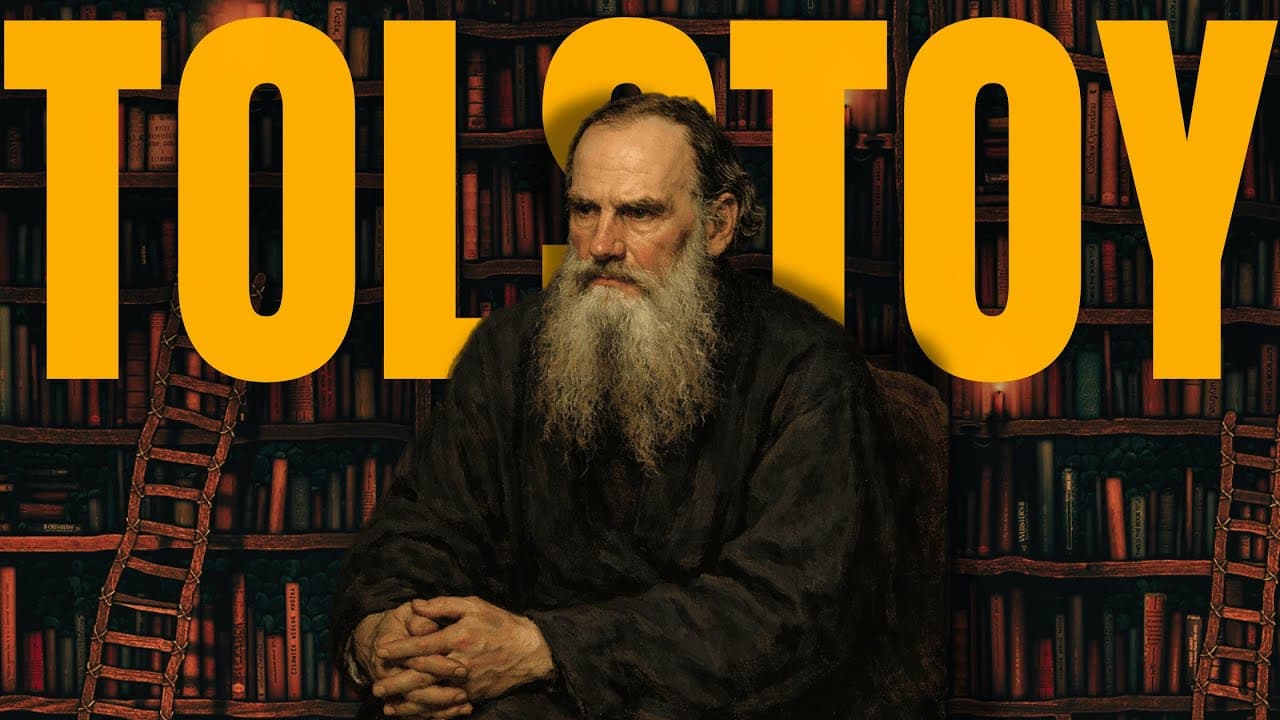
The Kingdom of God Is Within You
Leo Tolstoy's Complete Philosophy for Sleep
Chapters
- 0:00The Young Count and the World He Was Born Into
- 16:54War and Peace: History, Freedom, and the Illusion of Great Men
- 31:36Pierre Bezukhov and Prince Andrei: Two Searches for Meaning
- 46:56Anna Karenina and Levin: Love, Faith, and the Question of How to Live
- 59:49The Great Crisis: When the World Collapsed
- 1:14:00The Gospel in the Words of Jesus and the Rejection of the Church
- 1:28:35Nonviolence and the Moral Logic of Refusing to Kill
- 1:44:07The Death of Ivan Ilyich: How We Avoid Living
- 1:57:51Christian Anarchism: Simplicity, Labor, and the Rejection of Society
- 2:13:06Legacy: From Yasnaya Polyana to the World
Full Transcript
Chapter 01: The Young Count and the World He Was Born Into
There is a particular kind of country estate that existed in nineteenth-century Russia, vast and quiet and insulated from the noise of the wider world, and it was on one of these estates that Leo Nikolaevich Tolstoy was born on September 9, 1828. The estate was called Yasnaya Polyana, which translates roughly as "Bright Glade," and it sat in the Tula region, about one hundred and thirty miles southwest of Moscow. The name itself carries something of the quality that would come to define much of Tolstoy's later thought: a sense of clarity, of open space, of life lived close to the earth and far from the corruptions of the city. But in 1828, Yasnaya Polyana was not yet a symbol of anything. It was simply the home of a wealthy Russian aristocratic family, and Leo was simply one of their children, the fourth son, born into a world of privilege so deep and so thoroughly assumed that it rarely needed to be examined.
The Tolstoy family was old nobility. They carried the title of Count, and they belonged to that layer of Russian society which owned land in vast quantities, which kept serfs, which educated its sons in the manner befitting future officers or civil servants, and which lived according to rhythms and expectations that had remained largely unchanged for generations. Leo's mother, Princess Mariya Nikolaevna Volkonskaya, died when he was two years old, and so his earliest years were shaped by an absence that he would spend much of his life trying to understand. He was raised by his grandmothers and aunts, women who managed the household and who instilled in the young Leo a sense of duty, propriety, and the complex social choreography that governed life among the Russian nobility.
His father, Count Nikolai Ilyich Tolstoy, was a man of moderate reputation and some local importance. He managed the family estates and held a minor military rank, though he did not see active combat. He died when Leo was nine, and this second loss in childhood deepened the sense of orphan-like isolation that Tolstoy would later describe in his autobiographical writings. The family was not impoverished, but neither was it among the wealthiest noble houses in Russia. They occupied that middle ground of the aristocracy where comfort was assured but extravagance was not assumed, where the rhythms of the estate, the labor of the serfs, and the expectations of social standing all intersected in a web of obligation and habit.
Young Leo was not, by most accounts, a particularly distinguished student. He attended the University of Saint Petersburg briefly and then transferred to the University of Kazan, where he studied law and oriental languages. He did not complete his degree. The experience of formal education frustrated him, not because the material was beyond his grasp but because it seemed to him shallow and disconnected from the questions that genuinely interested him. He was already, in his adolescence, someone who found the surface world of institutions and social expectations inadequate to his deeper restlessness. He dropped out of university in 1847, returned to Yasnaya Polyana, and spent several years in a state of considerable dissipation. He gambled, he drank, he kept mistresses, and he lived with a heedless enjoyment of pleasure that he would later condemn with extraordinary severity.
It was during this period that he began to keep a diary, a practice he would maintain for the rest of his life. The early diary entries are remarkable for their honesty, even their brutality toward himself. Tolstoy recorded his failures, his lusts, his cowardice, and his self-deceptions with a candor that was unusual even by the standards of the confessional tradition. This habit of relentless self-examination would become one of the defining features of his inner life, and it would eventually find its most famous expression in the autobiographical essay known as Confession, written decades later when the entire architecture of his meaning had collapsed.
In 1851, at the age of twenty-two, Tolstoy enlisted in the Russian Army and was sent to the Caucasus, where Russian forces were engaged in a prolonged and brutal campaign against the Chechen and Circassian peoples of the region. This was not a war of grand strategy or national survival in the manner that the later Napoleonic campaigns would be described. It was a colonial war of suppression, fought in mountainous terrain against fighters who knew the land intimately and who were defending their homes against an imperial power that sought to consolidate its hold over the southern reaches of the empire. Tolstoy served as an officer in the artillery, and the experience left marks on him that never fully healed.
He saw killing. He saw the ways in which ordinary men, men who loved their families and told jokes around campfires, could be transformed by the machinery of war into instruments of destruction. He saw the gap between the language used to justify war, language of honor, duty, and patriotism, and the reality of what war actually was: confusion, pain, terror, and death. He began to write about these things, producing stories that would form the foundation of his literary reputation. The Sevastopol Sketches, based on his later experience during the Crimean War, are among the earliest works of fiction to describe warfare with something approaching journalistic honesty. They showed soldiers not as heroes or villains but as frightened, confused, and frequently absurd human beings caught in circumstances that no one fully understood.
The literary talent was unmistakable. Tolstoy could do things with language that very few writers of any era have been able to do. He could describe a character's inner life with such precision and depth that the reader felt they had been given access to another person's consciousness. He could describe a landscape or a social gathering or a moment of terror in battle with a vividness that made the scene feel more real than the reader's own experience. And he could sustain these achievements over enormous stretches of narrative, building novels of such scope and detail that they seem less like books and more like alternate worlds.
By the time he returned from military service and settled into literary life, Tolstoy was recognized as one of the leading writers of his generation. He married Sophia Andreevna Behrs in 1862, and the early years of the marriage were productive and, by most accounts, happy. They had thirteen children, of whom ten survived infancy. Sophia served as his copyist, transcribing the manuscripts of his novels, sometimes multiple times through successive drafts, and managing the practical affairs of the estate while her husband wrote.
It was in this period of relative stability and domestic contentment that Tolstoy produced his two greatest novels: War and Peace, published in serial form between 1865 and 1869, and Anna Karenina, published between 1875 and 1877. These works, whatever else they are, represent perhaps the highest achievements of the realist novel as a literary form. They are not merely great books. They are works that changed what it was possible for a novel to do, what it was possible for fiction to contain, and they remain, for many serious readers, the standard against which all subsequent fiction is measured.
Chapter 02: War and Peace, History, Freedom, and the Illusion of Great Men
War and Peace is, on its surface, a novel about the Napoleonic invasion of Russia in 1812 and the lives of several aristocratic families during that period. But it is also, and perhaps more fundamentally, a philosophical argument about the nature of history, the illusion of free will, and the question of what actually causes the events that shape the world.
Tolstoy's central philosophical claim in War and Peace is startling in its radicalism: that history is not made by great men. Napoleon did not cause the invasion of Russia. Alexander did not cause its defense. The generals did not determine the outcomes of battles. The politicians did not shape the course of events. History, Tolstoy argues, is the product of countless small decisions made by countless ordinary people, each responding to circumstances they do not fully understand, each acting according to impulses and pressures that they cannot fully articulate. The movements of armies are like the movements of bees in a hive: they appear purposeful from a distance, but up close they are revealed to be the aggregate of millions of individual actions, none of which, taken alone, is responsible for the overall pattern.
This is not merely an academic point. It is a direct challenge to the way most people think about history and about human agency. We want to believe that great events have great causes, that important things happen because important people decide to make them happen. We want to believe that Napoleon invaded Russia because he chose to, because his will determined the course of events. But Tolstoy insists that this is an illusion. Napoleon was carried along by forces he did not control and did not understand. He gave orders, but the orders were followed or ignored according to circumstances on the ground that Napoleon could not have known about. The invasion succeeded or failed at each point not because of Napoleon's genius or his mistakes but because of the aggregate behavior of hundreds of thousands of soldiers, each acting according to their own immediate situation.
The philosophical epilogue of War and Peace, which many readers skip, is where Tolstoy makes this argument most explicitly. He asks: what causes historical events? And he answers: everything and nothing. Every event is the product of an infinite chain of prior causes, each of which is itself the product of an infinite chain of prior causes. To say that Napoleon caused the invasion of Russia is to pick one link in an infinite chain and declare it the cause, which is arbitrary. You could just as easily say that the cause was the mood of a particular general on a particular morning, or the weather on a particular day, or the decision of a particular soldier to stand his ground rather than retreat.
This has implications for the concept of free will. If every event is determined by prior causes, and if the chain of causes stretches back infinitely, then in what sense are any of us free? Tolstoy's answer is characteristically paradoxical. From the inside, from the perspective of the person acting, we feel free. We feel that we choose, that we could have done otherwise, that our actions express our will. But from the outside, from the perspective of history, our actions are determined, part of a pattern that we did not choose and cannot control. Freedom and determinism are both true, depending on the perspective from which you look.
This is not a comfortable conclusion, and Tolstoy did not present it comfortably. The philosophical sections of War and Peace are dense, repetitive, and sometimes seem to contradict each other. But the novel itself embodies the argument far more effectively than the essays do. When we watch Pierre Bezukhov stumble through the Battle of Borodino, confused and terrified and unable to make sense of what is happening around him, we see Tolstoy's point made vivid. Here is a great historical event, the decisive battle of the Napoleonic invasion of Russia, and it is experienced by those who are in it as chaos, confusion, and incomprehension. No one knows what is happening. No one is in control. The battle unfolds not according to any plan but according to the accumulated actions of thousands of individuals, each doing what seems necessary or possible in the moment.
Chapter 03: Pierre Bezukhov and Prince Andrei, Two Searches for Meaning
Within the vast historical canvas of War and Peace, two characters carry the novel's deepest philosophical weight: Pierre Bezukhov and Prince Andrei Bolkonsky. They are, in a sense, two versions of Tolstoy himself, two attempts to answer the question that would consume his own life: how should one live?
Pierre Bezukhov is, at the beginning of the novel, a large, awkward, well-meaning, and thoroughly confused young man. He is the illegitimate son of a wealthy count, and when his father dies, he unexpectedly inherits an enormous fortune. He has no idea what to do with it. He has no idea what to do with himself. He is generous but easily manipulated. He is intelligent but incapable of sustained thought. He is sensitive but unable to translate his sensitivity into any consistent course of action.
Pierre's journey through the novel is a search for meaning. He tries Freemasonry, which promises secret knowledge and moral improvement. He tries philanthropy, attempting to improve the lives of his serfs. He tries love, marrying the beautiful and calculating Helene Kuragina, a marriage that ends in disaster. He tries philosophy, reading and thinking and debating. None of it works. None of it gives him what he is looking for: a sense of purpose, a feeling that his life is connected to something larger than himself, a foundation on which to build a meaningful existence.
The turning point for Pierre comes, improbably, in captivity. Captured by the French during the burning of Moscow, he is marched with other prisoners through the Russian winter. The conditions are terrible. He is cold, hungry, exhausted, stripped of every comfort and every illusion. And it is here, in the most degraded circumstances, that he finds something resembling peace. He meets Platon Karataev, a simple Russian peasant soldier, who embodies a kind of wisdom that Pierre has been seeking his entire life. Karataev does not philosophize. He does not construct theories or pursue self-improvement programs. He simply lives, with a quiet acceptance and a gentle humor that comes from somewhere deeper than thought. He is kind to those around him. He tells stories. He prays. He accepts his circumstances without resentment or self-pity.
Pierre learns from Karataev not any specific doctrine but a way of being. He learns that meaning is not something you find through intellectual searching but something that emerges naturally when you stop searching and start living. He learns that the simple rhythms of human existence, eating, sleeping, working, caring for others, are not obstacles to meaning but the medium through which meaning expresses itself. He learns, in short, what Tolstoy himself would later learn through his own crisis: that the peasants have something the intellectuals lack, not knowledge but wisdom, not theory but life.
Prince Andrei's search takes a different form. Where Pierre is warm and confused, Andrei is cold and clear. He is intelligent, ambitious, and contemptuous of the mediocrity he sees around him. He goes to war seeking glory and finds instead the senselessness of battle. Wounded at Austerlitz, lying on the field and looking up at the vast sky, he has a moment of revelation: the sky is infinite, and all the things he had valued, fame, success, the opinion of others, are infinitely small by comparison. Nothing matters except this immense, beautiful, indifferent sky.
But Andrei cannot sustain this insight. He recovers from his wound and returns to the world of ambition and activity. He falls in love with Natasha Rostova, and for a time the love seems to give his life the meaning he has been seeking. But the engagement is broken, Natasha is seduced by the dissolute Anatole Kuragin, and Andrei is devastated. He goes back to war, this time during the 1812 invasion, and is mortally wounded at Borodino. As he lies dying, he achieves a second, deeper revelation: that love, universal and unconditional love, is the meaning of existence. But this revelation comes too late to be lived. Andrei dies, having understood but not having had the chance to act on his understanding.
The two searches complement each other. Pierre finds meaning through lived experience, through suffering and simplicity and the example of a simple peasant. Andrei finds meaning through intellectual and spiritual insight, through the recognition that love is the fundamental reality. Pierre's path leads to life; Andrei's leads to death. Tolstoy seems to suggest that the lived path is the more authentic one, that meaning is not something to be understood but something to be inhabited, not a truth to be grasped but a way to be practiced.
Chapter 04: Anna Karenina and Levin, Love, Faith, and the Question of How to Live
Anna Karenina, published between 1875 and 1877, is a very different kind of novel from War and Peace. Where War and Peace is epic in scope, Anna Karenina is intimate. Where War and Peace is concerned with history and nations, Anna Karenina is concerned with individuals and families. But the philosophical questions it raises are equally profound, and in some ways more personal, more directly connected to the crisis that was building in Tolstoy's own life.
The novel has two main storylines that mirror and contrast with each other. The first is the story of Anna Karenina, a beautiful and intelligent woman married to a high-ranking government official, who falls passionately in love with Count Vronsky, a dashing young military officer. Their affair destroys Anna's marriage, alienates her from society, separates her from her son, and ultimately leads to her suicide. The second is the story of Konstantin Levin, a landowner and intellectual who struggles to find meaning in his life, who falls in love with Kitty Shcherbatskaya, who marries her, who works his land, and who, through a combination of love, labor, and a kind of intuitive faith, arrives at something resembling peace.
Anna's story is about the destruction that follows when passion becomes the sole organizing principle of a life. She loves Vronsky with an intensity that is, in its way, magnificent. But the love is not enough to sustain her. Separated from her son, ostracized by society, increasingly jealous and paranoid, she finds that passion without a broader framework of meaning becomes a prison. The love that was supposed to liberate her from the stifling conventions of her marriage instead becomes another kind of bondage, more intense and more destructive than the first. Her suicide is the logical conclusion of a life organized around a single emotion that could not bear the weight placed upon it.
Levin's story is, in many ways, Tolstoy's own. Levin is wealthy, intelligent, earnest, and deeply dissatisfied. He searches for meaning through philosophy, through agricultural reform, through social improvement, and through the kind of intellectual restlessness that characterized Tolstoy himself. He is drawn to the peasants who work his land, sensing that they possess a kind of wisdom that his education has not given him. He is troubled by death, by the apparent meaninglessness of existence, by the gap between what he knows intellectually and what he feels intuitively.
The resolution of Levin's crisis comes near the end of the novel, in a passage that anticipates Tolstoy's own later writings. Levin realizes that the meaning he has been seeking through reason cannot be found through reason. Reason leads to despair, to the recognition that life has no purpose that can be rationally demonstrated. But Levin does not live by reason alone. He lives by faith, by a kind of instinctive knowledge that tells him what is good and what is not, that gives him a sense of rightness and purpose that reason cannot explain. This faith is not theological in the conventional sense. It is not a set of doctrines or a system of beliefs. It is something more basic: a trust in life, a sense that existence has meaning even if that meaning cannot be articulated.
Chapter 05: The Great Crisis, When the World Collapsed
In the late 1870s, at the height of his fame and seemingly at the peak of his powers, Tolstoy experienced a crisis so severe that it nearly destroyed him. He described it later in Confession, one of the most searing documents of spiritual anguish ever written.
The crisis was not triggered by any external event. His health was good. His family was intact. His literary reputation was secure. He was wealthy, respected, and admired. By every conventional measure, his life was a success. And yet he found himself unable to continue living. Not because anything had gone wrong, but because he could no longer see the point.
The question that consumed him was simple: why? Why do anything? Why write? Why eat? Why care for his children? Why continue to exist? Every activity seemed pointless because every activity led to the same end: death. He would die. His children would die. His books would be forgotten. The estate would pass to others. Everything he had built would dissolve. And in the face of this universal dissolution, what was the point of building anything at all?
He described the experience in terms that suggest clinical depression, though the concept did not exist in his time. He could not work. He could not enjoy the things that had previously given him pleasure. He hid ropes and firearms from himself because he was afraid he would use them. The man who had written the greatest novels in the Russian language was unable to find a reason to get out of bed.
He searched for answers. He read philosophy: Schopenhauer, whose pessimism confirmed his darkest suspicions. Kant, whose moral philosophy seemed abstract and disconnected from lived experience. The ancient Stoics, who counseled acceptance but could not explain why one should accept rather than simply end. He read science, hoping that an understanding of the natural world would provide the meaning he sought. It did not. Science could explain how things worked but not why they mattered.
He looked at the people around him. How did they manage to go on living without being consumed by the same despair? He identified four strategies. Some were simply ignorant of the problem, too busy or too shallow to confront the fundamental questions. Some knew the problem but distracted themselves with pleasure, wealth, or activity, drowning the question in noise. Some saw the problem clearly and chose suicide, which Tolstoy considered the most logically consistent response. And some, despite seeing the problem, continued to live by faith, by a trust in life that did not depend on rational justification.
It was this last group that interested him. And it was among the peasants that he found its purest representatives. The peasants of Russia, the serfs and former serfs who worked the land and lived close to the earth, did not agonize over the meaning of life. They simply lived. They worked, they prayed, they loved their families, they endured hardship, and they died. And in their living there was a kind of faith, not the faith of theologians or philosophers, but a practical faith, a trust in the goodness of life that expressed itself in how they lived rather than in what they said.
Tolstoy began to suspect that this faith was more reliable than any intellectual system. The intellectuals, himself included, had thought their way into despair. The peasants, who did not think in the way intellectuals think, had not. Perhaps the problem was not that life lacked meaning but that a certain kind of thinking obscured the meaning that was already there. Perhaps the intellectual's curse was not greater insight but greater confusion, not deeper understanding but deeper alienation from the sources of meaning that sustained ordinary people.
Chapter 06: The Gospel in the Words of Jesus and the Rejection of the Church
In the early 1880s, Tolstoy undertook one of the most ambitious and controversial intellectual projects of the nineteenth century. He set about to rewrite the Gospels, stripping them of what he considered to be the theological and institutional accretions of centuries and restoring, as he believed, the original teachings of Jesus of Nazareth. The result was a work known variously as The Gospel in the Words of Jesus, or Tolstoy's Gospel Harmonization, and it represents one of the most radical engagements with the Christian scriptures ever produced by a major literary and intellectual figure.
Tolstoy's approach was brutally simple. He took the four Gospels and subjected them to a rigorous filter. Anything that involved the supernatural, miracles, resurrection, divine intervention, he removed. Anything that seemed to him to be a later addition by the church, theological concepts like the Trinity, doctrines of atonement, claims of divine sonship, he removed. What was left, he believed, was the actual moral teaching of Jesus, freed from the mythology and institutional apparatus that had accumulated around it.
What remained was a set of moral principles of extraordinary clarity and radical simplicity. Do not resist evil with force. Love your enemies. Do not judge others. Do not swear oaths. Do not accumulate wealth. Live simply. Work with your hands. Share what you have. These were not, in Tolstoy's reading, suggestions or ideals to be approximated. They were commands to be obeyed. Jesus meant exactly what he said. When he said do not resist evil, he meant do not resist evil. When he said love your enemies, he meant love your enemies. When he said give to everyone who asks, he meant give to everyone who asks.
The implications were devastating for organized religion. If Jesus's teaching was this simple and this direct, then the entire apparatus of the church, its hierarchy, its rituals, its theology, its wealth, its political power, was not merely unnecessary but actively harmful. The church had taken a teaching of radical simplicity and buried it under layers of complexity, institution, and compromise. It had turned a message of love and nonviolence into a justification for crusades, inquisitions, and the accumulation of wealth. It had betrayed the very teacher it claimed to serve.
Tolstoy's rejection of the Orthodox Church was total. He rejected the sacraments as superstition. He rejected the clergy as parasites. He rejected the theology as obscurantism. He rejected the institution as a tool of state power that had nothing to do with the teachings of Jesus. This was not a quiet, private disagreement. It was a public, passionate, relentless assault on one of the most powerful institutions in Russia.
The church responded in 1901 with a formal decree of excommunication. Tolstoy, the most famous writer in Russia, the man whose novels were read around the world, was officially expelled from the Russian Orthodox Church. The decree caused a sensation. Tolstoy received thousands of letters, some supporting the church's action, many more expressing sympathy and solidarity with the excommunicated writer. He accepted the excommunication with equanimity. He had already rejected the church in his own mind. The formal decree merely confirmed what was already true.
Chapter 07: Nonviolence and the Moral Logic of Refusing to Kill
Tolstoy's reading of the Gospels led him to what is perhaps his most radical and consequential philosophical position: absolute nonviolence. He came to believe that the use of force was never justified, under any circumstances, for any reason. Not in self-defense. Not in defense of others. Not in defense of the state. Not in any situation, no matter how extreme.
This was not pacifism in the conventional sense, which typically involves opposition to war while allowing for some use of force in other contexts. This was a total rejection of violence as a means of achieving any end, however good. Tolstoy argued that violence, by its very nature, cannot produce good outcomes. It can only produce more violence. The person who uses force to resist evil becomes evil himself. The state that uses force to maintain order becomes an instrument of oppression. The revolutionary who uses force to overthrow injustice creates new injustice. Violence is a trap from which there is no escape except through the refusal to enter it.
The argument rests on the teaching of Jesus: "Do not resist evil." Tolstoy took this literally. When someone strikes you, do not strike back. When the state demands your obedience in evil, refuse, but do not fight. When injustice surrounds you, bear witness to the truth, but do not use force to oppose it. This is not passive acceptance of evil. It is active resistance through noncooperation, through truth-telling, through the willingness to suffer rather than to inflict suffering.
Tolstoy recognized that this position seemed absurd by the standards of the world. How can you not resist evil? How can you stand by while innocent people are harmed? How can you refuse to defend your family, your community, your country? These objections seem overwhelming. But Tolstoy argued that they rest on a fundamental error: the assumption that violence is effective, that it actually achieves the goals it sets out to achieve.
Look at history, Tolstoy said. Has violence ever produced lasting peace? Has war ever ended war? Has punishment ever eliminated crime? Has coercion ever created genuine obedience? The answer, Tolstoy insisted, was no. Violence produces the appearance of order, but the order is maintained only by the threat of more violence. Remove the threat, and the order collapses. This is not genuine order. Genuine order comes from within, from the free consent of people who have been persuaded rather than coerced, who obey because they understand and agree rather than because they fear punishment.
The Kingdom of God Is Within You, published in 1894, is Tolstoy's most systematic statement of this philosophy. The title, taken from Luke 17:21, captures his central claim: that the transformation the world needs is not political or military but moral and spiritual. The kingdom of God is not a future state to be established through revolution or conquest. It is a present reality, available to anyone who chooses to live according to the teachings of Jesus. It exists wherever people refuse to participate in violence, wherever they choose love over force, wherever they live according to conscience rather than convention.
The book was banned in Russia. It circulated underground, in hand-copied manuscripts and smuggled editions. It reached readers who would transform the world. Among them was a young Indian lawyer named Mohandas Gandhi, who read The Kingdom of God Is Within You in the 1890s and described it as one of the most important books he had ever encountered. Gandhi's philosophy of satyagraha, truth-force, which he would develop over the following decades and which would eventually bring down British rule in India, was directly influenced by Tolstoy's ideas. The two men corresponded in the last year of Tolstoy's life, and Gandhi named his community in South Africa the Tolstoy Farm.
Martin Luther King Jr. would later draw on the same tradition, citing both Tolstoy and Gandhi as influences on the philosophy of nonviolent resistance that shaped the American civil rights movement. The line of transmission is clear: from Jesus to Tolstoy to Gandhi to King. A teaching of radical nonviolence, articulated in first-century Palestine, reinterpreted in nineteenth-century Russia, applied in twentieth-century India and America. Whatever one thinks of the teaching itself, its historical influence is undeniable.
Chapter 08: The Death of Ivan Ilyich, How We Avoid Living
In 1886, between the writing of Confession and The Kingdom of God Is Within You, Tolstoy published a novella that many consider his most perfect work of fiction: The Death of Ivan Ilyich. It is a short work, barely a hundred pages, but it contains, in compressed and devastating form, everything Tolstoy had learned about the failure of conventional life and the possibility of authentic existence.
Ivan Ilyich is a perfectly ordinary man. He is a judge, a member of the Russian professional class, a man who has done everything society expects of him. He has married appropriately, advanced in his career, decorated his house in the fashionable style, maintained the proper social connections, and lived a life that is, by every external measure, entirely successful.
And then he gets sick. A small injury, a bump against a window frame while hanging curtains, leads to a mysterious illness that gradually worsens. The doctors cannot agree on a diagnosis. The treatments do not work. Ivan Ilyich slowly realizes that he is dying.
What follows is one of the most profound explorations of mortality in all of literature. As Ivan Ilyich confronts death, he is forced to confront his life, and what he sees horrifies him. His life has been a lie. Not a deliberate lie, not a conscious deception, but a lie of convention, of going along, of doing what was expected without ever asking whether it was right or meaningful. He decorated his house to impress others, not because the decorations gave him pleasure. He pursued his career for status, not because the work was valuable. He maintained his marriage out of social obligation, not out of love. He lived, in short, as most people live: according to the expectations of others, never asking what he himself actually wanted or valued.
The horror of Ivan Ilyich's situation is that he realizes this only when it is too late to change. He has spent his entire life avoiding the questions that matter, the questions about death, meaning, purpose, love, and now that these questions have forced themselves upon him, he has no resources with which to face them. He has been so busy living correctly that he has never actually lived at all.
The novella's power lies in its universality. Ivan Ilyich is not a bad person. He is not particularly selfish or cruel. He is simply ordinary. He has done what most people do: followed the path of least resistance, adopted the values of his class, pursued the goals that society presented to him as desirable. And the result is a life that, when viewed honestly from the perspective of approaching death, turns out to have been empty.
The resolution comes in the final moments. As Ivan Ilyich lies dying, he achieves a kind of breakthrough. He sees that what he has feared, death, is not the end but the beginning of something, a release from the false life he has been living. He feels compassion for his family, who are suffering on his behalf. He lets go of his resentment, his self-pity, his terror. And in that letting go, he finds something that looks like peace, or even joy. "In place of death there was light."
Chapter 09: Christian Anarchism, Simplicity, Labor, and the Rejection of Society
The last three decades of Tolstoy's life were dominated by his attempt to live according to the principles he had articulated. This attempt was heroic, in some ways admirable, and in many ways a disaster.
He renounced his wealth, or tried to. He signed over the rights to his earlier works to the public domain and attempted to give away the estate. His wife, Sophia, resisted fiercely. She had thirteen children to provide for, and she was not willing to see the family fortune dispersed on the basis of her husband's religious convictions. The resulting conflict between Tolstoy's desire to renounce property and Sophia's determination to protect the family's interests became one of the most painful aspects of their marriage and would eventually contribute to its near-complete disintegration.
He tried to live like a peasant. He dressed in simple clothing, worked in the fields, made his own shoes, and ate a vegetarian diet. He rejected the luxuries of his class and attempted to demonstrate, through his own example, that a simple life was not only possible but morally superior to the life of privilege he had previously lived.
He rejected the authority of the state. He argued that all governments were based on violence, that taxation was theft enforced by threat of imprisonment, that military conscription was slavery enforced by threat of death. He refused to cooperate with the state in any way that he considered to involve complicity with violence. This put him in direct conflict with the Russian government, which regarded him with a mixture of respect for his literary achievement and anxiety about his political influence.
He became the center of a movement. Followers, called Tolstoyans, attempted to establish communities based on his principles: nonviolence, vegetarianism, manual labor, communal property, and the rejection of state authority. These communities were established in Russia, England, and elsewhere. Most did not last long. The demands of the lifestyle were extreme, the principles difficult to apply consistently, and the tensions between individual conscience and communal life proved difficult to resolve.
His relationship with Sophia deteriorated steadily. She resented his renunciation of their wealth. She was jealous of his followers and his secretary, Vladimir Chertkov, who she believed had too much influence over her husband. The household at Yasnaya Polyana became a site of perpetual conflict, with Sophia on one side and the Tolstoyans on the other, and Tolstoy himself caught in between, unable to satisfy either party.
Chapter 10: Legacy, From Yasnaya Polyana to the World
On October 28, 1910, at the age of eighty-two, Leo Tolstoy left his home for the last time. He had decided, after years of increasing conflict with his wife and growing despair at the gap between his principles and his life, to leave Yasnaya Polyana and live the simple, wandering life he had long idealized. He was accompanied by his daughter Alexandra and his physician.
He did not get far. Within days, he fell ill with pneumonia. He was taken off the train at the small station of Astapovo, where he was given a room in the stationmaster's house. As word spread that the most famous writer in the world was dying, journalists, photographers, and film crews descended on the tiny station. Sophia arrived but was not allowed to see him until he was unconscious. He died on November 7, 1910.
His death was a global event. The funeral at Yasnaya Polyana drew thousands of mourners, and it was notable for the absence of religious ceremony. Tolstoy had been excommunicated from the Orthodox Church, and his followers honored his wish for a simple burial without priests or ritual. He was buried in a small grove on the estate where, as a child, he had searched for a green stick on which, according to family legend, was written the secret of how to make all people happy.
The image of the green stick captures something essential about Tolstoy. He spent his entire life searching for the secret of human happiness, the principle or practice that would eliminate suffering and make life worth living. He believed, at various times, that the secret lay in art, in love, in faith, in the teachings of Jesus, in nonviolence, in simplicity, in labor. Each of these contained something real, something valuable. But none of them, individually or together, solved the problem completely. The suffering continued. The contradictions remained. The gap between what he preached and how he lived never fully closed.
And yet his search was not in vain. The questions he asked, the answers he proposed, and the radical seriousness with which he pursued both have continued to resonate across the century since his death. His influence on Gandhi and through Gandhi on the global nonviolent resistance movement is one of the most consequential lines of intellectual transmission in modern history. His literary works continue to be read, studied, and loved by millions. His moral philosophy, however extreme and impractical in some of its specifics, raises questions that every thoughtful person must eventually confront: How should we live? What do we owe to others? Is violence ever justified? Can we find meaning in a world where everything dies?
Tolstoy did not answer these questions definitively. No one has. But he asked them with a depth and sincerity that few have matched. He was willing to follow his convictions to their logical conclusions, even when those conclusions cost him his comfort, his relationships, and his peace of mind. He was willing to be wrong, to change his mind, to abandon positions he had held for decades when he became convinced they were false. He was willing, in the end, to sacrifice everything, his wealth, his social standing, his family harmony, in the pursuit of what he believed to be true.
Whether he found the truth is a question each reader must answer for herself. What is certain is that the search itself, conducted with such passion and such honesty over so many decades, is one of the great intellectual and moral dramas of the modern age. Tolstoy's life, with all its contradictions and failures, is a testament to the possibility and the cost of taking the fundamental questions seriously. He did not find the green stick. But he never stopped looking. And the search itself, perhaps, is the legacy that matters most.
Sources & Works Cited
- 1.Leo Tolstoy. War and Peace (2007)
- 2.Leo Tolstoy. Anna Karenina (2004)
- 3.Leo Tolstoy. A Confession and Other Religious Writings (1987)
- 4.Leo Tolstoy. The Kingdom of God Is Within You (1984)
- 5.Leo Tolstoy. The Death of Ivan Ilyich and Other Stories (2009)
- 6.Rosamund Bartlett. Tolstoy: A Russian Life (2011)
- 7.A.N. Wilson. Tolstoy: A Biography (1988)
- 8.Stanford Encyclopedia of Philosophy. Leo Tolstoy (Various)
Related Episodes
Hell Is the Inability to Love
What does it mean that hell, according to one seventh-century monk...
Beauty Will Save The World
This three-hour exploration follows the mind of Fyodor Dostoevsky, the Russian novelist who understood human nature with extraordinary depth. Beginning with his brutal years in Siberian prison, the episode moves through his masterpieces including Crime and Punishment, The Brothers Karamazov, and Notes from Underground. We examine his penetrating ideas about freedom, guilt, redemption, and the divided self, tracing why his insights into the darkest corners of human consciousness remain as vital today as when he first set them down.