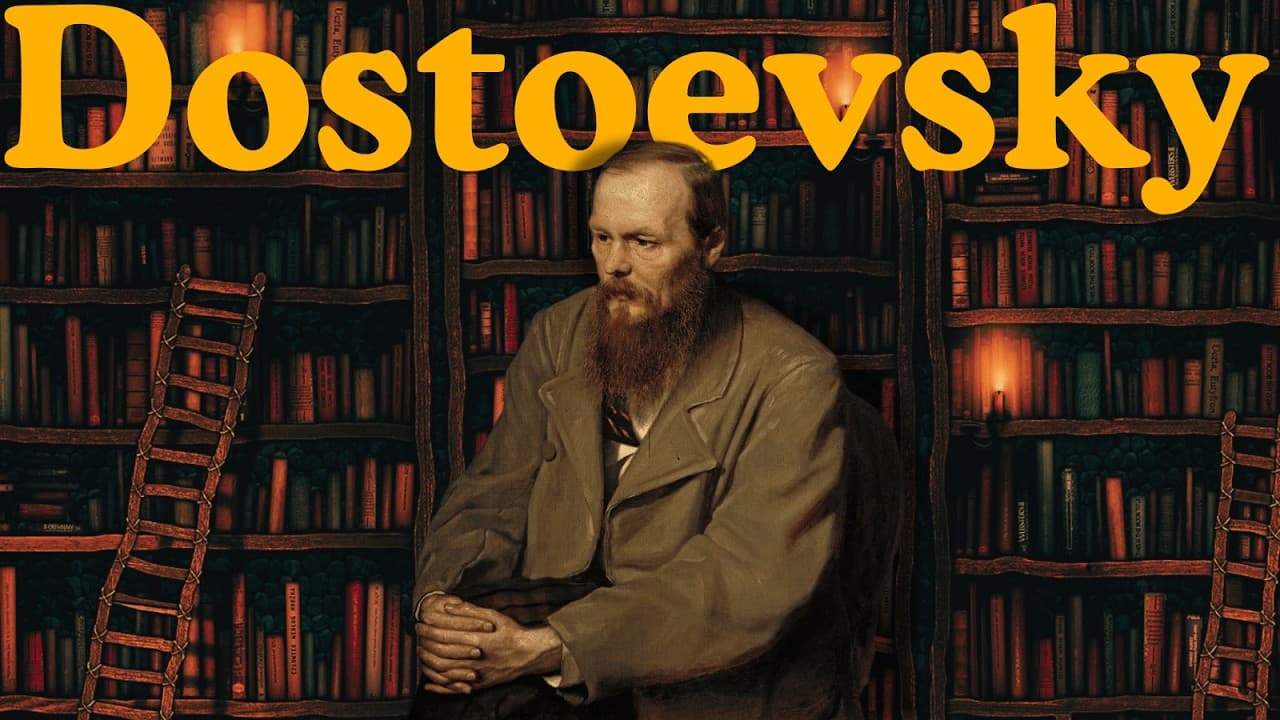
Beauty Will Save The World
Dostoevsky's Philosophy for Sleep
Chapters
- 00:00:00Chapter 01: Early Life, Siberia, and Return to St. Petersburg
- 00:18:39Chapter 02: Polyphony and Dialogism in Dostoevsky's Art
- 00:28:35Chapter 03: The Underground Man and the Revolt Against Reason
- 00:38:22Chapter 04: Rational Egoism and the Crystal Palace
- 00:46:31Chapter 05: The Right to Desire and the Limits of Arithmetic
- 00:54:57Chapter 06: Crime and Punishment: The Logic of Transgression
- 01:02:02Chapter 07: Raskolnikov's Conscience and the Problem of Confession
- 01:09:13Chapter 08: Sonya and the Meaning of Redemption
- 01:15:39Chapter 09: The Idiot: Prince Myshkin and the Ideal of Goodness
- 01:22:16Chapter 10: Beauty, Vulnerability, and the Failure of Innocence
- 01:29:21Chapter 11: Demons: Ideology and Revolutionary Violence
- 01:36:17Chapter 12: Shigalyov's System and the Logic of Absolutism
- 01:43:30Chapter 13: Stavrogin and the Emptiness of Nihilism
- 01:50:29Chapter 14: The Brothers Karamazov: Faith, Doubt, and the Human Condition
- 01:56:20Chapter 15: Ivan Karamazov's Rebellion Against Creation
- 02:03:37Chapter 16: The Grand Inquisitor and the Problem of Freedom
- 02:10:03Chapter 17: Zosima's Teaching and the Path of Active Love
- 02:16:18Chapter 18: The Question of Theodicy and the Meaning of Suffering
- 02:22:24Chapter 19: Dmitri, Smerdyakov, and the Web of Responsibility
- 02:29:35Chapter 20: Double Consciousness and the Divided Self
- 02:35:33Chapter 21: Shame, Pride, and the Theater of Confession
- 02:41:31Chapter 22: Freedom, Personhood, and Ethical Irreducibility
- 02:47:56Chapter 23: Religion as Risk: Faith Beyond Miracle and Mystery
- 02:53:51Chapter 24: Compassion, Solidarity, and Responsibility for All
- 03:00:01Chapter 25: Dostoevsky's Psychology and the Birth of Existentialism
- 03:06:00Chapter 26: Influence and Legacy in Philosophy and Literature
- 03:12:13Chapter 27: Closing Synthesis: Life as Question, Not Solution
Full Transcript
Chapter 01: Early Life, Siberia, and Return to St. Petersburg
The nineteenth century gave the world many great novelists, but few penetrated as deeply into the contradictions of human consciousness as Fyodor Mikhailovich Dostoevsky. Born in Moscow on November 11, 1821, he would become not merely a chronicler of his turbulent age but a prophet of the psychological and spiritual crises that would define modernity itself. His works resist simple categorization as either literature or philosophy, for in Dostoevsky these supposed opposites achieve a rare unity. Through the concrete particulars of individual human suffering, he articulated universal questions about freedom, faith, morality, and meaning that continue to resonate with extraordinary force.
Dostoevsky's early years provided little hint of the revolutionary artist he would become. His father, Mikhail Andreevich, served as a doctor at the Mariinsky Hospital for the poor in Moscow, a position that placed the family on the margins of the nobility while exposing young Fyodor to the suffering of Russia's underclasses. The hospital grounds where he played as a child bordered on a cemetery for criminals and suicides, those deemed unworthy of consecrated burial. This early proximity to death and social exclusion would leave permanent marks on his imagination.
His mother, Maria Fyodorovna, came from a merchant family and brought a gentler influence to the household. She taught her children to read using biblical stories, and Dostoevsky would later credit these early encounters with scripture as fundamental to his artistic development. The family maintained a small estate at Darovoe, where Dostoevsky spent summers observing peasant life, storing impressions that would surface decades later in his mature fiction. Yet this childhood contained darkness as well. His father ruled the household with severe discipline, and after Maria's death from tuberculosis in 1837, Mikhail Andreevich's behavior grew increasingly erratic and cruel.
At age sixteen, Dostoevsky entered the Nikolayev Military Engineering Institute in St. Petersburg, beginning a relationship with that strange and magnificent city that would persist throughout his life. St. Petersburg represented Russia's window to the West, a city conjured from swampland by Peter the Great's imperial will, its very existence a kind of fantastic rebellion against nature. For Dostoevsky, it would become the perfect stage for exploring the conflicts between Russian tradition and European modernity, between organic community and rational design, between the humble acceptance of limits and the proud assertion of human will.
The engineering academy proved a poor fit for Dostoevsky's temperament. While competent in his studies, he spent his free hours devouring the works of Pushkin, Gogol, Schiller, Balzac, and Dickens. He began to see literature not as mere entertainment but as a means of exploring the most fundamental questions of human existence. The sudden death of his father in 1839, reportedly murdered by his own serfs, intensified these philosophical preoccupations. Though Dostoevsky rarely spoke of this event directly, many scholars detect its influence in his later explorations of patricide, guilt, and the burden of inherited sin.
Upon graduating in 1843, Dostoevsky briefly worked as an engineer before resigning his commission to pursue writing full-time. This decision required considerable courage, as it meant abandoning the security of government service for the uncertainties of literary life. His first novel, Poor Folk, appeared in 1846 to considerable acclaim. The influential critic Vissarion Belinsky declared that a new Gogol had appeared, and overnight Dostoevsky found himself celebrated in St. Petersburg's literary circles.
The trial that followed his arrest as a member of the Petrashevsky Circle was a foregone conclusion. On November 16, 1849, Dostoevsky and fourteen other defendants were sentenced to death by firing squad. Then, on December 22, they were led to Semyonovsky Square, where scaffolds had been erected and soldiers waited with loaded rifles. At that moment, with rifle barrels pointed at his chest, Dostoevsky experienced what he later described as a revelation of life's infinite value, each remaining second expanding to contain whole universes of meaning. Then, at the last possible instant, a courier arrived with news that the Tsar had commuted their sentences. The entire execution had been a carefully orchestrated piece of psychological torture.
His actual sentence proved harsh enough: four years of hard labor in a Siberian prison camp, followed by an indefinite term of military service. The prison camp at Omsk represented a complete inversion of everything Dostoevsky had known. Here, aristocratic political prisoners mixed with common criminals, murderers, and thieves. Stripped of his class privileges and intellectual pretensions, he encountered the Russian people in their rawest form. He discovered that many of his fellow prisoners, despite their crimes, possessed a moral depth and spiritual intensity that exceeded anything he had encountered in Petersburg salons.
This experience fundamentally altered his understanding of human nature. The Enlightenment view of man as essentially rational, capable of organizing society according to scientific principles, could not account for what he witnessed in Omsk. The prisoners were capable of extraordinary cruelty and extraordinary kindness, often within the same hour. They could endure unimaginable suffering while maintaining an inner freedom that no chains could bind. They believed in God and committed terrible sins, sometimes simultaneously. They defied every attempt at systematic explanation.
This quest would drive his greatest creative period. Between 1864 and 1881, he would produce a series of novels that transformed not only Russian literature but world culture: Notes from Underground, Crime and Punishment, The Idiot, Demons, and The Brothers Karamazov. Each work represented a laboratory for exploring different aspects of the modern crisis, testing ideas through the concrete experiences of unforgettable characters.
Chapter 02: Polyphony and Dialogism in Dostoevsky's Art
The Russian literary critic Mikhail Bakhtin identified what he considered the defining feature of Dostoevsky's fiction: polyphony. Dostoevsky created the polyphonic novel, a form in which multiple independent consciousnesses coexist without being subordinated to a single authorial perspective. Each major character possesses a full and autonomous inner life. Each has his or her own ideological position, his or her own way of seeing the world. And these positions are not resolved into a single truth. Instead, they remain in dialogue, in conflict, in tension.
This reflects Dostoevsky's deepest philosophical conviction: that truth is dialogical, not monological. Truth cannot be possessed by a single consciousness in isolation. It arises in the encounter between consciousnesses, in the space of dialogue and relation. To silence another voice, to reduce another person to an object of one's own understanding, is to violate the very structure of truth and personhood.
This method has profound ethical implications. By refusing to reduce his characters to objects, by granting them autonomy and voice, Dostoevsky enacts in his fiction the respect for personhood that he insists is the foundation of ethics. This is what Dostoevsky means by freedom. It is not simply the ability to choose between options. It is the irreducibility of the person, the fact that no system, no theory, no ideology can fully capture or control the human subject.
Chapter 03: The Underground Man and the Revolt Against Reason
Notes from Underground is Dostoevsky's most concentrated and philosophical work. The narrator, known only as the Underground Man, is a retired civil servant who lives alone in a shabby corner of St. Petersburg. He is sick, spiteful, and bitter. His primary target is the ideology of rational egoism, which held that human beings act in their own self-interest and that, if properly educated, they would recognize that their true interest lies in cooperating with others for the common good.
The Underground Man rejects this optimism entirely. He argues that reason cannot dictate human behavior because human beings do not act solely in their rational self-interest. They act on impulse, passion, whim, and most importantly on the desire to assert their own will. People do things that harm them, that make them miserable, simply to prove that they are free, that they are not machines, that they cannot be predicted or controlled. He insists on the right to desire, the right to choose irrationally, the right to suffer if one wishes. To deny this right is to deny what is most human about us.
But the Underground Man is not a hero. Dostoevsky does not endorse his position without irony. His rebellion against reason has not liberated him. It has isolated him. He is free in the negative sense, free from external authority, free from social obligation, but he is not free in any positive sense. He cannot create, cannot love, cannot even act consistently on his own principles. This is the tragedy of the Underground Man. His critique of rational egoism is devastating, but his alternative is solipsism and despair.
Chapter 06: Crime and Punishment: The Logic of Transgression
Crime and Punishment represents Dostoevsky's first fully realized philosophical novel. The story follows Rodion Romanovich Raskolnikov, a former law student living in desperate poverty in St. Petersburg, who conceives and carries out the murder of an elderly pawnbroker named Alyona Ivanovna. Raskolnikov's justification for the murder combines utilitarian calculation with Napoleonic self-assertion. He reasons that the pawnbroker is a harmful creature whose death would benefit society. But Dostoevsky shows that this reasoning, however logical it may seem, is fundamentally corrupt because it treats a human being as an object to be weighed and discarded.
Chapter 14: The Brothers Karamazov: Faith, Doubt, and the Human Condition
The Brothers Karamazov, Dostoevsky's final and greatest novel, represents the culmination of his lifelong exploration of faith, freedom, and the meaning of suffering. The novel tells the story of Fyodor Pavlovich Karamazov, a dissolute and contemptible landowner, and his three legitimate sons: Dmitri, the passionate sensualist; Ivan, the intellectual atheist; and Alyosha, the novice monk. There is also a fourth son, the illegitimate Smerdyakov, who works as Fyodor's servant. The father is murdered, and the question of who is responsible, both legally and morally, drives the novel's plot while providing a framework for exploring the deepest questions of human existence.
Chapter 15: Ivan Karamazov's Rebellion Against Creation
Ivan Karamazov's rebellion is articulated most fully in a conversation with Alyosha in a tavern. Ivan begins by saying that he accepts God. He accepts that God exists and that God created the world. But he does not accept the world. He does not accept the suffering that pervades it, particularly the suffering of innocent children. He tells Alyosha a series of horrifying stories about children who have been tortured, abused, and killed by adults. Ivan asks: How can any future harmony, any ultimate good, justify such suffering? Even if the end result is a perfect world in which everyone is happy and reconciled, how can that compensate for the tears of one tortured child?
Chapter 16: The Grand Inquisitor and the Problem of Freedom
The parable of the Grand Inquisitor is the philosophical heart of The Brothers Karamazov and perhaps of Dostoevsky's entire body of work. Ivan tells Alyosha a story he has composed: Christ returns to earth in sixteenth-century Seville, during the Spanish Inquisition. He appears quietly, performing miracles, and the people recognize him. But the Grand Inquisitor, a ninety-year-old cardinal, has Christ arrested and imprisoned. In a long monologue, the Inquisitor accuses Christ of having placed an impossible burden on humanity by offering freedom. Human beings, the Inquisitor argues, do not want freedom. They want bread, miracles, and authority. They want someone to tell them what to do, to relieve them of the terrible weight of choice.
Chapter 27: Closing Synthesis: Life as Question, Not Solution
Dostoevsky's philosophical legacy resists systematic summary because his method was dialogical rather than dogmatic. He did not offer a system of thought that could be extracted from his novels and presented as a set of propositions. Instead, he created a form of literature that embodies philosophical inquiry as a living process. His novels are not arguments for particular conclusions but explorations of what it means to be human in a world where freedom, suffering, and the possibility of redemption are permanent features of existence.
What Dostoevsky ultimately shows us is that life is not a problem to be solved but a mystery to be lived. The attempt to reduce human existence to a formula, whether rational, political, or theological, always fails because it cannot accommodate the full depth and complexity of the human person. We are not machines. We are not numbers in a calculation. We are not stages in a historical process. We are persons, each one irreducible, each one bearing the image of God, each one capable of both terrible evil and astonishing goodness. And the response to this condition is not a theory but a practice: the practice of love, of compassion, of responsibility for one another, of openness to the suffering and the joy of being alive.
Sources & Works Cited
- 1.Dostoevsky, Fyodor. Crime and Punishment (1993)
- 2.Dostoevsky, Fyodor. The Brothers Karamazov (1990)
- 3.Dostoevsky, Fyodor. Notes from Underground (1993)
- 4.Dostoevsky, Fyodor. The Idiot (2003)
- 5.Dostoevsky, Fyodor. Demons (1995)
- 6.Frank, Joseph. Dostoevsky: A Writer in His Time (2010)
- 7.Williams, Rowan. Dostoevsky: Language, Faith, and Fiction (2008)
- 8.Berdyaev, Nikolai. Dostoevsky: An Interpretation (1934)
- 9.Stanford Encyclopedia of Philosophy. Dostoevsky
Related Episodes
Hell Is the Inability to Love
What does it mean that hell, according to one seventh-century monk...
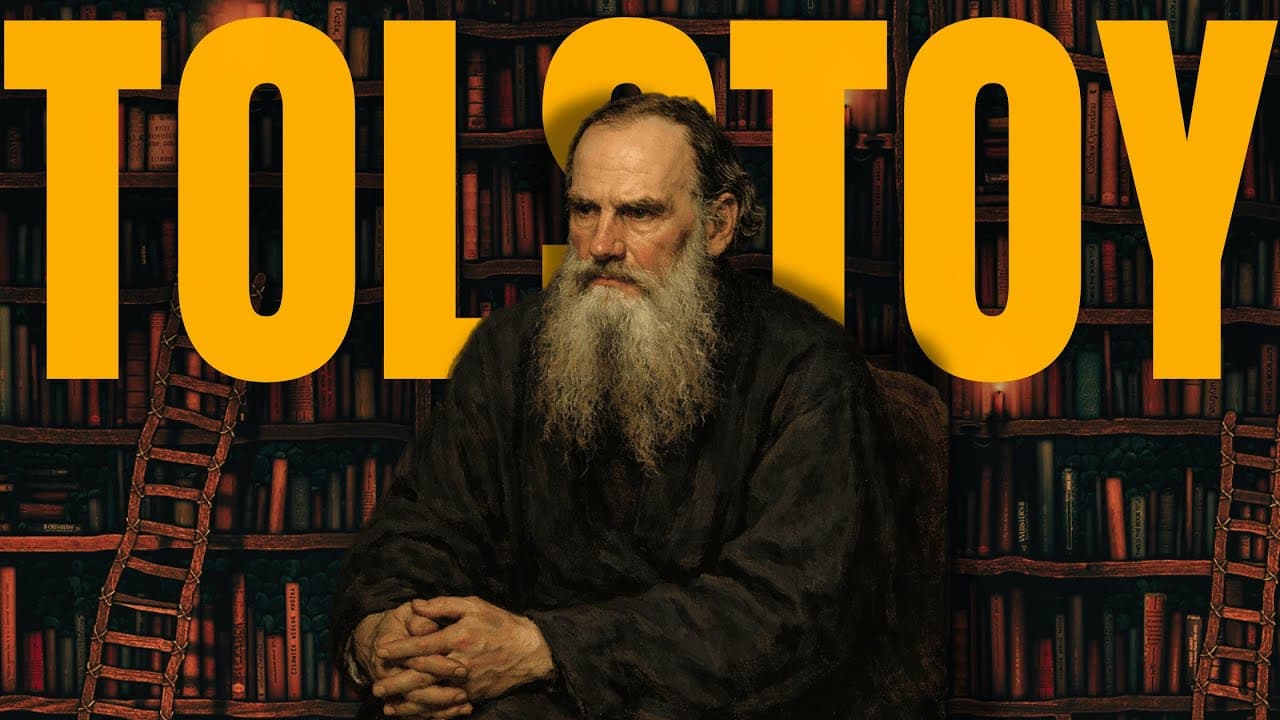
The Kingdom of God Is Within You
Leo Tolstoy was born on a vast Russian estate in 1828, a place of quiet and privilege that would shape everything he became and everything he later sought to destroy. He wrote two of the greatest novels in any language: War and Peace, which dismantled the myth of great men by showing that history is made by the countless small decisions of ordinary people, and Anna Karenina, which asked whether passion alone could ever carry a life. But his novels were only the beginning. In his fifties, the foundations of meaning collapsed beneath him entirely, and he turned to the Gospels with genuine seriousness for the first time. What he found there was not a theology but a practice: nonresistance to evil, love without exception, simplicity, and labor. These teachings cost him his marriage, his comfort, and his standing in the Orthodox Church, which excommunicated him in 1901. They also inspired Gandhi and Martin Luther King Jr., who built movements on the same tradition Tolstoy began.
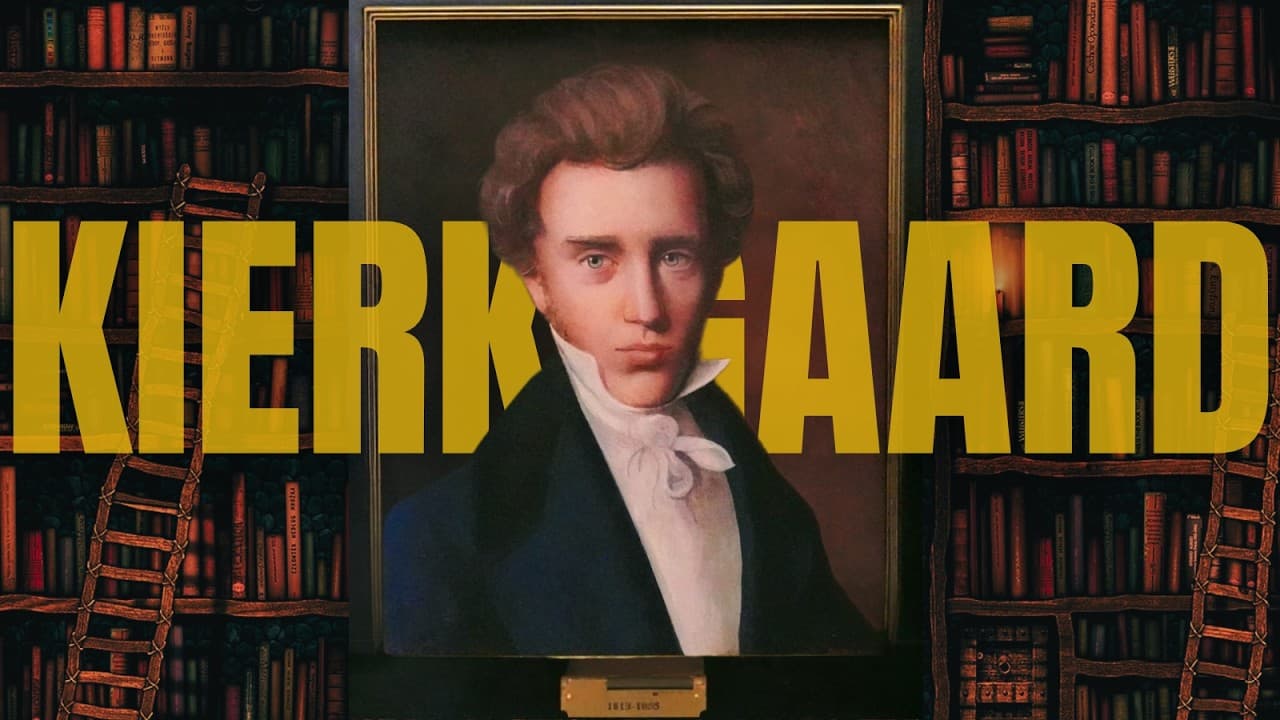
Life Is Not A Problem To Be Solved
This episode is a long, gentle walk through the thought of Soren Kierkegaard, the Danish philosopher who believed existence is not a puzzle to be solved but something lived inwardly, one anxious choice at a time. We explore his three stages of existence, the concept of anxiety as the dizziness of freedom, despair as the sickness unto death, and the radical leap of faith. From his broken engagement to Regine Olsen to his fierce attack on institutional Christianity, Kierkegaard's ideas resonate with striking force for anyone lying awake wondering what it all means.