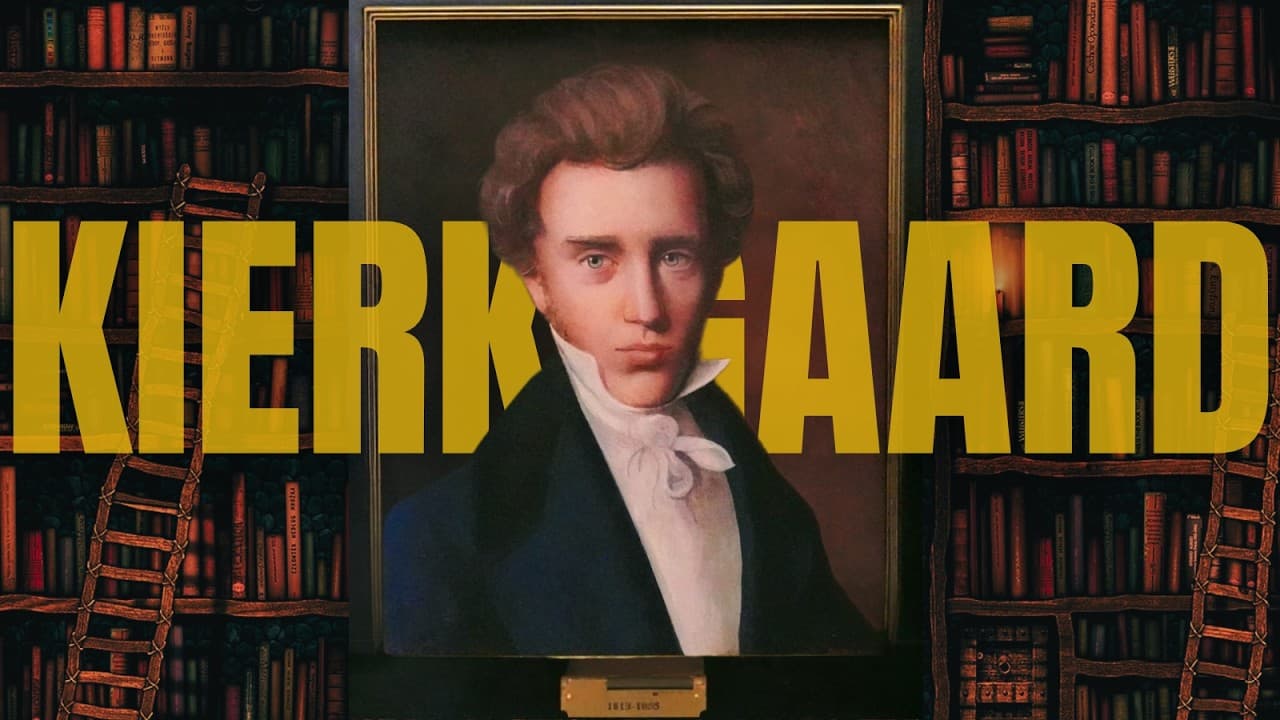
Life Is Not A Problem To Be Solved
Kierkegaard's Philosophy to Sleep To
Chapters
- 00:00:00Opening and Kierkegaard's Project
- 00:01:32Copenhagen, Family, and Melancholy
- 00:03:04University Years and Socratic Irony
- 00:04:36Regine Olsen and the Broken Engagement
- 00:06:08The Pseudonymous Strategy
- 00:09:12Objective vs Subjective Truth
- 00:10:44Inwardness and Appropriation
- 00:13:48The Aesthetic Stage of Existence
- 00:15:20The Ethical Stage and Commitment
- 00:16:52The Religious Stage and Fear and Trembling
- 00:18:24The Teleological Suspension of the Ethical
- 00:19:57The Knight of Faith
- 00:21:29Anxiety: The Dizziness of Freedom
- 00:24:33Despair: The Sickness Unto Death
- 00:30:41The Single Individual and the Hegel Critique
- 00:36:50The Attack on Christendom
- 00:41:26Death, Legacy, and Works of Love
- 00:53:42Practice in Christianity and Discipleship
- 01:05:58Reception, Influence, and the Journals
- 01:19:50Repetition, Irony, and the Self as Synthesis
- 01:41:18Sin, Suffering, and the Edifying Discourses
- 02:02:35Freedom, the Crowd, and the God-Relationship
Full Transcript
Soren Kierkegaard remains a figure whose thought resists easy summary, whose life invites curiosity, and whose questions continue to disturb settled assumptions about existence, truth, and faith. Born into a prosperous merchant family in early nineteenth-century Copenhagen, he devoted his brief life to a single overarching project: awakening his contemporaries to the strenuous inward task of becoming a self. He wrote prolifically, often under pseudonyms, and he challenged the dominant intellectual currents of his time, especially the grand systematic philosophy of Hegel and the comfortable institutional Christianity he saw embodied in the Danish state church. His work explores anxiety, despair, choice, passion, irony, love, and the paradoxes of faith, all with a precision and subtlety that have secured his place as a founding voice in existentialist thought. This episode offers a sustained look at Kierkegaard's central ideas, the contexts that shaped them, and the enduring questions they pose. We will proceed chronologically through his biography, thematically through his concepts, and carefully through his most important texts, maintaining a steady pace suited to long listening. Our aim is neither to evangelize for his conclusions nor to flatten his paradoxes, but to present his thinking as clearly and accurately as possible, so that each listener may reflect on what it means to exist, to choose, and to relate inwardly to truth.
Soren Aabye Kierkegaard was born on May 5, 1813, in Copenhagen, Denmark, the youngest of seven children. His father, Michael Pedersen Kierkegaard, had risen from humble origins in rural Jutland to considerable wealth as a hosier and merchant in the capital. The father's success afforded the family comfort, but it also came with a shadow. Michael was deeply religious, shaped by Moravian pietism, and prone to what Kierkegaard later described as melancholy. Family legend, much debated by scholars, holds that as a young shepherd boy on the heath, Michael had cursed God in a moment of cold and desperation, and that he believed this curse hung over his household. Whether or not the story is literally true, the sense of guilt, the weight of introspection, and the seriousness with which faith and sin were regarded in the Kierkegaard home profoundly marked young Soren. By the time he reached adolescence, five of his siblings had died, as had his mother, Ane Sorensdatter Lund Kierkegaard, in 1834. The father's expectation that he too would die before reaching middle age created an atmosphere of existential urgency and an acute awareness of mortality. This melancholy inheritance, combined with rigorous intellectual training, set the stage for a life devoted to examining existence from within.
Kierkegaard entered the University of Copenhagen in 1830 to study theology, as his father wished. His student years, however, were marked by restlessness and rebellion. He threw himself into the intellectual and social life of the city, attending lectures, frequenting salons, and reading widely in philosophy, literature, and aesthetics. For a time he drifted, neglecting his studies and exploring what he would later characterize as the aesthetic mode of existence. The death of his father in 1838 proved a turning point. Kierkegaard later wrote that this event spurred him to return to his theological studies with renewed seriousness. He completed his dissertation, titled On the Concept of Irony with Constant Reference to Socrates, in 1841, defending it successfully on September 29 of that year and receiving his Magister degree, equivalent to a doctorate in philosophy. The dissertation already shows his preoccupation with indirect communication, irony, and the Socratic method. Socrates, who professed to know nothing and who used questioning to draw out the latent knowledge or ignorance of his interlocutors, would remain a touchstone for Kierkegaard throughout his authorship. The maieutic approach, in which the teacher acts as midwife to the student's own insight rather than simply delivering content, became central to Kierkegaard's strategy for writing philosophy. He understood that truths about how to exist cannot be transmitted like mathematical theorems; they must be appropriated inwardly, lived, and chosen.
In the same period that Kierkegaard was finishing his degree, his personal life took a dramatic turn. In September 1840, he became engaged to Regine Olsen, a young woman he had known for several years. The engagement was by all accounts one of mutual affection. Regine was intelligent, warm, and from a respectable family. Kierkegaard later wrote that he loved her deeply. Yet almost immediately he began to experience profound doubt about his ability to be a husband. He felt himself unsuited to the ordinary domestic life that marriage entailed. His melancholy, his sense of a secret burden inherited from his father, and his conviction that he was called to a singular intellectual and religious vocation all weighed on him. After nearly a year of inner turmoil, during which he threw himself into his dissertation work and avoided Regine as much as propriety allowed, he broke off the engagement in October 1841. He returned her ring with a letter asking her to forget him and to forgive him for his inability to make her happy. The break was devastating for both parties. Regine protested; her father was bewildered; Copenhagen society buzzed with speculation. Kierkegaard left for Berlin shortly afterward, ostensibly to study but also to escape the painful aftermath. Regine eventually married another man, Frederik Schlegel, but Kierkegaard never ceased to think of her. References to her, veiled and overt, appear throughout his writings. The broken engagement became for him a lived parable of the collision between the universal ethical demand to marry, to fulfill social roles, to live transparently, and the singular religious call that isolated him and demanded renunciation.
Upon returning to Copenhagen in 1842, Kierkegaard embarked on an extraordinarily productive period of writing. His inheritance from his father gave him financial independence, and he devoted himself entirely to authorship. Between 1843 and 1846, he published a remarkable series of works, most of them under pseudonyms. The pseudonymous strategy was deliberate and carefully managed. Kierkegaard wanted to create a polyphonic literature in which different voices, representing different life views or stages of existence, could speak in their own idiom without the author standing behind them to endorse or correct. Each pseudonym has a distinct personality, style, and philosophical position. Victor Eremita is the editor of Either/Or, a work presenting contrasting aesthetic and ethical viewpoints. Johannes de Silentio, whose name means John the Silent, is the author of Fear and Trembling, a meditation on faith and Abraham's willingness to sacrifice Isaac. Constantin Constantius explores repetition; Vigilius Haufniensis, meaning Watchman of Copenhagen, writes The Concept of Anxiety; Johannes Climacus, named after a medieval monk who wrote The Ladder of Divine Ascent, authors both Philosophical Fragments and the Concluding Unscientific Postscript, massive works examining the nature of faith and subjective truth. Judge William appears in Either/Or and Stages on Life's Way as the voice of ethical commitment and married life. Anti-Climacus, used for The Sickness Unto Death and Practice in Christianity, represents a standpoint of idealized Christianity that Kierkegaard himself did not claim to embody, hence the pseudonym. Alongside these pseudonymous works, Kierkegaard published a series of upbuilding or edifying discourses under his own name. These were explicitly religious and devotional, addressed to that single individual, a phrase that became his hallmark.
The use of pseudonyms serves multiple purposes. First, it allows Kierkegaard to present ideas without directly advocating them, thus practicing the indirect communication he admired in Socrates. If a reader encounters the aesthetic life view articulated brilliantly by the young man in Either/Or, the reader must decide for himself whether that view is sustainable or whether it collapses into despair. Kierkegaard does not appear in the text to tell the reader what to think. Second, the pseudonyms create aesthetic distance. The ideas are dramatized, embodied in characters with particular temperaments and circumstances. This makes the philosophy vivid and personal rather than abstract. Third, the strategy respects the freedom and subjectivity of the reader. Kierkegaard believed that the worst thing a communicator could do was to overwhelm the reader with authority, to impose truth from without. Truth, especially truth about existence and faith, must be appropriated by the individual through inward struggle. By hiding behind pseudonyms, Kierkegaard removes his own personality from the equation and forces the reader to engage with the ideas themselves. Finally, the pseudonyms reflect Kierkegaard's conviction that there is no single, neutral standpoint from which to survey all of existence. Each stage or mode of life has its own logic, its own language, its own passions. To understand them, one must enter into them, and the pseudonyms are vehicles for that imaginative entry.
At the heart of Kierkegaard's philosophical project is a distinction between objective and subjective truth. Objective truth concerns facts that hold regardless of who believes them or how they are appropriated. Mathematical propositions, historical dates, and empirical observations belong to the realm of objective truth. Such truths can be communicated directly, verified by evidence, and known with a high degree of certainty. Subjective truth, by contrast, concerns the individual's relationship to what is known. It is not enough to know that God exists, or that Christ lived, or that death is inevitable. One must relate oneself to these truths inwardly, with passion, commitment, and personal appropriation. Subjective truth is lived truth. Kierkegaard often quotes the line, If a person does not become what he understands, then he does not understand it either. This means that understanding in the existential sense is not merely intellectual assent but transformation of one's being. One can memorize Christian doctrine without being a Christian. One can know ethical principles without living ethically. The decisive question is not what one knows but how one knows it, how one exists in relation to it. This is why Kierkegaard insists that subjectivity is truth. He does not mean that each person invents his own truth or that there is no objective reality. He means that for questions of how to live, for religious and ethical existence, the inward mode of appropriation is what matters. A person who holds an objective uncertainty, such as the paradox of the incarnation, with infinite passion is in truth, while a person who knows all the right answers but remains inwardly indifferent is in error.
The concept of inwardness is closely related. Inwardness refers to the quality of one's inner life, the depth and intensity of one's self-relationship, the earnestness with which one reflects on one's own existence. In a culture that prizes public achievement, social approval, and objective knowledge, inwardness is easily neglected. Kierkegaard saw his contemporaries as living in crowds, absorbed in external roles, defined by what others think, and estranged from their own subjectivity. To cultivate inwardness means to withdraw from the crowd, to take responsibility for one's choices, to reflect honestly on one's motives, fears, and commitments. It requires solitude, honesty, and courage. Inwardness is not introspection for its own sake, nor is it a retreat from action. Rather, it is the condition for authentic action. Only the person who knows himself, who has faced his own despair and chosen himself in earnest, can act ethically and religiously. Without inwardness, life becomes mechanical, external, a matter of going through the motions. With inwardness, even ordinary actions take on significance because they are performed by a self that has awakened to its own existence.
Kierkegaard's analysis of existence is organized around three stages or spheres: the aesthetic, the ethical, and the religious. These are not developmental stages through which everyone passes in sequence, nor are they exclusive categories. A person can oscillate between them or remain stuck in one. They are better understood as modes of existence, ways of organizing one's life, sources of meaning and identity. Each stage has its own logic, its own satisfactions, and its own form of despair. The movement from one stage to another is not achieved by argument or by accumulating more knowledge. It requires a leap, a decision, an act of will in which the individual breaks with the past and commits to a new way of being. This leap is not irrational, but it is not purely rational either. It involves the whole self, passion as well as thought, risk as well as reflection.
The aesthetic stage is characterized by the pursuit of immediate experience, pleasure, variety, and the avoidance of boredom and commitment. The aesthetic individual lives in the moment, seeking to maximize enjoyment and minimize pain. He values beauty, novelty, sensory delight, and emotional intensity. He may be a hedonist indulging in physical pleasures, or he may be a refined connoisseur cultivating taste and imagination. The archetype of the aesthetic life is the seducer, who pursues romantic and erotic conquests not for the sake of any particular woman but for the thrill of the chase, the aesthetic satisfaction of orchestrating desire. In Either/Or, the first volume presents the aesthetic view through the writings of a young man known simply as A. This character writes essays on music, particularly Mozart's Don Giovanni, on the tragic in ancient drama, on the rotation method for avoiding boredom, and on the art of seduction. His writing is brilliant, witty, and melancholy. He understands pleasure and beauty with sophistication. Yet beneath the surface there is an emptiness. The aesthetic life, because it depends on external circumstances and fleeting moods, is inherently unstable. The aesthete is at the mercy of chance. When pleasure fades, as it inevitably does, he is left with boredom and despair. He has no stable identity, no continuity, no purpose beyond the next experience. He floats, drifts, and ultimately suffers from what Kierkegaard calls despair, though the aesthete may not recognize it as such. He may call it ennui, melancholy, or simply the way things are. But it is a fundamental unhappiness rooted in the refusal to choose oneself, to commit, to take responsibility for one's existence.
The ethical stage represents a decisive break with the aesthetic. The ethical individual recognizes that life cannot be organized around pleasure or novelty. Instead, it must be grounded in duty, responsibility, and commitment. The ethical person chooses himself in his concrete, historical situation and accepts the obligations that come with being a self. He commits to roles: husband, father, citizen, professional. He lives according to universal moral principles. He values honesty, fidelity, justice, and consistency. In Either/Or, the ethical view is articulated by Judge William, a married magistrate who writes long letters to the young aesthete urging him to marry, to choose, to live earnestly. Judge William argues that marriage is the highest expression of the ethical life because it involves a total, lifelong commitment to another person and to the responsibilities of family and social life. He contrasts the Don Juan figure, who moves from one affair to another without ever committing, with the faithful husband, who finds depth and continuity through commitment. The ethical life has a seriousness and dignity that the aesthetic lacks. It provides stability, meaning, and a sense of identity. The ethical person knows who he is because he has chosen himself and taken responsibility for that choice. He is transparent, integrated, and capable of genuine relationships. Yet the ethical stage, for all its strengths, has its own limitations and its own form of despair. The ethical individual can become self-righteous, confident that his adherence to universal principles justifies him. He can lose sight of his own contingency, his own sinfulness, his own radical dependence on something beyond the universal moral order. When confronted with the absoluteness of religious demands, or with situations in which universal ethical principles collide, the ethical individual may find that duty is not enough.
The religious stage is the highest and most paradoxical. Here the individual stands in absolute relation to the absolute, to God, and discovers that this relation transcends and can even suspend the universal ethical order. The religious individual is defined not by aesthetic pleasure or ethical duty but by faith, by an inward passion directed toward the infinite and eternal. Faith is not a matter of intellectual assent to doctrines. It is not confidence based on evidence or probability. It is a leap, a risk, a commitment made in the face of objective uncertainty. The religious person accepts that God is wholly other, that divine commands may not align with human reason or ethics, and that the relationship with God is intensely personal, hidden, and inward.
Anxiety is another concept that Kierkegaard explores with penetrating depth, particularly in The Concept of Anxiety. Anxiety, or angst, is not the same as fear. Fear has a definite object. One fears a snake, a storm, a hostile person. Anxiety, by contrast, is objectless, a diffuse unease directed at nothing in particular. Kierkegaard describes anxiety as the dizziness of freedom. It arises when the self confronts the open horizon of possibility, the fact that it must choose and that every choice carries the weight of responsibility. Anxiety reveals the burden of selfhood. To be a self is to be responsible for oneself, to have to choose, to stand alone before the abyss of one's own freedom. This is why anxiety is both frightening and fascinating. It is the symptom of spirit awakening to itself.
Despair is the theme of The Sickness Unto Death, a work that may be Kierkegaard's most psychologically acute. Despair, like anxiety, is a universal condition, though not everyone recognizes it. Kierkegaard defines the self as a relation that relates itself to itself and, in relating itself to itself, relates itself to another. The self is not a substance or a fixed entity. It is a dynamic relation, a synthesis of opposites held together by spirit. Specifically, the self is a synthesis of the finite and the infinite, the temporal and the eternal, necessity and possibility, body and soul. Despair arises when this synthesis is disturbed, when one element is out of balance or when the self refuses to be itself. Despair is overcome only when the self wills to be itself and grounds that willing in God. This is faith. Faith is the opposite of despair. In faith, the self accepts itself as it is, with all its limits and contradictions, and entrusts itself to the power that created it.
Kierkegaard's work, for all its difficulty and complexity, has a certain simplicity at its core. The central question is: How should one live? The central answer is: In faith, in love, in earnestness, as a self before God. Everything else, all the philosophical analysis, all the psychological insight, all the theological reflection, all the polemics and paradoxes, serves this simple question and this simple answer. Kierkegaard wants to help people to live authentically, to exist inwardly, to take their lives seriously, to make choices with full awareness of what is at stake, to relate to God in faith and to the neighbor in love. This is the task of human existence, and it is a task that is never complete, that must be renewed every day, that requires constant vigilance and effort.
Sources & Works Cited
- 1.Kierkegaard, Soren. Either/Or, Parts I and II (1987)
- 2.Kierkegaard, Soren. Fear and Trembling / Repetition (1983)
- 3.Kierkegaard, Soren. The Concept of Anxiety (1980)
- 4.Kierkegaard, Soren. The Sickness Unto Death (1980)
- 5.Kierkegaard, Soren. Works of Love (1995)
- 6.Kierkegaard, Soren. Concluding Unscientific Postscript (1992)
- 7.Kierkegaard, Soren. Practice in Christianity (1991)
- 8.Carlisle, Clare. Philosopher of the Heart: The Restless Life of Soren Kierkegaard (2019)
- 9.Hannay, Alastair and Marino, Gordon (eds.). The Cambridge Companion to Kierkegaard (1998)
- 10.Stanford Encyclopedia of Philosophy. Soren Kierkegaard
- 11.Internet Encyclopedia of Philosophy. Soren Kierkegaard
Related Episodes
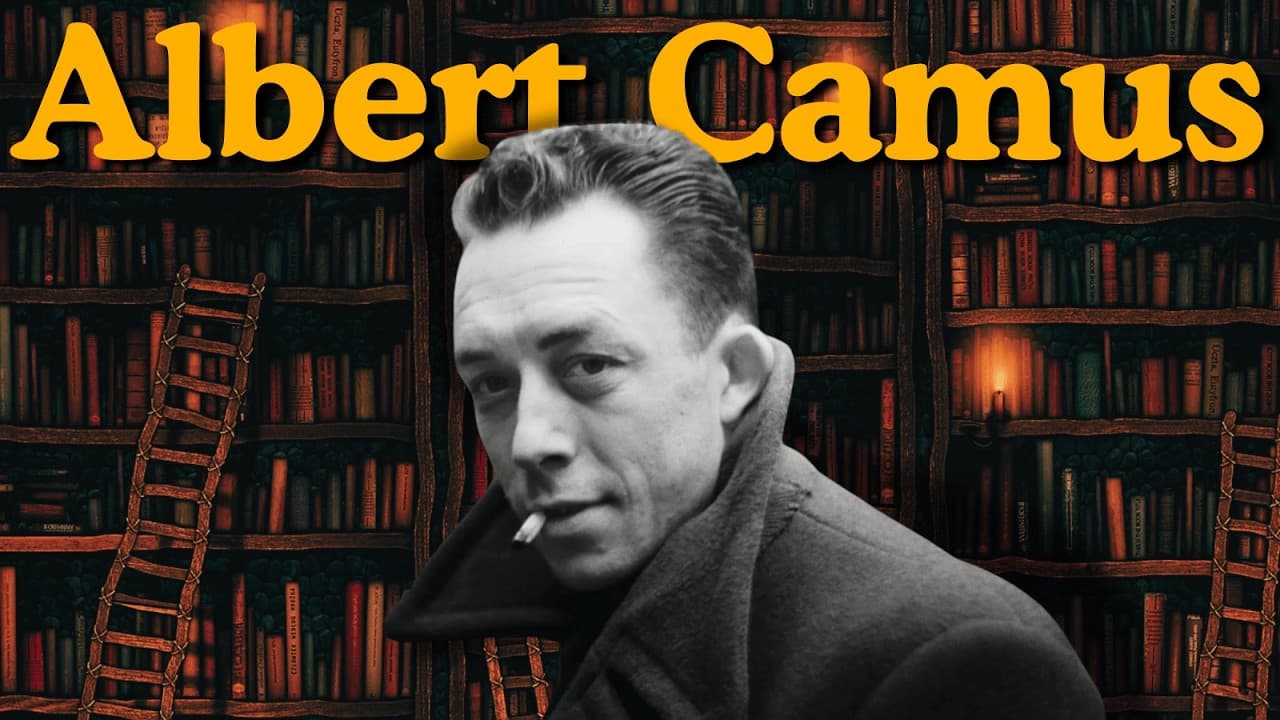
One Must Imagine Sisyphus Happy
What if a man condemned to push a boulder up a mountain for eternity is actually happy? This question opens Albert Camus's philosophy of the Absurd, the confrontation between our need for meaning and the universe's profound silence. Over four hours, we follow Camus from sun-drenched Algeria through wartime France, through The Stranger and The Plague, through his philosophical essays and his break with Sartre. We distinguish absurdism from both nihilism and existentialism, and discover why accepting meaninglessness might liberate us to live more fully than we ever imagined.
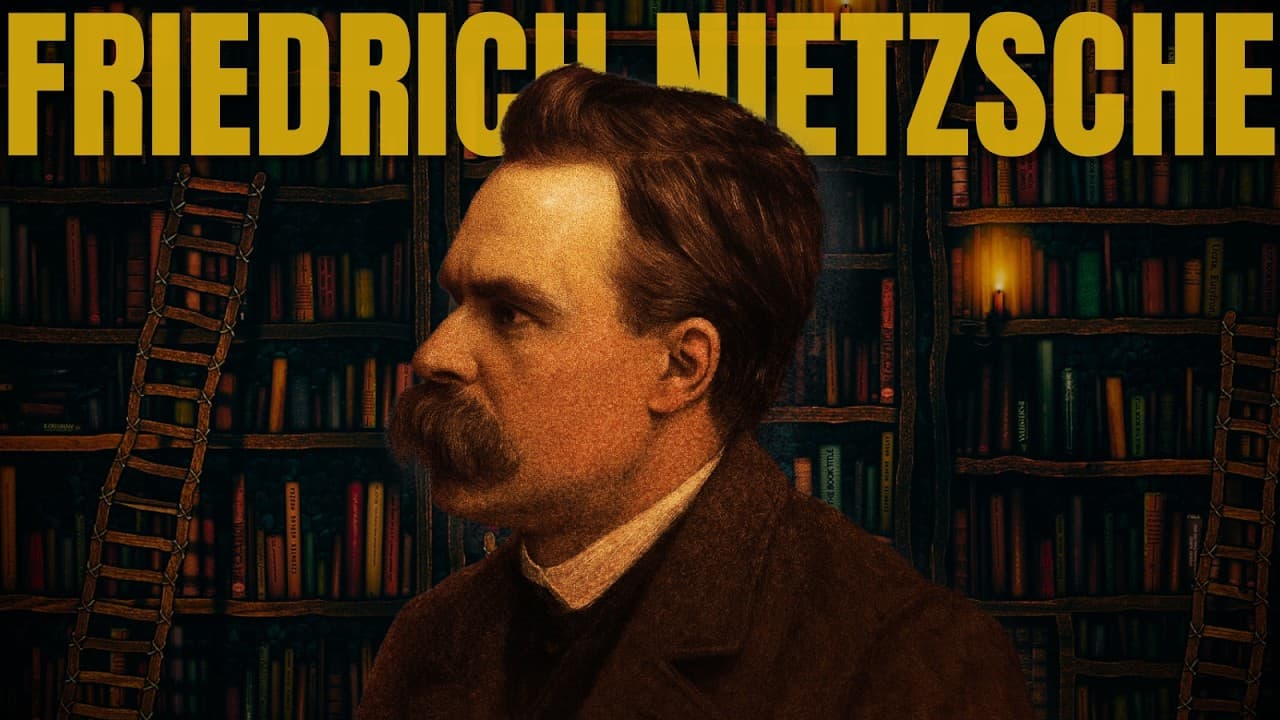
Nietzsche: God is Dead and We Have Killed Him
Friedrich Nietzsche diagnosed the death of God not as triumph but as catastrophe, recognizing that the foundation Western civilization had rested on for two thousand years had collapsed. This three-hour exploration traces his journey from pastor's son in Rocken to solitary philosopher, through his masterworks including The Birth of Tragedy, Thus Spoke Zarathustra, Beyond Good and Evil, and On the Genealogy of Morals. It examines his core concepts in depth: the death of God, will to power, eternal recurrence, the Ubermensch, amor fati, and the distinction between master and slave morality. The episode follows his friendship and break with Wagner, his decade of solitary wandering, his collapse in Turin, and the posthumous distortion of his work by his sister Elisabeth and the Nazi appropriation that followed. His influence on Freud, Heidegger, existentialism, Foucault, and Deleuze confirms that the questions Nietzsche raised about nihilism, values, and human flourishing remain urgently alive today.
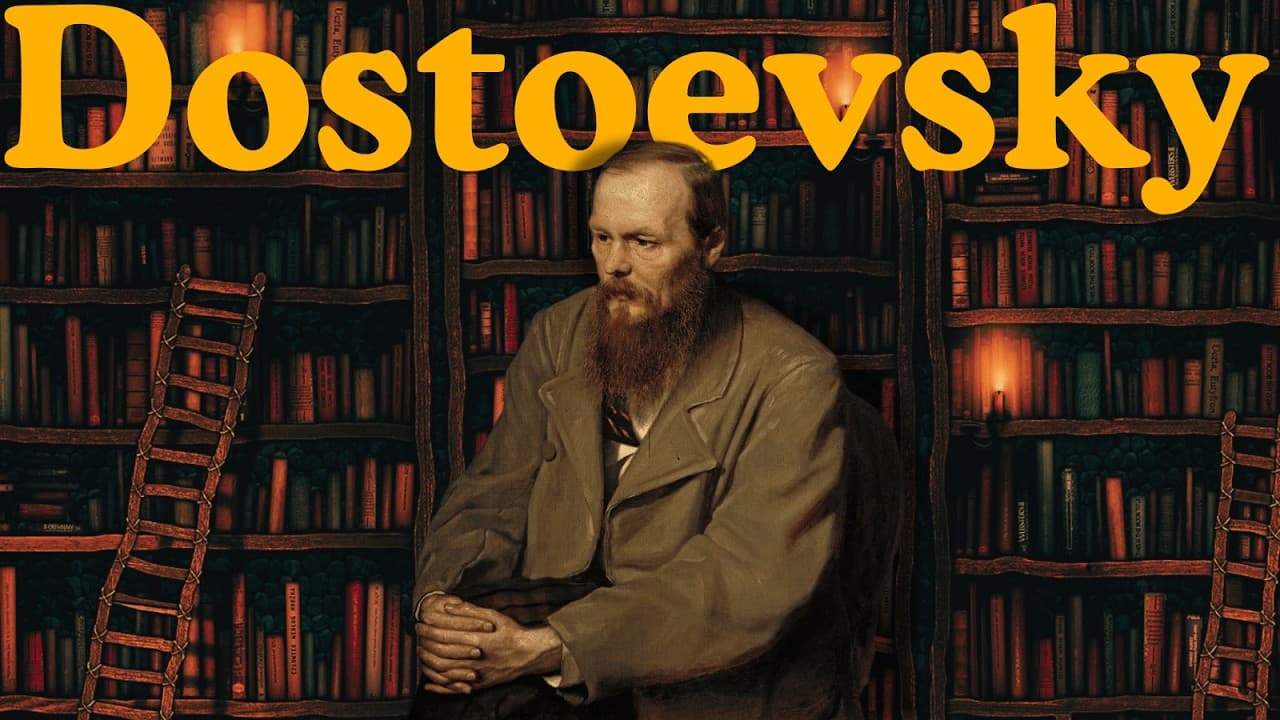
Beauty Will Save The World
This three-hour exploration follows the mind of Fyodor Dostoevsky, the Russian novelist who understood human nature with extraordinary depth. Beginning with his brutal years in Siberian prison, the episode moves through his masterpieces including Crime and Punishment, The Brothers Karamazov, and Notes from Underground. We examine his penetrating ideas about freedom, guilt, redemption, and the divided self, tracing why his insights into the darkest corners of human consciousness remain as vital today as when he first set them down.