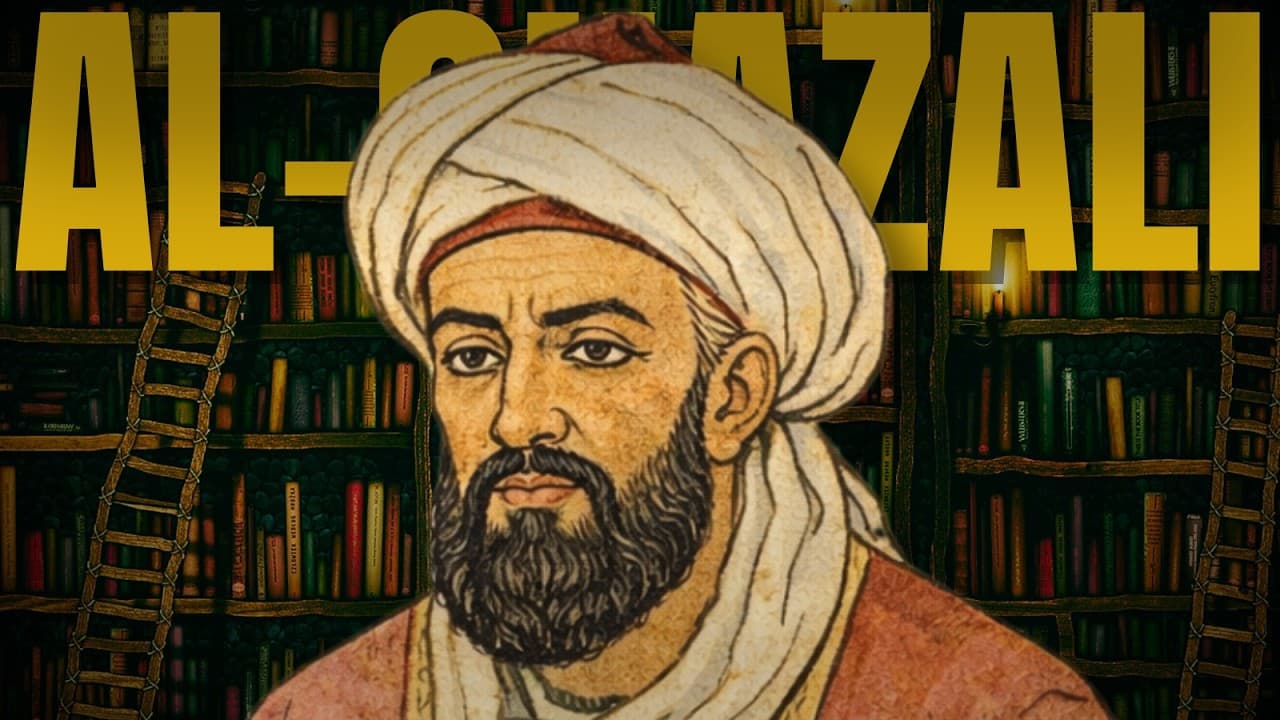
What Happens When a Genius Doubts Everything?
Al-Ghazali's Search for Certainty
Chapters
- 00:00:00The Scholar Who Could Not Speak
- 00:10:51The World of Medieval Islam
- 00:22:18From Orphan to the Most Famous Scholar in Baghdad
- 00:34:26The Incoherence of the Philosophers
- 00:52:17The Crisis: When Certainty Collapsed
- 01:05:57The Departure: Walking Away from Everything
- 01:16:47The Wandering Years: Damascus, Jerusalem, Mecca
- 01:28:10The Revival of the Religious Sciences
- 01:44:21The Diseases of the Heart
- 01:56:35The Path to Certainty: Beyond Reason to Experience
- 02:07:45The Return and the Final Years
- 02:16:08Legacy: From Baghdad to the Modern World
- 02:26:59The Heart That Sought and Found
Full Transcript
Chapter 01: The Scholar Who Could Not Speak
In the year 1095, he held the most prestigious teaching position in the Islamic world. Thousands attended his lectures in Baghdad, the intellectual capital of a civilization that stretched from Spain to Central Asia. He had written books that scholars debated across an empire. Rulers sought his counsel. Religious authorities deferred to his judgments. He was forty years old, at the absolute height of his powers, and the words would not come.
When Al-Ghazali stood before his students, his tongue failed him. The lectures he had delivered with such ease, the arguments that had flowed from him like water from a spring, simply stopped. When he tried to eat, his stomach refused the food. For six months he struggled, forcing himself to teach, pushing through the lectures, but his voice grew weaker and his body grew thinner. The doctors examined him and found nothing physically wrong. The sickness was not in his body. It was in his soul.
He had built his life on knowledge. From his earliest years as an orphan in the Persian city of Tus, he had devoted himself to learning. He had studied under the greatest teachers of his age. He had mastered Islamic law in all its complexity, Islamic theology in all its subtlety, and the philosophical tradition that stretched back through Arabic translations to ancient Greece. He could argue any position and defeat any opponent. His intellect was legendary. His reputation was unmatched.
And yet something was wrong. Not with his arguments, which remained as rigorous as ever. Not with his knowledge, which was genuinely vast. Something was wrong with the foundation. He had begun to suspect that the certainty on which his entire intellectual life was built was not certainty at all. That the things he claimed to know, he did not actually know. That the arguments he used to convince others had never fully convinced himself. That the whole edifice of his learning was constructed on sand.
This was not an abstract philosophical concern. It was a crisis of the soul, a collapse so thorough that it destroyed his ability to function. The man who had lectured with supreme confidence before the largest audiences in the Islamic world could no longer speak. The scholar whose name was known from Andalusia to Samarkand could no longer eat. The most famous intellectual of his age was falling apart, and no one around him could understand why.
The crisis had been building for years. Al-Ghazali had always been aware, somewhere beneath the surface of his public brilliance, that his motives were not pure. He taught not only to serve God and guide seekers but also because he loved the applause, the prestige, the feeling of being the most important person in the room. He debated not only to defend truth but because he enjoyed defeating opponents and demonstrating his superiority. His scholarship was tangled with his ego, and the tangle had grown so tight that he could no longer separate the genuine search for truth from the performance of being a great scholar.
This awareness gnawed at him. He tried to redirect his motives, to purify his intentions while continuing his work. But the effort failed. The lectures continued, the books were written, the debates were won, and still the inner corruption persisted. He was living a divided life, outwardly a model of Islamic scholarship, inwardly aware that much of what drove him was vanity.
Then came the doubt. Not doubt about this or that particular belief, but doubt about the very possibility of certain knowledge. He began to question the reliability of the senses. The eye sees a shadow and takes it for a solid object. The stars appear tiny, yet astronomy proves them enormous. If the senses deceive us so easily, how can we trust them? Perhaps everything we think we perceive is distorted, and we lack the faculty to recognize the distortion.
He pushed deeper. Even if the senses are unreliable, surely reason is secure. Mathematical truths, logical principles, the law of non-contradiction: these seem beyond doubt. Ten is greater than three. A thing cannot both exist and not exist at the same time. These are not matters of perception but of pure thought. How could they be wrong?
But then he imagined a challenge. What if there is a faculty above reason, just as reason is above the senses? What if, from the perspective of this higher faculty, the certainties of reason are as illusory as the certainties of the senses appear from the perspective of reason? We cannot rule this out. The senses do not know they are being corrected by reason. Perhaps reason does not know it is being corrected by something higher. And if this is even possible, then the certainties of reason are not absolute. They are conditional, dependent on there being no higher faculty that overturns them.
This was devastating. If even reason could not be trusted absolutely, then nothing could be trusted. Every chain of argument, every logical proof, every intellectual achievement rested on a foundation that might be hollow. The greatest scholar in the Islamic world had thought himself to the edge of an abyss, and when he looked over, he saw nothing solid beneath him.
The crisis lasted six months. During this time, he continued to try to teach, but his body rebelled. The tongue that had shaped the most sophisticated arguments in the Islamic world refused to form words. The stomach that had digested comfortable meals in the finest academic institution of the age rejected food. His physicians were baffled. The symptoms were real, but there was no physical cause they could identify. Today we might call it a psychosomatic breakdown, a case where psychological distress manifests as physical illness. Whatever the terminology, the effect was the same: Al-Ghazali was unable to continue the life he had been living.
In the end, he did the only thing he could. He left. He invented a story about planning a pilgrimage to Mecca, settled his affairs, arranged for his family's care, and walked away from the most prestigious teaching position in the Islamic world. He had held the chair at the Nizamiyyah in Baghdad, the most famous institution of learning in medieval Islam. He gave it up. Not for another position, not for a better opportunity, but for nothing. He walked out of Baghdad and into the desert, a broken man seeking something he could not name.
He was forty years old. He would spend the next eleven years wandering: through Damascus, where he lived as an anonymous seeker in the great mosque. Through Jerusalem, where he prayed at the Dome of the Rock. Through Mecca and Medina, where he completed the pilgrimage. Through the cities and deserts of the Islamic world, practicing the spiritual disciplines of the Sufis, the Muslim mystics who sought direct experience of God rather than mere knowledge about God.
What he found during those years changed him, and through him, it changed Islam. When he finally returned to teaching, he was a different man. The arguments were still sharp, the knowledge still vast, but the foundation had shifted. He no longer built on reason alone. He had found something beneath reason, something that held when reason cracked: a direct experience of divine reality that he described as a light that God cast into his breast.
The books he wrote after his return are among the most influential in Islamic history. The Revival of the Religious Sciences is a vast synthesis of Islamic law, theology, ethics, and mysticism that attempted to reunite the outer and inner dimensions of religious life. It has been called the most important Islamic book after the Quran. The Incoherence of the Philosophers is a systematic dismantling of the claims of the philosophical tradition, arguing that the philosophers' pretensions to demonstrative certainty about the nature of God, the world, and the soul were unfounded. The Deliverance from Error is a spiritual autobiography that traces his journey from doubt to certainty, from the prestige of Baghdad to the poverty of the road, from knowledge about God to knowledge of God.
His story matters because it addresses questions that are not confined to eleventh-century Islam. What do we do when the foundations crack? When the things we thought we knew turn out to be uncertain? When success feels hollow and achievement fails to satisfy? When the life we have built seems to be missing something essential, but we cannot say what? These are perennial questions, and Al-Ghazali's response to them, honest, radical, costly, and ultimately transformative, speaks across the centuries to anyone who has felt the ground shift beneath their feet.
Chapter 02: The World of Medieval Islam
To understand Al-Ghazali, we must first understand the world that produced him. The Islamic civilization of the tenth and eleventh centuries was, by almost any measure, the most intellectually vibrant civilization on Earth. While Europe languished in what later historians would call the Dark Ages, the Islamic world was experiencing a golden age of science, philosophy, literature, and theological inquiry that would not be matched in the West for centuries.
The territory was vast. By the time Al-Ghazali was born in 1058, the Islamic world stretched from Spain in the west to the borders of China in the east. It encompassed what is now the Middle East, North Africa, Central Asia, parts of India, and the Iberian Peninsula. Within this enormous territory, Arabic served as the common language of scholarship, much as Latin served in medieval Europe. A scholar educated in Persia could travel to Egypt, Morocco, or Spain and find colleagues who read the same books, debated the same questions, and recognized the same intellectual authorities.
The centers of learning were numerous and impressive. Baghdad, founded in 762 as the capital of the Abbasid caliphate, was the intellectual heart of the Islamic world for centuries. Its House of Wisdom, established in the ninth century, organized the systematic translation of Greek philosophical and scientific texts into Arabic, making the works of Aristotle, Plato, Galen, Euclid, and Ptolemy available to Arabic-speaking scholars for the first time. This translation movement was one of the great intellectual enterprises of human history. Without it, much of Greek philosophy and science might have been lost entirely, as the original texts were often preserved only in the Arabic translations.
Other cities rivaled Baghdad. Cairo, under the Fatimid caliphate, was a center of learning and patronage. Cordoba, in Islamic Spain, housed libraries that dwarfed anything in Christian Europe. Samarkand and Bukhara, in what is now Central Asia, produced scholars and scientists of the first rank. Isfahan, in Persia, combined political power with intellectual sophistication. The network of cities, libraries, schools, and traveling scholars created a civilization of extraordinary breadth and depth.
The intellectual achievements were remarkable. In mathematics, Islamic scholars developed algebra (the word itself is Arabic, from al-jabr), advanced trigonometry, and transmitted the Indian numeral system (including the concept of zero) to the West. In astronomy, they refined Ptolemaic models, built sophisticated observatories, and produced star catalogs of unprecedented accuracy. In medicine, figures like Avicenna (Ibn Sina) wrote encyclopedic works that served as standard medical textbooks in both the Islamic world and Europe for centuries. In optics, Ibn al-Haytham (known in the West as Alhazen) conducted experiments that laid the groundwork for the modern understanding of vision and light.
Philosophy flourished within this environment. The translation of Greek texts had introduced Islamic thinkers to the works of Aristotle and Plato, and a sophisticated philosophical tradition developed in response. Al-Kindi, in the ninth century, was the first major Islamic philosopher, working to reconcile Greek philosophy with Islamic theology. Al-Farabi, in the tenth century, developed a comprehensive philosophical system that drew on both Aristotle and Plato and influenced all subsequent Islamic philosophy. Avicenna, in the early eleventh century, produced the most systematic and influential philosophical work in the Islamic tradition, a vast synthesis that covered metaphysics, natural philosophy, psychology, and logic.
These philosophers, known in Arabic as the falasifa (from the Greek philosophia), occupied a complex position in Islamic intellectual life. On one hand, their mastery of Greek thought gave them enormous intellectual prestige. On the other hand, some of their conclusions seemed to conflict with Islamic orthodoxy. The philosophers argued, following Aristotle, that the world was eternal, not created in time as the Quran seemed to teach. They argued that God's knowledge was of universals only, not of particular events, which seemed to deny God's providence over individual lives. They argued that the resurrection of the body was a metaphor rather than a literal truth. These positions brought them into conflict with the theologians, who defended Islamic orthodoxy using a different intellectual tradition.
The theologians, known as the mutakallimun (practitioners of kalam, or theological discourse), had their own sophisticated methods. The dominant school in Sunni Islam was the Ash'ari school, founded by Abu al-Hasan al-Ash'ari in the tenth century. The Ash'aris defended orthodox positions using rational argumentation, developing detailed philosophical arguments for the creation of the world, the reality of divine attributes, and the possibility of miracles. They were not anti-philosophical in the sense of rejecting reason; rather, they used philosophical methods to defend conclusions that differed from those of the falasifa.
A central doctrine of Ash'ari theology was occasionalism, the view that God is the direct cause of every event in the universe. What appears to be natural causation, fire burning cotton, a stone falling to the ground, is actually God's continuous creative activity. There is no necessary connection between what we call a cause and what we call an effect. God simply creates the burning after the fire touches the cotton, and He could just as easily create something different. The regularities we observe in nature are not laws that bind God but habits that God maintains by choice and could change at any moment.
This doctrine had profound implications. It preserved God's absolute sovereignty and freedom while undermining the philosophers' claims about necessary connections in nature. If there are no necessary connections, then the philosophers cannot claim to have demonstrated truths about how the universe must work. Their conclusions are at best descriptions of how God has chosen to arrange things, not discoveries about the nature of reality itself.
The Islamic world also had a rich tradition of mysticism. The Sufis, from the Arabic word suf (wool, referring to the simple garments worn by early ascetics), sought direct experience of God through spiritual practice. Sufi masters developed elaborate systems of spiritual discipline involving prayer, meditation, asceticism, and the cultivation of particular states of consciousness. They spoke of annihilation of the self in God, of becoming a mirror that reflects divine light, of a journey through stations and states that culminated in union with the divine.
The relationship between Sufism and mainstream religious authority was often tense. Some Sufi masters made claims that seemed to border on heresy. The most famous case was that of Al-Hallaj, a tenth-century mystic who reportedly declared "I am the Truth" (ana al-haqq), a statement that could be interpreted as a claim to divinity. He was executed in 922 in Baghdad. Other Sufis expressed themselves in poetry and language that blurred the distinction between the human and the divine, causing concern among the theologians and legal scholars who guarded orthodoxy.
Yet Sufism also had deep roots in Islamic tradition. The Quran itself speaks of God being closer to man than his jugular vein. The Prophet Muhammad, according to tradition, experienced mystical states including the famous Night Journey and Ascension. Many of the earliest Muslims were known for their intense devotion, their renunciation of worldly goods, and their focus on the inner dimensions of faith. Sufism could claim continuity with this earliest layer of Islamic piety.
This was the world into which Al-Ghazali was born: a world of philosophical sophistication, theological controversy, mystical aspiration, and political complexity. The tensions between the philosophers, the theologians, and the mystics defined the intellectual landscape. Each group claimed to offer the path to truth, and their competing claims created a ferment of ideas that makes this period one of the most fascinating in the history of human thought.
Chapter 03: From Orphan to the Most Famous Scholar in Baghdad
Abu Hamid Muhammad ibn Muhammad al-Ghazali was born in 1058 in Tus, a city in the Khorasan region of northeastern Persia, near the modern city of Mashhad in Iran. His father was a wool spinner of modest means, a pious man who died when Al-Ghazali was still young. Before his death, the father entrusted his two sons to a Sufi friend, asking him to use a small amount of money to educate them. When the money ran out, the friend told the boys to seek their education wherever they could find it, telling them that their father's wishes for their learning were the best legacy he could leave.
This early loss shaped Al-Ghazali in ways that are difficult to overestimate. The orphan in the Islamic world occupied a particular position: vulnerable, dependent on the generosity of others, yet also the object of religious obligation, since the Quran repeatedly commands care for orphans. Al-Ghazali grew up knowing what it meant to be without protection, without resources, without the secure foundation that a family provides. This awareness of vulnerability may have contributed to both his extraordinary drive to achieve and his later willingness to give up everything he had achieved.
His early education followed the traditional pattern. He studied Islamic law, Quran recitation, and Arabic grammar with local teachers. He showed exceptional ability from the beginning. The accounts describe a young man of prodigious memory, quick understanding, and insatiable curiosity. He moved from Tus to the nearby city of Jurjan to continue his studies, and then to Nishapur, the great intellectual center of eastern Persia, where he studied under the most important theologian of the age: Imam al-Haramain al-Juwayni.
Al-Juwayni was the foremost Ash'ari theologian of his generation, a thinker of enormous learning and formidable argumentative skill. Under his guidance, Al-Ghazali mastered Ash'ari theology, Islamic jurisprudence, and the methods of philosophical argument. He also began to engage with the philosophical tradition, reading the works of Avicenna and the other falasifa. His combination of theological training and philosophical knowledge would prove crucial. He would eventually become the most effective critic of the philosophers precisely because he understood their arguments from the inside, having studied them with a thoroughness that few theologians could match.
Al-Juwayni recognized Al-Ghazali's exceptional talent. According to later accounts, he described his student as "a deep sea" of knowledge. When Al-Juwayni died in 1085, Al-Ghazali, now twenty-seven years old, was already recognized as one of the most brilliant young scholars in the Islamic world.
His next step brought him into the orbit of political power. Nizam al-Mulk, the vizier (chief minister) of the Seljuk Empire, had established a network of colleges across the empire called Nizamiyyah colleges, designed to train scholars in Sunni orthodoxy and combat the influence of Ismaili Shia propaganda. The most prestigious of these was the Nizamiyyah college in Baghdad, the intellectual capital of the Islamic world. In 1091, Nizam al-Mulk appointed Al-Ghazali to the chair of this institution.
He was thirty-three years old. The appointment was extraordinary. The Nizamiyyah in Baghdad was the most important academic institution in the Islamic world, and its chair was the most prestigious teaching position available. Al-Ghazali's lectures attracted hundreds, sometimes thousands, of students. His reputation spread rapidly across the Islamic world. He debated with rivals and won. He wrote books that demonstrated his mastery of multiple fields. He was consulted by rulers and recognized by religious authorities. By any measure, he had achieved the highest success his world could offer.
The years in Baghdad were productive. He wrote extensively, including early versions of works on Islamic law and theology. He engaged deeply with philosophy, studying the works of the falasifa with meticulous care. This study would result in two of his most important books. The first, The Intentions of the Philosophers, was a summary of philosophical positions written with such clarity and fairness that it was later mistaken in medieval Europe for a work by a philosopher rather than a critic of philosophy. The second, The Incoherence of the Philosophers, was the devastating critique that would shake the philosophical tradition to its foundations.
But beneath the public success, the private crisis was building. Al-Ghazali was aware that his motives were mixed. The applause of the students, the prestige of the position, the satisfaction of intellectual victory: these were entangled with his genuine desire to serve God and seek truth. He knew, with the penetrating self-awareness that would later characterize his spiritual autobiography, that vanity had corrupted his work. He taught partly for God and partly for glory, and he could not separate the two.
The doubt that would eventually overwhelm him was also growing. His deep study of philosophy had shown him how much the philosophers claimed to know. His study of theology had shown him how much the theologians claimed to know. His study of Islamic law had shown him how much the legal scholars claimed to know. But did any of them actually know what they claimed to know? Were their certainties genuine, or were they merely habits of thought, assumptions so deeply ingrained that they felt like knowledge without actually being knowledge?
These questions were not idle academic speculation. For Al-Ghazali, the question of whether we can truly know anything was a question about the meaning of his entire life. If the knowledge he had spent decades acquiring was not really knowledge, then what had he been doing? If the certainty he projected was not really certainty, then he was a fraud, however unintentionally. The stakes could not have been higher.
Chapter 04: The Incoherence of the Philosophers
Before his crisis, while he was still functioning as the great professor of Baghdad, Al-Ghazali wrote the work that would make him most famous in the history of philosophy: The Incoherence of the Philosophers (Tahafut al-Falasifa). This book is one of the most important critiques of philosophy ever written, and its arguments continue to be debated nearly a thousand years later.
The target was the philosophical tradition represented primarily by Avicenna, the greatest of the Islamic Aristotelians. Al-Ghazali identified twenty positions on which the philosophers claimed demonstrative certainty, and he set out to show that their arguments failed. On three of these positions, he went further: he charged the philosophers not merely with intellectual error but with outright unbelief (kufr), a serious accusation in medieval Islam.
The three positions he declared heretical were: the eternity of the world (the philosophers claimed the world had no beginning, contradicting the Islamic doctrine of creation), the denial that God knows particular things (the philosophers claimed God knows only universals, which seemed to deny God's providential care for individual creatures and events), and the denial of bodily resurrection (the philosophers interpreted the afterlife as purely spiritual, denying the physical resurrection that the Quran describes).
On these three points, Al-Ghazali argued that the philosophers had not merely failed to prove their positions but had actively contradicted clear teachings of Islam. This was significant because it drew a line between legitimate philosophical inquiry and positions that placed one outside the boundaries of the faith. It was not a blanket condemnation of philosophy. Al-Ghazali accepted the validity of logic, mathematics, and much of natural science. His critique was targeted and specific: the philosophers were wrong about certain metaphysical and theological claims, and their pretension to demonstrative certainty about these claims was unfounded.
The method of the book is remarkable. Al-Ghazali does not simply assert that the philosophers are wrong and appeal to scriptural authority. He engages with their arguments on their own terms, using the tools of logic and philosophy to show that the philosophers' conclusions do not follow from their premises. He beats the philosophers at their own game, demonstrating a mastery of philosophical argumentation that impressed even his opponents.
The argument about causality is perhaps the most famous and philosophically significant. The philosophers, following Aristotle, held that there are necessary connections between causes and effects. Fire necessarily burns cotton. A falling stone necessarily moves downward. These connections are part of the nature of things and can be known through reason.
Al-Ghazali denied this. He argued that what we observe is not a necessary connection between cause and effect but merely a regular conjunction. We see fire touch cotton and we see the cotton burn. But we do not see a necessary connection between the two events. The burning follows the contact, but perhaps it does not follow because of the contact. Perhaps God creates the burning directly, and He simply chooses to create it whenever fire touches cotton. He could just as easily choose not to create it. There is no logical contradiction in imagining fire touching cotton without the cotton burning.
This argument is striking because it anticipates, by six centuries, the famous analysis of causality by the Scottish philosopher David Hume. Hume would argue in the eighteenth century that we never perceive necessary connections between events; we perceive only constant conjunction, one event regularly following another. Our belief in causation is a habit of the mind, not a perception of reality. Al-Ghazali had made essentially the same point in the eleventh century, though his conclusions were different. Where Hume drew skeptical conclusions about the limits of human knowledge, Al-Ghazali drew theological conclusions about the absolute freedom of God.
If there are no necessary connections in nature, then miracles are possible. If God is the direct cause of every event, and the regularities we observe are merely God's habits rather than iron laws of nature, then God can change those habits whenever He wishes. A prophet walking on water or splitting the moon is no more logically problematic than water flowing downhill or the moon following its orbit. Both are acts of God; one is simply less common than the other.
The Incoherence was not, despite what is sometimes claimed, an attack on reason itself. Al-Ghazali valued logic and used it throughout his career. What he attacked was the pretension to demonstrative certainty on questions where such certainty was impossible. The philosophers claimed to have proven that the world was eternal, that God knows only universals, that bodily resurrection is impossible. Al-Ghazali showed that their proofs were faulty, that alternative positions were logically possible, and that the certainty they claimed was unjustified.
The book had enormous influence. It was the most powerful critique of the philosophical tradition that the Islamic world had seen, and it reshaped the intellectual landscape for centuries. Its arguments were taken up, debated, and developed by subsequent thinkers in all three Abrahamic traditions. The great Andalusian philosopher Averroes (Ibn Rushd) wrote a point-by-point response, The Incoherence of the Incoherence, defending the philosophical tradition against Al-Ghazali's attacks. The debate between them became one of the most important in the history of philosophy.
But the Incoherence was also, in a sense, a preparation for what came next. By demolishing the philosophers' claims to certainty, Al-Ghazali cleared the ground for a different kind of knowing. If reason cannot give us absolute certainty about the highest truths, then perhaps something else can. The Incoherence is a work of destruction; the works that followed would be works of reconstruction, offering a positive vision of how truth can be known when philosophical proof falls short.
Chapter 05: The Crisis: When Certainty Collapsed
The intellectual critique of philosophy was one thing. The personal crisis was another. The Incoherence of the Philosophers was an academic work, brilliant and devastating, but written from within the safety of the scholarly establishment. The crisis that followed was something far more radical: it was the collapse of Al-Ghazali's ability to believe in the foundations of knowledge itself.
He describes the experience in his spiritual autobiography, the Deliverance from Error (Al-Munqidh min al-Dalal), written years later. The account is one of the most remarkable documents in the history of philosophy, comparable in its honesty and psychological depth to Augustine's Confessions or Descartes' Meditations.
The crisis began with what Al-Ghazali called a period of doubt that lasted about two months. But this was not ordinary doubt, the kind that can be resolved by further study or additional evidence. This was radical doubt, doubt about the very faculties we use to acquire knowledge. Can we trust the senses? Can we trust reason? Is there any foundation on which certain knowledge can be built?
He began with the senses. We rely on our senses to tell us about the world, but the senses are unreliable. The eye sees a shadow and takes it for something solid. A stick partly submerged in water appears bent. The stars appear small, but astronomy proves them enormous. At every point, the senses deliver information that turns out to be false when checked by reason. So the senses cannot be the foundation of certainty.
But then what about reason? Surely mathematical and logical truths are beyond doubt. Ten is greater than three. A thing cannot both exist and not exist at the same time. These are not matters of sensory perception; they are truths of reason itself. Can we doubt them?
Al-Ghazali imagined a devastating challenge. The senses are confident in their deliverances. When the eye sees the shadow, it does not announce that it might be wrong. The senses present their information with full conviction. Yet reason overrules them. What if there is a faculty above reason that can overrule reason just as reason overrules the senses? What if the certainties of reason are as illusory, from the perspective of this higher faculty, as the certainties of the senses are from the perspective of reason?
This is not a hypothetical fantasy. The Sufis claim exactly such a higher faculty: a state of consciousness beyond ordinary reason in which truths are perceived that reason cannot grasp. If such a state exists, then the certainties of reason might be provisional rather than absolute. And if they are provisional, then Al-Ghazali has no secure foundation on which to stand.
The doubt was not merely intellectual. It affected him physically. His body rebelled against the life he was living, a life built on certainties that he could no longer trust. The tongue that had formed the most elegant arguments refused to speak. The stomach that had received the comfortable meals of academic privilege refused food. He was, quite literally, falling apart.
He tried to cure the doubt by argument. But this was futile. You cannot use reason to prove that reason is reliable; that would be circular. You cannot stand on the foundation to prove that the foundation is solid. The doubt about reason's reliability cannot be resolved by reasoning, because the very tool you would use to resolve it is the tool you are doubting.
For two months he lived in this state, which he described as a sickness. Not a metaphorical sickness; a real affliction that prevented him from functioning. He could not teach, could not write, could not eat properly. The most brilliant man in the Islamic world was paralyzed by the recognition that he did not know whether he knew anything.
The resolution came not through argument but through what he described as a light that God cast into his breast. This was not a conclusion reached through reasoning; it was an experience, a direct illumination that restored his confidence in the basic principles of knowledge without providing a logical proof that those principles were reliable. He did not solve the philosophical problem of skepticism. He received something that made the problem dissolve, not by answering it but by making the answer unnecessary.
This is one of the most provocative aspects of Al-Ghazali's account. He does not claim to have refuted skepticism. He does not provide an argument that proves reason is reliable. He claims to have been given a direct experience that restored his capacity for trust in knowledge, and he compares this experience to the way one recognizes the truthfulness of a person not through argument but through direct perception. Some truths are not proven; they are seen. And once seen, they do not need proof.
The implications are profound. If the foundations of knowledge are secured not by argument but by direct experience, then the entire project of foundationalist epistemology, the attempt to build knowledge on a base of indubitable truths established through reason alone, is misconceived. What we need is not better arguments but a kind of inner transformation that allows us to perceive truths directly. And this is precisely what the Sufi tradition claimed to offer.
After the light came, Al-Ghazali could function again. But he could not simply return to his old life. The crisis had shown him that his life as a professor was corrupted by mixed motives and built on a foundation he had discovered to be unstable. He needed to rebuild, and the rebuilding required not more scholarship but a different kind of engagement with truth.
Chapter 06: The Departure: Walking Away from Everything
In 1095, after six months of struggle, Al-Ghazali made his decision. He would leave Baghdad. He would give up the most prestigious teaching position in the Islamic world. He would walk away from his reputation, his income, his students, his influence, everything that defined him as the greatest scholar of his age.
The decision was agonizing. He describes the inner battle in the Deliverance from Error. For months he went back and forth. One day he would resolve to leave; the next day he would find reasons to stay. The world pulled at him with its familiar comforts. The ego, with its love of prestige and its fear of obscurity, mounted argument after argument for remaining. He was needed, he was doing good, he was serving the faith. Surely he could reform his motives without abandoning his position.
But these arguments felt hollow. The deeper voice, the voice that had been silenced by years of public performance, told him that staying was impossible. His teaching had become corrupted at its root. The motives that drove him, fame, applause, the pleasure of intellectual victory, were not the motives that should drive a scholar of religion. As long as he remained in his position, surrounded by the temptations of prestige, the corruption would continue. He needed to cut himself free entirely.
He describes the moment of decision in terms that suggest divine intervention. God made it easy for him by blocking his tongue, making it physically impossible to continue teaching. When the body refused to cooperate with the corrupted life, the decision was effectively made for him. He could not teach; therefore, he had to leave.
But leaving was not simple. He was the chair of the Nizamiyyah in Baghdad, an appointment that carried political as well as academic significance. Simply walking away could have consequences. He invented a cover story, telling people he was planning a pilgrimage to Mecca. He distributed his wealth, keeping only enough for his family's basic needs. He arranged for his brother to take over some of his responsibilities. And then he left.
The departure was a kind of death. The man who walked out of Baghdad was not the man who had arrived there four years earlier. The brilliant professor, the celebrated scholar, the favorite of the powerful, all of these identities were left behind. What remained was a seeker, stripped of pretension, carrying nothing but the need to find what he had lost: genuine certainty, authentic knowledge, a relationship with truth that was not corrupted by ego.
He went first to Damascus, where he lived for about two years. He spent much of his time in the great Umayyad Mosque, practicing Sufi spiritual disciplines. He prayed, fasted, performed the remembrance of God (dhikr), examined his conscience, and worked to purify his heart of the diseases that had corrupted his intellectual life. The man who had lectured before thousands now sat alone in a corner of a mosque, anonymous and poor.
The disciplines he practiced were those of the Sufi tradition. They included regular prayer beyond the required five daily prayers, fasting beyond the required fast of Ramadan, extended periods of solitary retreat (khalwa), and the systematic examination of the states of the heart. The Sufis had developed detailed maps of the spiritual journey, identifying stages (maqamat) and states (ahwal) through which the seeker passed on the way to direct experience of God. Al-Ghazali now followed this map with the same thoroughness he had brought to his academic work.
The goal was not merely moral improvement, though that was part of it. The goal was a transformation of consciousness, a purification of the inner faculties that would allow them to perceive spiritual realities directly. The Sufis taught that the heart, understood not as a physical organ but as the spiritual center of the person, was capable of a kind of perception that went beyond the senses and beyond reason. But this perception was blocked by the diseases of the heart: pride, envy, anger, greed, attachment to the world, love of praise, fear of blame. These diseases acted like clouds obscuring the sun, or like rust on a mirror, preventing the heart from reflecting the light of truth.
The work of purification was therefore epistemological as well as moral. By removing the diseases of the heart, the seeker was not merely becoming a better person; he was clearing the channels through which higher knowledge could flow. This is why Al-Ghazali's crisis of knowledge could not be resolved by argument alone. The problem was not that he lacked the right argument but that his heart was not in the right condition to perceive truth directly. The cure was not philosophical but spiritual: a transformation of the whole person that would restore the heart's capacity for direct knowledge.
Chapter 07: The Wandering Years: Damascus, Jerusalem, Mecca
For eleven years, Al-Ghazali wandered. The great professor became a poor seeker, moving from city to city, mosque to mosque, practicing the disciplines he had once merely studied. The journey took him through some of the most important spiritual centers of the Islamic world, and at each stop he deepened his practice and his understanding.
In Damascus, he lived in the great Umayyad Mosque, one of the most beautiful and historically significant mosques in Islam. He spent his time in prayer, meditation, and the examination of his heart. He deliberately sought anonymity, avoiding any situation that might reignite the desire for recognition that had corrupted his earlier career. He was working on himself, and the work required the absence of an audience.
From Damascus, he traveled to Jerusalem, where he visited the Al-Aqsa Mosque and the Dome of the Rock, sites of enormous spiritual significance in Islam. Jerusalem was the city to which the Prophet Muhammad had been transported in his Night Journey, and from which he had ascended through the heavens. For Al-Ghazali, the visit was an encounter with the history of prophecy, a reminder of the direct divine encounters that the prophets had experienced and that he himself was seeking.
He then completed the pilgrimage to Mecca and Medina, fulfilling one of the fundamental obligations of Islam. The pilgrimage (hajj) is not merely a journey to a geographical location; it is a ritual enactment of submission to God, a stripping away of all distinctions of wealth and status as pilgrims don the simple white garments and perform the prescribed rites. For Al-Ghazali, who was engaged in stripping away his own pretensions, the symbolism must have been powerful.
He visited Hebron, where according to tradition Abraham is buried. Abraham was the model of surrender to God, the prophet who was willing to sacrifice his son at God's command. The theme of radical surrender, of giving up what you love most because God requires it, was central to Al-Ghazali's own journey. He had given up his career, his reputation, his comfort. He was discovering what remained when everything was stripped away.
Throughout these years, he continued to study and practice the Sufi path. The practices were demanding. Extended periods of solitary retreat, sometimes lasting forty days, involved isolation, fasting, prayer, and the constant repetition of divine names and formulas. The purpose was not mere endurance but transformation: to weaken the grip of the ego and the world on the heart, and to strengthen the heart's capacity for awareness of God.
He also continued to write. The most important product of these years was the beginning of his masterwork, The Revival of the Religious Sciences (Ihya Ulum al-Din). This enormous book, which would eventually fill four volumes, was nothing less than an attempt to reunite the outer and inner dimensions of Islamic life. It covered everything from the rules of prayer and fasting to the ethics of marriage and commerce, from the diseases of the heart to the stages of the spiritual journey, from the fear of death to the hope of paradise.
The Revival was unique in its combination of legal, theological, ethical, and mystical material. Previous scholars had written about these topics separately. The legal scholars wrote about the rules of worship and social interaction. The theologians wrote about the attributes of God and the defense of orthodoxy. The ethicists wrote about virtues and vices. The Sufis wrote about spiritual states and the journey to God. Al-Ghazali wove all of these strands together into a single fabric, showing how they related to one another and why all were necessary for a complete religious life.
The wandering years were also years of personal transformation that he described but never detailed fully. He mentions that he experienced spiritual states and insights that he could not adequately convey in words. He hints at direct experiences of God that confirmed the truth of what the Sufis had taught him. He says that the Sufi path is not a matter of learning and argument but of experience and transformation, and that those who have not experienced it cannot truly understand it.
This reticence is characteristic of mystical traditions generally. The deepest experiences are said to be ineffable, beyond the capacity of language to express. Words can point toward the experience but cannot capture it. Those who have had the experience recognize the pointing; those who have not are left with descriptions that inevitably fall short.
What is clear is that the Al-Ghazali who emerged from these years was different from the one who entered them. He had found what he was looking for, or perhaps more accurately, he had been found by what he was looking for. The certainty that had collapsed in Baghdad had been restored, but on a different foundation. It was no longer the certainty of philosophical argument but the certainty of direct experience, of what the Sufis called tasting (dhawq) and the theologians might call illumination.
Chapter 08: The Revival of the Religious Sciences
The Revival of the Religious Sciences (Ihya Ulum al-Din) is Al-Ghazali's masterwork, the book that would be called the most important Islamic book after the Quran. It is an enormous work, filling four volumes, covering virtually every aspect of religious life, from the outward practices of worship to the inner states of the heart. Its scope is breathtaking, its learning is vast, and its vision of what the religious life should be remains influential to this day.
The book is divided into four quarters. The first quarter covers acts of worship: prayer, fasting, almsgiving, pilgrimage, Quran recitation. The second quarter covers the customs of daily life: eating, marriage, earning a livelihood, friendship, travel. The third quarter covers the destructive vices: gluttony, lust, anger, envy, avarice, worldliness, ostentation, pride, self-deception. The fourth quarter covers the saving virtues: repentance, patience, gratitude, fear, hope, poverty, renunciation, trust in God, love, longing, intimacy with God, sincerity, self-examination, and meditation on death and what comes after.
This structure reveals Al-Ghazali's comprehensive vision. The religious life is not merely a matter of performing the required acts of worship correctly, though that is important. It is not merely a matter of following the ethical rules that govern daily life, though that too is important. It is fundamentally a matter of inner transformation: identifying and treating the diseases that corrupt the heart, and cultivating the virtues that heal it. The outer practices are means to this inner end. Prayer without presence of heart is empty form. Fasting without the discipline of desire is mere hunger. Pilgrimage without spiritual intention is tourism.
The treatment of worship is characteristic. Al-Ghazali provides the legal rulings governing each act, drawn from the Shafi'i school of law to which he belonged. He tells you how to perform the prayer correctly: the proper postures, the required words, the conditions that must be met. But then he goes beyond the legal minimum to discuss the inner dimensions. What should you be feeling during prayer? What should your heart be doing while your body goes through the motions? How do you maintain awareness of God when the words have become so familiar that they can be recited without thought?
His answer is that the outer form must be animated by inner presence. The worshipper should understand what the words mean, feel the weight of standing before God, bring attention and humility to every movement. Prayer performed in this way is transformative. Prayer performed mechanically, with the mind wandering to business or social matters, is barely prayer at all. It meets the legal requirement but misses the spiritual purpose.
The same principle applies throughout. Every external act has an inner dimension. Every rule has a spiritual purpose. Every practice of the body is meant to affect the heart. Al-Ghazali was not interested in mere compliance. He was interested in transformation, and the entire Revival is designed to show how the practices of Islam, properly understood and properly performed, serve as the means to that transformation.
The third quarter, on the destructive vices, is perhaps the most psychologically acute section of the book. Al-Ghazali's analysis of the diseases of the heart draws on both Islamic tradition and Greek ethical thought (particularly Aristotle, though Al-Ghazali rarely credits him explicitly). The result is a detailed map of the ways in which the human heart can go wrong, the mechanisms by which vice operates, and the methods by which it can be treated.
Consider his treatment of pride (kibr). Pride, Al-Ghazali argues, is one of the most dangerous and deeply rooted of the heart's diseases. It is the disease of believing oneself to be superior to others, and it takes many forms. There is pride in knowledge: the scholar who looks down on the ignorant. There is pride in worship: the devout person who despises the negligent. There is pride in lineage, in wealth, in beauty, in strength. Each form of pride involves the same essential error: the confusion of one's gifts with one's own achievement, and the use of those gifts as a basis for contempt.
The treatment of pride is humility, but Al-Ghazali is realistic about how difficult this is. You cannot simply decide to be humble. Humility must be cultivated through practices that weaken the ego: serving others, performing tasks that the proud person considers beneath him, reflecting on one's own mortality and insignificance, remembering that all one's gifts come from God and could be taken away at any moment. The treatment is a long-term process, not a quick fix.
His treatment of envy (hasad) is equally penetrating. Envy is the pain we feel at another's good fortune. It is not merely wishing we had what they have; it is wishing they did not have it. It is a desire for the other's loss, and it corrupts the heart because it makes another person's happiness into our unhappiness. Al-Ghazali traces the roots of envy to competition, to the fear of being surpassed, to the equation of one's own worth with one's relative standing. The cure involves recognizing that God distributes gifts as He sees fit, that another person's blessing does not diminish our own, and that envy harms only the one who harbors it.
The fourth quarter, on the saving virtues, builds toward a vision of the complete spiritual life. The journey begins with repentance, the recognition that one has been going in the wrong direction and the decision to turn around. It proceeds through patience, gratitude, and the fear and hope that motivate the seeker. It passes through poverty and renunciation, the letting go of worldly attachments that obstruct the spiritual path. It arrives at trust in God (tawakkul), the state in which one relies entirely on God rather than on one's own resources and planning. And it culminates in love of God (mahabba), the highest state, in which the seeker's will is aligned with God's will and the distinction between lover and beloved begins to dissolve.
The Revival is not a mystical manual in the usual sense. It does not describe specific meditation techniques or claim to provide a guaranteed method for attaining mystical states. What it does is integrate the mystical dimension into every aspect of religious life. The message is that mysticism is not a specialty for a few advanced practitioners but the inner meaning of everything that every Muslim does. Prayer is mysticism. Fasting is mysticism. Even the mundane activities of daily life, eating, sleeping, working, marrying, can become occasions for spiritual awareness if approached with the right inner attitude.
This was revolutionary. Previous scholars had tended to treat the outer and inner dimensions of religion as separate fields, each with its own specialists. The legal scholars handled the outer requirements; the Sufis handled the inner cultivation. Al-Ghazali insisted that these could not be separated without losing the essential point. A religion that was only outer practice was dead formalism. A religion that was only inner experience was dangerous antinomianism, the rejection of the law's authority. What was needed was a synthesis, and the Revival provided it.
Chapter 09: The Diseases of the Heart
Al-Ghazali's psychology of the heart deserves special attention because it remains one of the most sophisticated analyses of human inner life in any tradition. He approached the heart not as a modern psychologist would, through empirical observation and statistical analysis, but as a spiritual physician, diagnosing diseases and prescribing treatments based on a detailed understanding of how the inner world works.
The heart, in Al-Ghazali's understanding, is not the physical organ that pumps blood. It is the spiritual center of the person, the seat of consciousness, will, and knowledge. It is what we truly are beneath the surface of our social performances, our habitual patterns, our automatic reactions. It is capable of perceiving truths that the senses and the intellect cannot grasp, but only when it is healthy. When it is diseased, its perception is distorted, like looking at the world through dirty glass.
The diseases of the heart are numerous, but they share a common structure. Each disease involves an attachment to something other than God, an attachment that distorts perception, corrupts motivation, and prevents the heart from fulfilling its true function. Gluttony is attachment to food. Lust is attachment to sexual pleasure. Anger is attachment to control. Envy is attachment to comparison. Avarice is attachment to wealth. Pride is attachment to self-image. Worldliness is attachment to the world as an end in itself rather than a means to a higher end.
The root of all these diseases, in Al-Ghazali's analysis, is the nafs, the ego or lower self. The nafs is the aspect of our being that is oriented toward the world, that seeks pleasure and avoids pain, that wants to be special and fears being ordinary, that clings to life and dreads death. It is not evil in itself; it is the part of us that enables survival and functioning in the material world. But when it dominates, when it becomes the governing principle of our lives, it corrupts everything it touches.
The nafs operates through deception. It presents worldly desires as reasonable and virtuous. The glutton tells himself he needs the extra food for his health. The miser tells himself he is being prudent. The proud person tells himself he is merely recognizing his genuine merits. The angry person tells himself he is standing up for justice. At every turn, the nafs provides rationalizations that make its demands seem legitimate. This is why self-knowledge is so difficult: the very faculty we would use to examine ourselves is compromised by the thing we are trying to examine.
Al-Ghazali's treatment prescriptions are practical and specific. For each disease, he identifies the root cause, describes its manifestations, explains why it is harmful, and prescribes a course of treatment. The treatments typically involve a combination of cognitive and behavioral elements: reflecting on the nature and consequences of the disease (the cognitive element) and deliberately engaging in actions that counter the disease (the behavioral element).
For pride, the treatment includes reflecting on one's origin (a drop of fluid, utterly dependent on others for survival in infancy), one's destination (the grave, where the body will decay), and the source of one's gifts (God, not one's own effort). It also includes deliberate acts of humility: performing menial tasks, serving those one considers inferior, accepting correction without defensiveness.
For anger, the treatment includes the prophetic advice to change one's physical state (sit down if standing, lie down if sitting, perform ritual ablution), to seek refuge in God from Satan, and to reflect on the consequences of acting in anger. It also includes the cultivation of patience (sabr) and forbearance (hilm), qualities that weaken anger's grip over time.
For love of the world, the treatment is the most radical: it is the cultivation of genuine love of God, which Al-Ghazali argues will naturally displace attachment to worldly things. Just as falling in love with a person can make previous attachments seem trivial, falling in love with God can make the attractions of the world pale by comparison. This is not renunciation through willpower but transformation through desire: the heart turns from the world not because it is forced to but because it has found something better.
Al-Ghazali's psychology anticipates several features of modern psychological understanding. His recognition that self-deception is pervasive and that the ego constructs rationalizations to protect its interests resembles psychoanalytic insights about defense mechanisms. His emphasis on the gap between what we think motivates us and what actually motivates us resonates with research on motivated reasoning and cognitive bias. His insistence that change requires not merely insight but sustained practice parallels cognitive-behavioral approaches to therapy.
But his framework differs from modern psychology in important ways. He does not view the self as autonomous; the heart is fundamentally oriented toward God, and its diseases are departures from its true nature. He does not view health as mere psychological well-being; a healthy heart is one that perceives spiritual reality accurately and responds to it appropriately. And he does not view treatment as an end in itself; the purification of the heart is preparation for knowledge of God, which is the ultimate purpose of human existence.
Chapter 10: The Path to Certainty: Beyond Reason to Experience
At the heart of Al-Ghazali's mature thought lies a distinction that has profound implications for how we understand knowledge. It is the distinction between propositional knowledge, knowing that something is the case, and experiential knowledge, knowing what something is like from the inside. This distinction, simple to state, transforms everything.
Consider an analogy Al-Ghazali himself might have used. You can learn about honey from a book. You can read about its chemical composition, its color, its consistency, its nutritional properties. You can learn that it is sweet. All of this is propositional knowledge: a set of true statements about honey. But none of this is the same as tasting honey. The person who has tasted honey knows something that the person who has only read about it does not know, even if the reader can recite every fact about honey that exists. The taster has experiential knowledge; the reader has only propositional knowledge.
The application to spiritual knowledge is direct. One can learn about God from theology: His attributes, His actions, His relationship to creation. This propositional knowledge has its value. It protects against errors, provides a framework for understanding, enables communication with others about spiritual matters. But propositional knowledge of God is not the same as direct knowledge of God. The theologian who has mastered all the proofs may never have experienced what the proofs point toward. The simple believer who cannot construct a single theological argument may live in intimate awareness of divine presence.
This distinction helps explain Al-Ghazali's crisis and its resolution. He had possessed propositional knowledge about God and the spiritual life in abundance. He could discuss, define, prove, refute. But he lacked experiential knowledge. His learning was about the truth rather than of the truth. This is why argument could not resolve his doubt. Doubt about the reliability of reason cannot be answered by reasoning, which would be circular. What resolved his doubt was not a better argument but a direct illumination that bypassed argument altogether.
The path to experiential knowledge requires transformation of the knower. This is why the purification of the heart is not merely moral advice but epistemological necessity. The corrupted heart cannot perceive spiritual truth, just as the diseased eye cannot perceive physical light. The diseases of the heart, pride and envy and anger and the rest, cloud the heart's vision and distort its perception. Remove the diseases and the heart can see. Leave them in place and the heart remains blind, no matter how sophisticated its theories.
The transformation required is not primarily intellectual. It involves the whole person: body, emotions, habits, relationships, daily practices. This is why Al-Ghazali emphasizes spiritual disciplines: prayer, fasting, remembrance, examination of conscience. These disciplines work on all aspects of the person, not just the thinking mind. They weaken the ego's hold on attention. They strengthen the heart's capacity for presence. They create space in which something new can emerge.
Al-Ghazali does not claim that experiential knowledge is available to everyone who wants it. The path is demanding, and many who begin do not complete it. But he insists that it is real, that it is available, and that it is ultimately what the religious life aims at. Propositional knowledge is not enough. Correct belief is not enough. Even sincere practice is not enough if practice remains external and does not transform the heart. What is needed is direct knowledge, the tasting that removes all doubt.
The comparison with Descartes is instructive. Both thinkers confronted radical doubt about the foundations of knowledge. Both asked how we can be certain of anything. But their solutions differed dramatically. Descartes sought certainty through a rigorous method of reasoning that would arrive at indubitable first principles from which all other knowledge could be derived. He found his foundation in the famous cogito: I think, therefore I am. The certainty of his own existence as a thinking thing was the rock on which he rebuilt the edifice of knowledge.
Al-Ghazali's solution was quite different. He did not find certainty through reasoning but through an illumination that bypassed reasoning. The light that God cast into his heart was not a conclusion reached through argument but a direct perception that made argument unnecessary. The certainty he achieved was not propositional but experiential, not a matter of logic but of sight. Once he had seen, doubt was not merely answered but dissolved.
This does not mean that Al-Ghazali became anti-intellectual. He continued to write, argue, and teach. His intellectual powers remained formidable to the end of his life. But he now understood those powers differently. Reason was a tool, valuable for certain purposes, inadequate for others. The highest knowledge lay beyond reason's reach, accessible only through a transformation that prepared the heart to receive what reason could not grasp.
The prophets, in Al-Ghazali's understanding, exemplified this higher knowledge. They did not arrive at truth through philosophical reasoning. They received it directly, through revelation. Their knowledge was not inference but perception, not conclusion but vision. This is why prophets can speak with an authority that philosophers lack. The philosopher constructs arguments that others can evaluate and potentially refute. The prophet proclaims what he has seen, and his proclamation carries a different kind of certainty.
Ordinary believers cannot be prophets, but they can, according to Al-Ghazali, attain something analogous to prophetic knowledge through the Sufi path. They can purify their hearts until those hearts become capable of receiving divine illumination. They can practice the disciplines that weaken the ego and strengthen the spirit. They can travel the stations of the path that the great Sufis have mapped. And they can arrive, perhaps, at a direct knowledge of God that transforms everything they thought they knew.
This vision places the Sufi path at the center of the religious life. Not every Muslim can become a philosopher, nor does Al-Ghazali think philosophy is the highest path even for those who can. Not every Muslim can become a master of law, nor is legal expertise the ultimate goal. But every Muslim can, in principle, pursue the purification of the heart and the direct knowledge of God that it makes possible. This is the path Al-Ghazali himself traveled, and his books are invitations to others to travel it too.
The implications for education are significant. Traditional Islamic education focused on transmitting propositional knowledge: the text of the Quran, the prophetic traditions, the rulings of the law, the arguments of theology. Al-Ghazali does not reject this kind of education, but he relativizes it. Propositional knowledge is a beginning, not an end. It provides the framework within which deeper knowledge can be sought. But it is not itself the knowledge that matters most. The goal is transformation, and transformation requires more than information.
This is why Al-Ghazali wrote the Revival as he did. The book transmits propositional knowledge, certainly. It contains information about prayer, fasting, ethics, and the stages of the spiritual path. But it is designed to do more than inform. It is designed to transform. The descriptions of the diseases of the heart are meant not merely to identify those diseases but to help readers recognize them in themselves and begin the work of cure. The guidance on spiritual practice is meant not merely to explain what practitioners do but to enable readers to practice themselves. The book points beyond itself to an engagement that books cannot replace.
Chapter 11: The Return and the Final Years
In 1106, after eleven years of wandering, Al-Ghazali returned to public teaching. He was fifty years old. He had given up the most prestigious academic position in the Islamic world and had become a wandering seeker, anonymous and poor. Now he was asked to return to teaching by the political authorities, specifically by the vizier who served the new Seljuk sultan. At first he refused. Then, after reflection, he accepted.
The reasons for his return were complex. He had originally left because his teaching had been corrupted by worldly motives: the desire for fame, the enjoyment of applause, the satisfaction of defeating rivals. These motives had emptied his work of its true purpose and had left him spiritually sick. But now, after years of practice and transformation, his motives were different. He no longer needed the approval of audiences. He no longer cared about fame or victory in debate. He could teach from a different place, a place of service rather than self-aggrandizement.
There was also the consideration that knowledge should be shared. The experiences he had gained, the insights he had won, the guidance he could offer: these were not meant for him alone. To keep them to himself when others might benefit would be a kind of hoarding, a spiritual version of the greed he had worked so hard to overcome. The sage who has completed the inner journey does not remain in seclusion forever. He returns to the world to serve, but now without attachment to the world's rewards.
The appointment was not to Baghdad, where he had taught before, but to Nishapur, the city where he had studied under Al-Juwayni decades earlier. This was the intellectual center of the eastern Islamic world, an important position but not the supreme position he had held in Baghdad. Perhaps this was appropriate. Al-Ghazali was no longer seeking the highest position for its own sake. He was willing to teach wherever teaching could be useful.
The teaching he offered was different from what he had offered before. He had been a brilliant lecturer, capable of dazzling audiences with his eloquence and defeating opponents with his argumentation. These powers had not disappeared; his intellect remained as sharp as ever. But now the brilliance was in service of something larger. He taught not to demonstrate his own excellence but to guide seekers on the path he had traveled. He argued not to win debates but to clear away obstacles that blocked spiritual progress.
He also continued to write. The works of this final period include some of his most important books. The Alchemy of Happiness is a Persian adaptation of key themes from the Revival, designed for a popular audience that might not read the longer Arabic original. It presents the essential teachings about self-knowledge, knowledge of God, knowledge of this world and the next, in accessible language. The title suggests the transformative aim: alchemy is the art of turning base metals into gold, and spiritual alchemy turns the base material of the untransformed soul into something precious.
The Niche of Lights is a more esoteric work, a meditation on the Light Verse of the Quran, which describes God as the Light of the heavens and the earth. Al-Ghazali explores the symbolism of light, the levels of meaning in the verse, and the relationship between the visible light that the eyes perceive and the spiritual light that the purified heart perceives. This is one of his most philosophically dense works, engaging with the Neoplatonic tradition while subordinating it to Islamic purposes.
His teaching in Nishapur did not last long. After a few years, he returned to his hometown of Tus, where he established a Sufi community and a school for teaching religious law. This was a quieter existence than either his years in Baghdad or his return to Nishapur. He lived among a small group of disciples, teaching, writing, practicing the disciplines he had mastered during his years of wandering. The great public career was behind him; what remained was the simpler work of guiding those who came to him and completing his own journey.
The final years were marked by illness. Al-Ghazali's health had never been robust, and the rigors of his spiritual practices may have weakened him further. He continued to teach and write as long as he was able, but his body was wearing out. In December of 1111, he died at his home in Tus, just short of his fifty-fourth birthday.
The story of his death has been told in various forms. According to one account, he rose early, performed the dawn prayer, asked for his burial shroud, kissed it, placed it over his eyes, and said that he was obedient to the command to enter the presence of his Lord. Then he stretched out his feet and died. Whether or not the details are accurate, they capture something of how his followers remembered him: a man who faced death with acceptance and trust, who had spent his life preparing for this moment, and who met it with the same integrity he had sought in his living.
He was buried in Tus, near the tomb of the great Persian poet Ferdowsi. The two men represented different dimensions of Persian culture: the poet who had celebrated the pre-Islamic heroes of Persia and the scholar who had dedicated his life to Islam. That they lie near each other suggests something about the synthesis that characterized Persian Islamic civilization, in which ancient heritage and new faith combined to create something distinctive.
Al-Ghazali left behind a body of work that would be read for centuries. The Revival of the Religious Sciences became the most influential book in the Islamic tradition after the Quran itself. The Incoherence of the Philosophers shaped debates about the relationship between faith and reason for generations. The Deliverance from Error became a classic of spiritual autobiography, inspiring countless readers who recognized their own struggles in his account. His shorter works continued to circulate, be copied, be studied, and be commented upon across the Islamic world.
His influence was not only through his writings. He had trained students who became teachers themselves, passing on not only his ideas but something of his spiritual presence. The Sufi communities he had helped establish continued, developing their own traditions while preserving his memory. The integration of Sufism into mainstream Islamic orthodoxy, which his work had done so much to accomplish, became the norm across most of the Sunni world.
The transformation that Al-Ghazali underwent during his years of wandering was not unique to him. The Sufi tradition was full of stories of seekers who had left everything to pursue the path. But Al-Ghazali was unique in combining this transformation with extraordinary intellectual power and the ability to articulate what he had experienced. He could not only travel the path but map it for others. He could not only taste the truth but describe its flavor in language that others could understand. This combination made him the great bridge between the scholars and the saints, the jurists and the mystics, the outer and the inner dimensions of Islam.
His death did not end his influence but transformed it. A living teacher can respond to questions, adapt teachings to circumstances, correct misunderstandings. A dead teacher is known only through texts, which must be interpreted by readers who may or may not understand them rightly. Al-Ghazali's reputation grew after his death, until he became known as the Proof of Islam, the Renewer of Religion, a title that expressed the reverence in which he was held. Whether he would have been comfortable with such exalted titles is uncertain. He had struggled so hard against pride. But the titles testified to the impact of his work on those who came after him.
Chapter 12: Legacy: From Baghdad to the Modern World
The influence of Al-Ghazali extended far beyond his own time and place. In the centuries after his death, his works shaped how Muslims understood and practiced their faith. His ideas traveled across cultural and linguistic boundaries, reaching Jewish and Christian thinkers who grappled with similar questions. And debates about his legacy continue to this day, with scholars still arguing about his role in Islamic intellectual history and the relevance of his insights for contemporary life.
Within the Islamic world, Al-Ghazali's most immediate impact was on the relationship between Sufism and mainstream religious life. Before him, there had been tension between the mystics and the scholars of law and theology. The Sufis spoke of direct experience of God, of states of consciousness beyond ordinary awareness, of love that dissolved the boundary between lover and beloved. The legal scholars emphasized obedience to divine commands, the careful observance of rules, the proper ordering of social life. These emphases could seem opposed. Was the goal law-abiding behavior or mystical union? Was God the lawgiver to be obeyed or the beloved to be sought?
Al-Ghazali bridged this gap. He insisted that law and mysticism were not alternatives but complementary dimensions of a single path. The law provided the outer framework within which the inner transformation could occur. The mystical path provided the inner purpose that gave meaning to legal observance. To practice law without mysticism was to have a body without a soul, mere external compliance without interior transformation. To pursue mysticism without law was to seek spiritual heights without a proper foundation, to risk the kind of antinomian excess that had brought some Sufis into disrepute.
This synthesis became the dominant understanding in the Sunni Islamic world. The Revival of the Religious Sciences was its charter, providing detailed guidance for integrating outer observance with inner transformation. Sufi orders, which proliferated after Al-Ghazali's time, typically accepted the legal framework of one of the established schools while adding their own distinctive spiritual disciplines. This was the pattern Al-Ghazali had exemplified: a Shafi'i in law, an Ash'ari in theology, a Sufi in spiritual practice. The combination was not a contradiction but a fullness.
The impact on philosophy was more ambiguous and remains hotly debated. Al-Ghazali's Incoherence of the Philosophers was the most powerful attack on the philosophical tradition that the Islamic world had seen. It charged the philosophers with unbelief on specific points and argued more generally that their claims to demonstrative certainty were unfounded. In the centuries after Al-Ghazali, philosophical activity in the Islamic heartlands declined, and some historians have blamed him for this decline, calling him the man who killed Islamic philosophy.
This interpretation has been challenged. The decline of philosophy had multiple causes: political instability, the disruptions of the Mongol invasions, shifts in patronage, the rise of legal studies as the dominant intellectual activity. Al-Ghazali may have contributed to these trends, but he did not single-handedly cause them. Furthermore, his critique was not of reason as such but of the pretensions of a particular philosophical tradition. He valued logic and employed it brilliantly in his own work. He did not think reason was useless, only that it was limited.
Moreover, philosophical activity did not cease entirely. The great response to Al-Ghazali, Averroes's Incoherence of the Incoherence, was written in the western Islamic world a century later. In the eastern Islamic world, a tradition of philosophical theology continued, integrating elements of Avicennan philosophy with Ash'ari theology. In Persia, a distinctive philosophical tradition developed that engaged with Al-Ghazali's work while going beyond it. The story is more complicated than a simple narrative of decline would suggest.
Al-Ghazali's influence reached beyond the Islamic world through the medium of translation. His works were translated into Latin in medieval Europe, where Christian scholars were wrestling with similar questions about the relationship between faith and reason. Thomas Aquinas knew Al-Ghazali's arguments, referred to him by the Latin name Algazel, and responded to some of his positions. The critique of causality had particular resonance; Aquinas defended the reality of natural causation against the occasionalist alternative.
Jewish thinkers also engaged with Al-Ghazali. Moses Maimonides, the greatest medieval Jewish philosopher, read him carefully. Maimonides' own relationship to the philosophical tradition was complex; he was a defender of Aristotelian philosophy in some respects while recognizing its limits in others. His engagement with Al-Ghazali helped shape his positions on issues like the relationship between reason and revelation, the nature of divine knowledge, and the possibility of natural theology.
The anticipation of later Western philosophy has intrigued modern scholars. Al-Ghazali's argument that we observe only sequence, not necessary connection, and that what seems like causation might be merely constant conjunction, resembles the arguments David Hume would make six centuries later. Whether Hume knew Al-Ghazali's work, directly or indirectly, remains uncertain. But the similarity is striking and suggests that these are perennial problems that different thinkers in different traditions independently discover.
Similarly, Al-Ghazali's wager argument, his suggestion that even if the promises of religion cannot be proven, the prudent person will live as if they were true because the potential gain vastly outweighs the potential loss, anticipates the famous wager of Blaise Pascal. The French mathematician and philosopher, writing in the seventeenth century, argued that if God exists and one believes, one gains everything; if God does not exist and one believes, one loses little. But if God exists and one does not believe, one loses everything. Therefore, rational self-interest counsels belief even in the absence of proof.
Al-Ghazali had made a similar argument centuries earlier. In the context of addressing those who doubted the reality of the afterlife, he suggested that the wise person should act as if the warnings of the prophets were true. If they are true and you have heeded them, you are saved. If they are false and you have heeded them, you have lost nothing of ultimate importance. But if they are true and you have ignored them, you face disaster. The expected value calculation favors belief and the conduct that follows from belief.
Whether Pascal knew Al-Ghazali's work, directly or indirectly, remains uncertain. But the structural similarity is notable. Both thinkers recognized that existential decisions must sometimes be made without demonstrative proof, and both argued that reason itself recommends the choice that faith would endorse. This convergence suggests that these problems are not merely cultural artifacts but reflect something deep in the human situation.
Al-Ghazali's influence on Jewish philosophy has also been significant. Moses Maimonides, the greatest medieval Jewish philosopher, read Al-Ghazali carefully and engaged with his arguments. Maimonides' own relationship to the philosophical tradition was complex; he was a defender of Aristotelian philosophy in some respects while recognizing its limits in others. His famous work, The Guide for the Perplexed, addresses many of the same questions that Al-Ghazali had raised: the relationship between reason and revelation, the nature of divine knowledge, the possibility of natural theology. The engagement with Al-Ghazali helped shape Maimonides' positions, even where he disagreed.
In the modern period, Al-Ghazali's legacy has been claimed by various parties. Islamic reformers have invoked him as a model for renewing religious life in the face of stagnation and decline. His emphasis on interior transformation rather than mere external conformity appeals to those who see contemporary Muslim practice as overly formalistic. His critique of scholars who pursue learning for its own sake rather than for spiritual growth resonates with critics of contemporary academia.
At the same time, Al-Ghazali has been blamed for what his critics see as the anti-intellectualism of much Muslim thought. His attack on philosophy, they argue, discouraged the rational inquiry that the Islamic world needed for continued intellectual progress. His emphasis on tradition and authority over independent investigation contributed to a conservatism that stifled creativity. His success in integrating Sufism into mainstream Islam spread mystical attitudes that were hostile to empirical science.
These debates are unlikely to be resolved because they involve larger questions about the direction Islamic civilization should take. Those who think the Islamic world needs more rationalism will tend to view Al-Ghazali negatively. Those who think it needs more spirituality will view him positively. He has become a symbol in a larger argument, and the symbol has sometimes obscured the man.
What can be said without controversy is that Al-Ghazali was one of the most influential thinkers in Islamic history. His works continue to be read, studied, and debated. His synthesis of law, theology, and mysticism remains the dominant framework within Sunni Islam. His questions about certainty, the limits of reason, and the possibility of direct experience of truth remain live questions that every thoughtful person must confront. Whether one agrees with his answers or not, the questions themselves are inescapable.
Chapter 13: The Heart That Sought and Found
At the center of Al-Ghazali's life and thought was a single conviction: that human beings are made for more than what the ordinary world offers. The accumulation of knowledge, the achievement of fame, the acquisition of wealth, the enjoyment of pleasure: none of these can finally satisfy. The heart has a hunger that worldly goods cannot fill, a thirst that worldly drinks cannot quench. This is not a failing to be corrected but a feature to be honored. The heart's dissatisfaction with the world is a sign that it was made for something beyond the world.
Al-Ghazali's own life demonstrated this truth. He achieved everything that the world he lived in could offer: the most prestigious position, the highest reputation, the patronage of the powerful, the admiration of thousands. And he found that it was not enough. The success that others envied revealed itself as empty. The knowledge that had made him famous felt hollow. The arguments that had defeated opponents could not defeat the doubt that attacked his own foundations. At the peak of his worldly achievement, he discovered that worldly achievement was not what he truly sought.
What he truly sought was certainty, not the certainty that comes from winning arguments but the certainty that comes from seeing truth directly. He sought knowledge that was not merely about God but of God, not merely describing the divine but encountering it. He sought transformation, not just of his beliefs but of his entire being, so that he would become the kind of person who could perceive what his ordinary self could not perceive. This seeking drove him to abandon everything and wander for eleven years, practicing disciplines that promised what he sought but could not guarantee it.
And he found what he sought. The accounts he left do not describe the experience in detail; perhaps it cannot be adequately described. But they make clear that something happened, that the certainty he had sought was granted, that the knowledge he had longed for came to him. He was not the same person afterward. The learning remained, the intellectual power, the capacity for argument. But now these were grounded in something deeper, an experiential foundation that gave weight to everything else.
The message he brought back from his journey was both simple and demanding. The path to God is through the heart, and the heart must be purified before it can see. The diseases that corrupt the heart: pride, envy, anger, greed, love of the world, all these must be diagnosed and treated. The practices that purify: prayer, fasting, remembrance, self-examination, all these must be undertaken seriously and persistently. The transformation is not instant; it unfolds over years, perhaps over a lifetime. But it is possible. The great saints have demonstrated that it is possible. And for those who undertake it, everything changes.
This message has not lost its relevance. The world has changed dramatically since the eleventh century. The empires Al-Ghazali knew have dissolved. The cities he visited have been rebuilt many times. The technologies that shape daily life would be unrecognizable to him. But the fundamental human situation remains the same. People still seek what cannot satisfy. They still pursue success that turns out to be empty. They still accumulate knowledge that does not transform them. They still hunger for something they cannot name.
Al-Ghazali's diagnosis of this situation is as penetrating now as it was nine centuries ago. The problem is not a shortage of information. Modern people have access to more information than any previous generation. The problem is not a lack of technique. Modern science and technology can do things that medieval people would have considered magical. The problem is in the heart, in the fundamental orientation of desire, in the assumptions about what matters and what makes life worth living. Information cannot change this. Technique cannot fix it. What is needed is transformation.
The spiritual path Al-Ghazali described is not the only path that has been proposed for such transformation. Other religions, other philosophies, other therapeutic approaches offer their own methods and their own promises. Whether Al-Ghazali's path is the best path, or even a valid path, is a question each seeker must answer for herself. But the problem to which he offered his path remains. The hunger remains. The dissatisfaction with worldly success remains. The sense that there must be something more remains. These are permanent features of the human condition, and they ensure that Al-Ghazali will continue to be read as long as human beings continue to seek.
For those who do read him, the encounter can be transformative. His prose is clear without being simplistic, learned without being pedantic, demanding without being inaccessible. He writes as one who has traveled the path he describes, not as an outsider reporting what others have said. This experiential authority gives his words a weight that purely theoretical discussions lack. One senses that he knows what he is talking about, that he has paid the price of knowledge in his own life, that his guidance can be trusted.
The trust is not blind. Al-Ghazali does not ask readers to accept his conclusions on authority. He presents arguments, provides evidence, appeals to reason. But he also points beyond what reason can establish, to experiences that reason can neither produce nor evaluate. At some point, the seeker must move from reading about the path to walking it, from understanding descriptions of the goal to actually pursuing it. Al-Ghazali can help with the first stages of this journey. He can clear away misconceptions, provide orientation, describe what others have found. But he cannot walk the path for anyone else. Each person must walk it for herself.
The heart that Al-Ghazali described, the spiritual center of the human being, remains mysterious. Modern psychology has different categories, speaks of consciousness and unconsciousness, of cognitive processes and emotional states, of behavior and its conditioning. These categories are useful for certain purposes, but they do not capture what Al-Ghazali meant by the heart. He was pointing to something that contemporary frameworks tend to miss: the place in us where our deepest knowing and willing occur, the place that orients us toward whatever we truly love, the place that can be healthy or sick, clear or clouded, turned toward God or turned away.
This heart is not directly observable. We cannot see it the way we see physical objects. We cannot measure it the way we measure brain activity. But we can become aware of it through attention, through reflection, through the practices that Al-Ghazali recommended. And when we become aware of it, we discover that it is indeed the center, the place from which everything else proceeds, the hidden root of all our visible activities.
The purification of this heart is the work of a lifetime. Al-Ghazali did not claim that the work can be completed quickly or easily. The diseases that corrupt the heart are deeply rooted, intertwined with everything else we are, resistant to treatment. Pride, especially, is stubborn. We can work on it for years and still find new forms of it arising. Envy, anger, greed, attachment to the world: these too have roots that go deep and keep growing back. The work is never finished in the sense of being done once and for all. But it can make progress. The heart can become clearer, the clouds can thin, the light can grow stronger.
For those who make this progress, the reward is what Al-Ghazali found: certainty. Not the certainty of intellectual proof, which can always be challenged, but the certainty of direct experience, which is its own confirmation. The one who has tasted honey does not need arguments that honey is sweet. The one who has seen light does not need proofs that there is light to see. This experiential certainty is available, Al-Ghazali testified. It is what the great Sufis have found. It is what he himself found. And it is what every sincere seeker can hope for.
The story that began with a scholar who could not speak ends with a message that continues to speak across centuries. Al-Ghazali found his voice again, a voice rooted not in learning alone but in transformation. He spoke from the heart to the heart. He addressed the hunger that no worldly food can satisfy. He pointed to a path that he had traveled and that others could travel. And his words remain, waiting for those who are ready to hear them, inviting those who have ears to hear.
The scholar who walked away returned as a guide. The mind that dismantled the philosophers' pretensions became a heart that pointed beyond all pretensions to what is real. The crisis that seemed like destruction was actually the breaking open of something that needed to break. And the man who thought he knew everything discovered that true knowledge was just beginning.
This is the legacy of Al-Ghazali: not answers that end inquiry but an invitation that opens it. Not conclusions that close discussion but questions that deepen it. Not a system to be memorized but a path to be walked. The heart that sought and found remains an inspiration to hearts that are still seeking. And the certainty he achieved remains a promise to those who are willing to pay the price.
Sources & Works Cited
- 1.Al-Ghazali. Deliverance from Error and Other Works (1999)
- 2.Al-Ghazali. The Incoherence of the Philosophers (2000)
- 3.Al-Ghazali. The Revival of the Religious Sciences (abridged) (Various)
- 4.Al-Ghazali. The Alchemy of Happiness (1991)
- 5.Al-Ghazali. The Niche of Lights (1998)
- 6.Al-Ghazali. On Disciplining the Soul and Breaking the Two Desires (1995)
- 7.Frank Griffel. Al-Ghazali's Philosophical Theology (2009)
- 8.Eric Ormsby. Ghazali: The Revival of Islam (2007)
- 9.W. Montgomery Watt. Muslim Intellectual: A Study of Al-Ghazali (1963)
- 10.Michael E. Marmura. Ghazali's Attitude to the Secular Sciences and Logic (1975)
- 11.Richard M. Frank. Al-Ghazali and the Ash'arite School (1994)
- 12.Marshall G.S. Hodgson. The Venture of Islam, Volume 2 (1974)
Related Episodes

Why Does Evil Exist If God Is Good?
Augustine of Hippo asked why we do what we know is wrong, why nothing ever satisfies us, and where evil comes from if God is good. This episode tells the complete story of the philosopher who shaped Western thought more profoundly than almost any other figure. It follows Augustine from his African childhood to the streets of Carthage, through nine years with the Manichaeans, to the garden in Milan where everything changed. The episode explores his revolutionary ideas: evil as the absence of good, the will divided against itself, time existing only in the mind, memory as a palace larger than the world, grace that breaks chains human effort cannot loosen, and the two cities built on two loves that have been at war since the beginning of history. It also confronts the difficult dimensions of his legacy, including his teachings on predestination, original sin, and the endorsement of coercion against religious dissenters.

The Saint Who Made Aristotle Christian
Thomas Aquinas synthesized Aristotelian philosophy with Christian theology to build one of the most comprehensive intellectual systems in Western history. This episode follows his life from his childhood at Roccasecca through his defiance of family opposition to join the Dominican order, his studies under Albertus Magnus, and his career at the University of Paris. It examines his masterwork the Summa Theologica in depth, including the Five Ways of proving God's existence, his metaphysics of being and existence, divine simplicity, natural law ethics, the theory of virtue, and his understanding of grace. The story concludes with his mystical vision of December 1273, when he declared all his writings to be straw, and the long arc of his legacy from condemnation to canonization to the modern Thomistic revival.

Divine Hiddenness and Reasonable Nonbelief
When someone prays and hears nothing back, when a sincere seeker finds only silence, what does that tell us about whether God exists? Divine hiddenness is one of philosophy's most emotionally charged problems. If a loving God exists and wants relationship with us, why does he not make himself known to those who genuinely seek him? This exploration examines the problem from every angle, beginning with the raw experience of unanswered prayer and tracing it through scripture, the mystics, and contemporary analytic philosophy. John of the Cross described the dark night of the soul; Mother Teresa endured fifty years of spiritual darkness documented in her private letters. J.L. Schellenberg's argument from reasonable nonbelief gives the ancient cry rigorous philosophical form, claiming that the very existence of sincere seekers who find nothing is incompatible with a perfectly loving God.