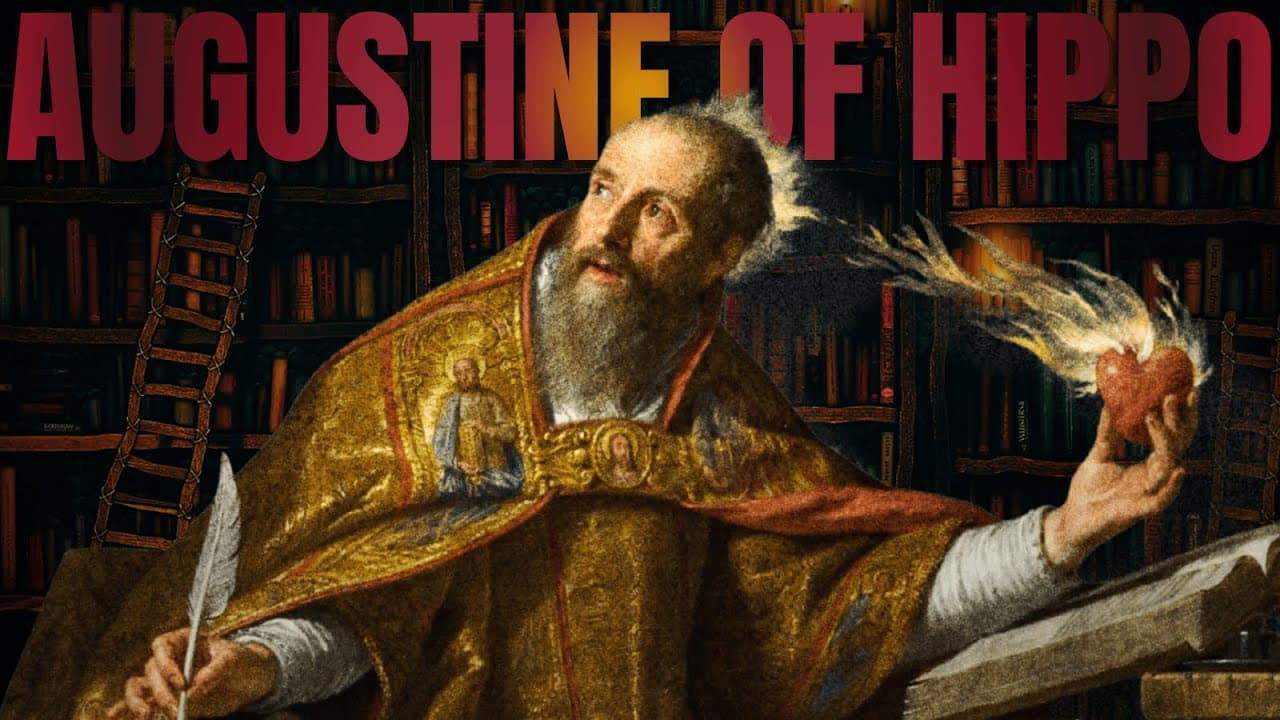
Why Does Evil Exist If God Is Good?
Augustine of Hippo | Complete Philosophy
Chapters
- 0:00:00Chapter 1: You Have Made Us for Yourself
- 0:08:41Chapter 2: Thagaste and the World of Roman Africa
- 0:16:34Chapter 3: Monica and Patricius, The Mother and the Father
- 0:25:32Chapter 4: Carthage, Pleasure, Ambition, and the Unnamed Woman
- 0:34:48Chapter 5: The Theft of the Pears, Why We Do Wrong
- 0:41:45Chapter 6: The Manichaeans, Light, Darkness, and the Problem of Evil
- 0:49:52Chapter 7: The Hortensius and the Love of Wisdom
- 0:56:42Chapter 8: Milan, Ambrose, the Platonists, and the Crisis
- 1:04:59Chapter 9: The Garden, Tolle Lege
- 1:11:54Chapter 10: Baptism, Monica's Death, and the Return to Africa
- 1:20:11Chapter 11: The Confessions, The Invention of the Self
- 1:27:38Chapter 12: The Problem of Evil, Where Does It Come From?
- 1:34:52Chapter 13: Evil as Privation, The Absence of Good
- 1:41:23Chapter 14: Free Will and the Bondage of the Will
- 1:48:23Chapter 15: Pelagius and the Controversy Over Grace
- 1:54:12Chapter 16: Original Sin, The Inheritance of Adam
- 2:00:36Chapter 17: Predestination, The Terrible Logic
- 2:06:53Chapter 18: What Is Time?
- 2:13:10Chapter 19: Memory, The Vast Palace Within
- 2:18:40Chapter 20: The Sack of Rome and the Two Cities
- 2:24:56Chapter 21: The City of God and the City of Man
- 2:30:39Chapter 22: The Bishop of Hippo, Donatists, Coercion, and the Last Years
- 2:37:07Chapter 23: The Restless Heart That Shaped the West
Full Transcript
Chapter 01: You Have Made Us for Yourself
You have made us for yourself, and our hearts are restless until they rest in you. These words have echoed through fifteen centuries of Western thought. Augustine spoke them to God in the opening lines of the Confessions, but he was also speaking about every human being who has ever lived. We are restless. We want things, and when we get them, we want other things. We chase pleasure, and pleasure fades. We chase success, and success feels empty. We chase love, and love disappoints us or dies. Something in us is always reaching for something else, something more, something we cannot quite name.
Augustine knew this restlessness from the inside. He had chased pleasure through the streets of Carthage. He had chased wisdom through the teachings of the Manichaeans. He had chased ambition through the imperial court of Milan. And none of it satisfied him. He stole pears he did not want to eat, just for the thrill of stealing. He wept at the death of a friend and could not understand why loss hurt so much. He wanted to be good but could not stop doing what he knew was wrong. The will itself seemed broken, divided against itself.
And then, in a garden in Milan, he heard a child's voice singing, and his life broke open. Everything changed. The man who could not control his desires became the bishop who shaped Western Christianity. The intellectual who wandered through philosophies became the theologian whose answers dominated a thousand years of thought. The sinner who could not stop sinning became the saint whose confession of weakness became a model for understanding the human soul.
Augustine matters because he asked the questions we still ask. Why do we do wrong when we know better? Why does nothing satisfy us? Where does evil come from if God is good? What is time? What is memory? Who am I when I try to find myself beneath all my masks and contradictions? He answered these questions in ways that shaped Christianity, that shaped philosophy, that shaped the very way Western people think about themselves.
To understand Augustine is to understand the roots of the Western mind. He gave us the vocabulary of original sin and grace, of the inner self and the divided will. He made the problem of evil a central question of philosophy. He wrote the first true autobiography, not just a record of events, but an exploration of the hidden depths of memory and desire. He analyzed time in ways that philosophers still grapple with today. He created a political theology of two cities that influenced how the West understood the relationship between church and state, between heaven and earth.
Augustine's influence runs deeper than most people realize. When Descartes said "I think, therefore I am," he was building on Augustine's prior discovery of the self as a thinking thing that cannot doubt its own existence. When Luther and Calvin broke with Rome, they did so armed with Augustine's theology of grace and predestination. When modern people write memoirs exploring their psychological depths, they are following a path Augustine blazed. He is one of those rare figures whose ideas became so foundational that we think them without knowing we think them.
But Augustine is also a figure of controversy. His teachings on predestination suggest that God chooses some souls for salvation and others for damnation before they are born, regardless of their choices or their merit. His views on original sin and infant baptism have troubled believers and unbelievers alike. His later endorsement of state coercion against religious dissenters planted seeds that would grow into the Inquisition. His complicated relationship with sexuality, he prayed for chastity, but not yet, has shaped centuries of Christian anxiety about the body and desire. To engage with Augustine honestly is to engage with ideas that illuminate and ideas that disturb.
The man who emerges from the historical record is neither a plaster saint nor a simple sinner. He was brilliant, passionate, tortured by his own desires, relentless in his pursuit of truth. He loved his unnamed concubine for fifteen years and then sent her away to make a respectable marriage, keeping their son while she disappeared into history. He loved his mother Monica with an intensity that has puzzled readers for centuries. He loved his friends, his books, his God, and the work of understanding.
Augustine lived at a hinge point of history. He was born in 354, when the Roman Empire still stretched from Britain to Mesopotamia, when Christianity was the favored religion but paganism still flourished, when the great philosophical schools of Athens continued their ancient work. He died in 430, as Vandal armies besieged his city of Hippo, as the Western Empire crumbled, as the ancient world gave way to what we call the Middle Ages. He stood at the end of classical antiquity and the beginning of medieval Christendom, and his thought bridges both worlds.
He was African, though Roman. He came from Thagaste, a small town in what is now Algeria, in the Roman province of Numidia. He spoke Latin, not Greek. He was educated in the Latin classics, Virgil, Cicero, the poets and orators who formed the culture of the Western Empire. His Africa was prosperous, literate, deeply Christian, and deeply Roman. It would be destroyed within a generation of his death, conquered by the Vandals, never to recover its ancient glory. Augustine saw the end coming and asked what meaning remained when empires fell.
This story begins in that small African town, in a household divided between a pagan father and a Christian mother, between worldly ambition and heavenly longing. It follows a young man through the temptations of Carthage, through nine years of intellectual wandering with the Manichaeans, through the bright court of Milan where everything came to a crisis. It traces the famous conversion, the baptism by Ambrose, the death of his mother as they returned to Africa. It examines the three great works, the Confessions, the City of God, On the Trinity, that contain his most profound thinking. It confronts the controversies, over grace, over predestination, over original sin, over the use of force, that made him both the father of Western theology and a troubling figure for modern readers.
Augustine invites us to examine ourselves. His restlessness is our restlessness. His questions are our questions. His struggles with desire, with understanding, with the gap between what we know and what we do, are struggles we recognize. He offers answers, but the questions matter as much as the answers. To follow Augustine through his life and thought is to think more deeply about what it means to be human, to be broken, to seek healing, to hope for something beyond ourselves.
We live in an age of distraction, an age when desires multiply and satisfaction recedes. We accumulate pleasures that do not satisfy, achievements that do not fulfill, connections that do not console. Augustine would recognize our condition. He lived it. He analyzed it with precision that has never been surpassed. The restless heart that he described is the heart that beats in every human breast, in every century, under every sky.
The heart that was restless found its rest. Whether we share Augustine's faith or not, we can learn from his journey. The questions he asked are still the questions that matter most.
Chapter 02: Thagaste and the World of Roman Africa
Augustine was born on November 13, 354, in Thagaste, a market town in the highlands of Numidia. Today we would place it in northeastern Algeria, near the modern city of Souk Ahras. In Augustine's time, it was part of Roman Africa, a prosperous region that had been Roman for five hundred years. The Punic past of Carthage and Hannibal was a distant memory. Latin was the language of the educated, though Punic lingered in the countryside. The people were Roman in law, in culture, in aspiration, whatever their Berber or Phoenician ancestry.
Roman Africa was one of the richest parts of the empire. Its wheat fed Rome. Its olive oil lit the lamps of the Mediterranean world. Its cities boasted theaters, baths, forums, and all the amenities of Roman civilization. Christianity had taken deep root there, Africa had produced Tertullian, Cyprian, and a tradition of fierce theological controversy. The African church was proud, independent, and prone to schism. Augustine would spend much of his career dealing with its divisions.
Thagaste was no great city. It had perhaps fifteen thousand inhabitants, enough for a forum, baths, and civic buildings, but small compared to nearby Carthage or the great cities of the empire. Augustine's family was neither wealthy nor poor. His father Patricius owned some land, enough to be counted among the local gentry, not enough to fund his son's education without strain. The family had slaves, as was common. They had standing in their small community, but they were always striving for something more.
The Roman Empire in 354 was vast and troubled. Constantine had died seventeen years earlier, having legalized Christianity and moved the capital to Constantinople. His sons had fought civil wars; Julian, called the Apostate, would soon try to restore paganism. The empire was officially Christian but still religiously diverse. Temples still functioned. Philosophers still taught in Athens. The old aristocratic families in Rome still cherished their ancestral gods. Christianity was favored by emperors but not yet totally dominant.
The empire was also under pressure from beyond its borders. Germanic peoples pressed against the frontiers in Europe. Persia menaced the east. Within a generation of Augustine's birth, Goths would cross the Danube and destroy a Roman army at Adrianople. The western provinces would gradually slip from imperial control. But in 354, the empire still seemed eternal. Rome had stood for a thousand years. No one imagined it could fall.
Augustine grew up speaking Latin. He studied Latin literature in the local schools of Thagaste and later in nearby Madauros. He learned to parse Virgil, to admire Cicero, to master the arts of rhetoric and persuasion that were the mark of a Roman gentleman. Education was the path to advancement. A boy from a provincial town could become an orator, a lawyer, a civil servant, even a provincial governor if his talents were great enough.
Augustine hated Greek. This may seem strange for someone who would become one of the greatest thinkers of the ancient world, but it reflects his provincial Roman education. Greek was taught, but poorly, and Augustine never mastered it. He could read Latin translations of Plato and Plotinus, but he could not read the original texts of Greek philosophy. This linguistic limitation shaped his thought. He engaged with Greek philosophy through Latin intermediaries, often at one remove from the sources. His thought is Latin through and through, shaped by Cicero, by Virgil, by the Latin Bible, by the Latin theological tradition of Tertullian and Cyprian.
As a boy, Augustine was mischievous, bright, prone to getting in trouble. He tells us that he hated school, hated being beaten by his teachers, prayed to God to escape the beatings and then laughed at adults who had similar troubles. He was competitive, vain, eager to excel, proud of his talents. He loved games and shows. He cheated to win. He was, in short, a normal boy with an exceptional mind.
But something else was forming in him, a restlessness, a hunger that games and prizes could not satisfy. He loved stories, loved the tears he shed for Dido abandoned by Aeneas in Virgil's epic. He loved language itself, the power of words to move and persuade. He sensed, even as a child, that something was missing in the world of prizes and beatings and ordinary ambition. He did not yet know what it was.
The household where Augustine grew up was religiously divided. His mother Monica was a devout Christian, raised in the faith, zealous for its truth. His father Patricius was a pagan, following the old Roman gods, content with the traditional religion of his ancestors. This was not unusual in the fourth century. Many families were mixed. Christianity was spreading, but conversion was often gradual, and households might contain believers and unbelievers together.
Monica enrolled Augustine as a catechumen, a candidate for baptism, but did not have him baptized as an infant. This too was common practice. Baptism was believed to wash away sins, and many families delayed it so that the sins of youth would be forgiven later. Monica wanted Augustine to be baptized eventually, but she was in no hurry. She could not have known that this delay would extend for decades, through years of Manichaeism and skepticism, until Augustine was thirty-two years old.
Patricius converted to Christianity only at the end of his life, baptized on his deathbed. Augustine says little about his father in the Confessions, a few brief mentions of his temper, his ambition for his son, his marital infidelity, his final conversion. We learn more about Monica than about Patricius, perhaps because Monica shaped Augustine's spiritual life more profoundly, perhaps because Patricius died when Augustine was still young.
The world of Augustine's childhood was a world between worlds, between paganism and Christianity, between Roman prosperity and coming collapse, between provincial obscurity and the great cities of the empire. He would move from Thagaste to Carthage to Rome to Milan, each step taking him farther from home and deeper into the intellectual and spiritual crises of his age. But Thagaste formed him. The Latin language, the Roman education, the mixture of piety and worldliness in his household, the provincial ambition that drove him forward, all of this came from his African childhood.
Chapter 03: Monica and Patricius: The Mother and the Father
No figure looms larger in Augustine's spiritual autobiography than his mother Monica. She appears throughout the Confessions as a woman of faith, tears, and relentless pursuit. She prayed for her son's conversion for decades. She followed him across the sea from Africa to Italy. She wept so often for his soul that a bishop reportedly told her that a child of so many tears could not be lost. When Augustine finally converted and was baptized, she was there. When she died shortly afterward at Ostia, near Rome, Augustine grieved with an intensity that broke through even his austere theology.
Monica was born around 331 in Thagaste, into a Christian family. She was raised in the faith by a strict elderly servant who disciplined the household and controlled the children's access to food and drink. This servant taught Monica habits of self-denial that would mark her whole life. Monica learned to wait, to endure, to persist. These qualities would define her relationship with her son.
She married Patricius while still young. It was probably an arranged marriage, as most were. Patricius was not a Christian, though his mother was. He was hot-tempered, prone to anger, unfaithful to his wife. Monica bore these trials with patience, or so Augustine tells us. She did not provoke quarrels when her husband raged. She waited for his anger to pass, then spoke gently if reproof was needed. She won him over by submission rather than confrontation. Other wives, Monica observed, had gentler husbands who still beat them. Patricius never struck her.
This portrait of marital submission has troubled modern readers. Augustine presents Monica's patience as a model of Christian womanhood, her quiet endurance as wisdom. But we might also see a woman trapped in a difficult marriage, coping as best she could with limited options. The ancient world offered few alternatives for a wife unhappy with her husband. Monica made peace with her circumstances and channeled her energy into her children and her faith.
Monica had at least three children, Augustine, a brother named Navigius, and a sister whose name we do not know. Augustine was clearly her favorite, the one on whom her hopes and prayers focused. His brilliance was evident from childhood. His ambition matched hers. She saw in him the possibility of worldly success and, more important, of eternal salvation. But as he grew into adolescence and young adulthood, he slipped away from her faith even as he climbed the ladder of worldly advancement.
Patricius is a shadowy figure in the Confessions. Augustine mentions his father's pride when Augustine's developing body showed that he would soon give Patricius grandchildren. This moment, observed in the public baths, emphasizes sexuality in ways that made Augustine uncomfortable when he wrote about it years later. Patricius cared about his son's worldly success and about continuing the family line. He does not seem to have cared much about Augustine's soul.
But we should not be too quick to dismiss Patricius. He was poor enough that he struggled to afford Augustine's education, yet he managed it. When Augustine needed a year off from studies for lack of funds, Patricius found a patron to continue the investment. He believed in his son's talents and sacrificed for them. Augustine mentions this with gratitude even as he criticizes his father's priorities. Patricius wanted Augustine to become a great orator, perhaps a lawyer or civil servant. He got what he wanted, Augustine became a brilliant speaker and teacher, though not in the ways Patricius had imagined.
Patricius died around 371, when Augustine was about seventeen. He had recently been baptized, finally accepting his wife's faith at the end of his life. Augustine says almost nothing about this death. He does not describe grief or loss. Patricius simply disappears from the narrative, his deathbed conversion noted in passing. Perhaps the relationship was too distant or too complicated to mourn publicly. Perhaps Augustine, writing decades later, simply had little to say about a man he barely knew.
Monica, by contrast, dominates the Confessions. Her faith is unshakeable. Her love for Augustine is fierce and unrelenting. She wants two things for him: success in the world and salvation in the next. When he takes a concubine, she is troubled but tolerates it. When he becomes a Manichaean, she is horrified but does not abandon him. When he sneaks away to Rome without telling her, she follows him to Milan. She will not let him go.
The relationship between Augustine and Monica is intense enough to make modern readers uncomfortable. Some have seen erotic undertones, an Oedipal drama beneath the surface of piety. Others have seen a controlling mother and a son who never quite breaks free. Still others see genuine Christian love, a mother who cared for her son's eternal soul more than anything in this world. Augustine himself seems to have felt all these things at once. He loved Monica deeply. He also needed to escape her.
The famous scene of their shared vision at Ostia, shortly before Monica's death, shows the intensity of their bond. They stood together at a window overlooking a garden, talking about eternal life. Their conversation rose higher and higher, beyond the physical world, beyond their own minds, until for one moment they touched something beyond all words, the eternal Wisdom that is God. Then they returned to ordinary speech and Monica said that she had nothing left to live for. She had wanted to see Augustine baptized and faithful. Now that was done. She could die in peace.
She died about a week later, at the age of fifty-six. Augustine suppressed his grief, believing that tears were inappropriate for someone who died in Christian hope. But the grief broke through. He wept, finally, in private, praying to God for his mother's soul. He asks readers not to think badly of him for weeping, a strange request that reveals how conflicted he felt about natural emotion.
Monica was buried at Ostia and her grave forgotten for centuries. In 1430, almost exactly a thousand years after her death, her remains were discovered and brought to Rome, where they now rest in the church of Sant'Agostino. She became a saint, the patron of mothers and of difficult children. Her patient tears became a model of maternal piety.
But Monica was more than a pious mother. She was intelligent, shrewd, and strong-willed. She managed a difficult household. She navigated the complex society of Roman Africa. She pursued her son across the Mediterranean with determination that bordered on obsession. She engaged in his intellectual struggles even when she did not fully understand them. A bishop she consulted about Augustine's Manichaeism told her that Augustine was not yet ready to listen, but that she should pray and wait. She was not satisfied with this answer and kept pressing until the bishop reportedly said, "Go away from me now. As you live, it is impossible that the son of such tears should perish." Monica took this as a divine oracle and held onto it for years.
The relationship between mother and son shaped Augustine's thought in ways that are difficult to measure. His emphasis on grace over human effort, his sense that we cannot save ourselves, his conviction that God pursues us even when we flee, all of this may owe something to Monica's relentless pursuit of him. He experienced grace as something like a mother's love that will not let go. God chased him as Monica chased him, with tears and prayers and stubborn refusal to give up.
Chapter 04: Carthage: Pleasure, Ambition, and the Unnamed Woman
At the age of sixteen or seventeen, Augustine went to Carthage to continue his education. Carthage was the great city of Roman Africa, a teeming metropolis of perhaps half a million people, with a magnificent harbor, grand public buildings, theaters, baths, schools of rhetoric, and all the distractions of urban life. For a bright young man from a provincial town, it was overwhelming and intoxicating.
Augustine himself captures the sensation in one of the most famous sentences of the Confessions: "I came to Carthage, and all around me in my ears were the sizzling and frying of unholy loves." The Latin is more elegant, stagabat undique sartago flagitiosorum amorum, but the meaning is clear. Carthage was a cauldron of temptation, and Augustine plunged in.
He was there to study rhetoric, the art of persuasion, which was the key to advancement in the Roman world. Lawyers, politicians, civil servants all needed rhetorical skill. A brilliant speaker could rise to prominence regardless of birth. Augustine had the talent. His teachers recognized it. His father had sacrificed to give him this chance. Now he had to prove himself in competition with other ambitious young men.
But Carthage offered more than education. It offered theater, spectacles, entertainments of every kind. It offered friendships with other students, drinking parties, late-night conversations about philosophy and love. It offered the shows of the arena, which Augustine watched with mixed fascination and guilt. And it offered sexual opportunity, which Augustine pursued without restraint.
He fell in love. More than that, he took a concubine, a woman of lower social status with whom he lived as a wife in all but legal standing. Roman law did not permit marriage between persons of vastly different social classes, but concubinage was an accepted alternative. A man might live with a concubine for years, even have children with her, without scandal as long as he did not try to call it marriage.
We do not know her name. Augustine never tells us. She is simply the woman he loved for fifteen years, the mother of his son Adeodatus, the companion of his youth and early adulthood. Some scholars have suggested that Augustine suppresses her name out of shame; others, that naming her would have been inappropriate given Roman conventions about concubinage. Whatever the reason, her absence from the text is haunting. She appears only as a shadow, a presence defined by her absence.
Augustine loved her. He makes this clear. He was faithful to her for the fifteen years they were together, an unusual faithfulness for a Roman man of his class and era. When she was eventually sent away so that Augustine could make a respectable marriage, he tells us that his heart was broken, that the wound bled for a long time. She had been torn from his side, he says, and the tearing was agony.
Their son Adeodatus was born around 372, when Augustine was about eighteen. The name means "gift of God", a strange name for a child born outside marriage to a father who had abandoned Christianity for the Manichaeans. Perhaps Augustine already sensed something sacred in the child, something that his wandering intellect could not explain. Adeodatus grew to be brilliant, surpassing his father in quickness of mind, participating in philosophical dialogues as an equal even in his teens. He was baptized with Augustine in 387 and died shortly afterward, perhaps around 388. Augustine barely mentions him after the baptism. The loss seems too deep for words.
In Carthage, Augustine's intellectual life took a decisive turn. He encountered a now-lost dialogue by Cicero called the Hortensius, which praised philosophy as the highest pursuit of the human mind. Reading this book set Augustine on fire. He wanted wisdom. He wanted truth. The ordinary ambitions of his parents, wealth, status, a respectable career, suddenly seemed empty compared to the philosophical quest for understanding.
But where could he find the wisdom Cicero promised? He turned first to the Christian scriptures, the Bible his mother had urged on him since childhood. He was disappointed. The Latin Bible of his time was rough, unpolished, inelegant compared to the refined prose of Cicero. It seemed crude to a young man trained in rhetoric. Augustine's pride could not accept that truth might come in humble garments. He turned away.
Instead, he found the Manichaeans. Manichaeism was a religion founded by the Persian prophet Mani in the third century. It spread rapidly through the Roman Empire, offering an elaborate mythology that explained the origin of the universe, the nature of good and evil, and the path to salvation. For Augustine, it answered the question that troubled him most: where does evil come from?
The Manichaean answer was dualism. The universe contained two ultimate principles, Light and Darkness, Good and Evil, eternally at war. The material world was created when Darkness invaded the realm of Light, and particles of divine Light became trapped in matter. Human beings contained sparks of this trapped Light. Salvation meant freeing the Light from the prison of the body and returning it to its divine source.
This doctrine appealed to Augustine for several reasons. First, it explained evil without blaming God. Evil was not God's creation but came from an independent principle of Darkness. God was purely good, fighting against an equally real force of evil. Second, it provided an excuse for Augustine's own moral failures. If the body was a prison of Darkness, then the sins of the flesh were not really his fault. The Light within him was pure; only the matter encasing it was corrupt. Third, it seemed rational and philosophical. The Manichaeans mocked the crude stories of the Old Testament and promised a more sophisticated religion of reason.
Augustine became a Manichaean "hearer", a lower rank of follower who observed some dietary restrictions but did not take the full vows of the "elect." He remained a hearer for nine years, from about 373 to 382. During this time, he taught rhetoric in Carthage, built his reputation, lived with his concubine, raised his son, and argued vigorously for Manichaean doctrines among his friends.
But doubts crept in. The Manichaean cosmology was elaborate but also vulnerable to criticism. How exactly did Light and Darkness come into conflict? If Light was good and powerful, how could Darkness capture it? The explanations Augustine received were unsatisfying. He was told to wait for the great Manichaean teacher Faustus, who would answer all questions. Faustus arrived, and Augustine found him charming but intellectually shallow. Faustus could not answer the hard questions. The edifice of Manichaean belief began to crack.
Meanwhile, Augustine's career advanced. He won rhetorical competitions. He taught students. He made influential friends. He was becoming exactly what his father had hoped, a successful man of letters with prospects for further advancement. But the success felt hollow. Cicero had promised that philosophy would satisfy the soul. The Manichaeans had promised answers. Neither promise was kept. Augustine remained restless, hungry for something he could not name.
Carthage was the scene of Augustine's youth, its pleasures, its ambitions, its intellectual awakening. He spent about a decade there as student and teacher, living in the cauldron of unholy loves, pursuing wisdom and finding confusion. When he finally left for Rome around 383, he left behind the city that had formed him but not the questions that haunted him. Those questions would follow him across the sea.
Chapter 05: The Theft of the Pears: Why We Do Wrong
Among the most famous passages in the Confessions is Augustine's extended meditation on a seemingly trivial incident from his adolescence. When he was about sixteen years old, he and some friends stole pears from a neighbor's orchard. They did not steal them because they were hungry. They did not steal them because the pears were particularly good, Augustine says they were not. They stole them and then threw them to the pigs. The act was pointless, gratuitous, evil for its own sake.
Why does Augustine spend so much time on this minor theft? Because it reveals something profound about the nature of sin. Most wrongdoing can be explained by misdirected desire for something genuinely good. A thief steals money because money can buy comfort and security. A murderer kills out of anger, or fear, or jealousy, all distorted forms of natural emotions. Even adultery aims at pleasure, which is good in itself. We can understand these sins as perverted attempts to obtain real goods.
But the theft of the pears has no such explanation. Augustine and his friends did not want the pears. They had better food at home. They did not sell the pears or eat them or give them to anyone who needed them. They simply stole and destroyed. The act was sheer malice, destruction for its own sake, evil that served no purpose other than evil itself.
Augustine explores possible explanations and finds them all inadequate. Perhaps they stole for the thrill of doing something forbidden? But why is the forbidden thrilling? Perhaps they stole for the pleasure of companionship with their friends? But why does companionship in sin give pleasure? Perhaps they stole to feel powerful, to assert themselves against authority? But why does defiance feel satisfying?
Each explanation points toward a mystery at the heart of human evil. We do wrong not only by mistake, not only from weakness, not only in pursuit of misguided goods. Sometimes we do wrong because wrongness itself attracts us. We want to be like God, Augustine suggests, not in God's goodness but in God's freedom. We want to answer to no one, to make our own rules, to be a law unto ourselves. The theft of the pears was a tiny, pathetic assertion of absolute freedom, freedom from morality, from authority, from the constraints that make us human.
This analysis anticipates by fifteen centuries the existentialist notion of radical freedom, the idea that we sometimes act simply to prove that we can. Augustine sees in his adolescent theft the essence of all sin: the will turning away from God, not toward some greater good, but toward nothingness. Sin is a kind of self-destruction, a choosing of less being rather than more, a preference for the dark.
Yet Augustine recognizes that he could not have done this alone. He needed companions. Sin is social as well as individual. Alone, he would have felt silly stealing pears to throw to pigs. With friends, laughing together, egging each other on, the silliness became excitement. We sin together more easily than alone. The group gives permission that the individual conscience would deny.
Here is another mystery. We are made for community, for friendship, for love. But community can corrupt as well as support. The friends who encouraged Augustine's theft were using friendship for evil. The bond between them was real, but it was misdirected. They were united in malice rather than in good. This too is a form of the human tragedy: our deepest needs can become vehicles of our destruction.
Augustine's meditation on the pears is not moralizing. He is not simply saying that stealing is wrong. He is probing the psychology of wrongdoing, trying to understand why we do what we know we should not do. The puzzle of akrasia, acting against our own better judgment, haunted ancient philosophy. Socrates had argued that no one does wrong willingly; if we truly knew the good, we would choose it. Plato suggested that the soul has parts that can conflict, so that reason might be overcome by appetite or passion.
Augustine's analysis goes deeper. The will itself is divided. We do not simply have reason pulling one way and appetite pulling another. The will, the center of our choosing, is broken. We can will what we do not want to will. We can choose against our own choice. Paul had captured this experience in his letter to the Romans: "I do not do the good I want to do, but the evil I do not want to do, this I keep on doing." Augustine's theft of the pears is his concrete example of this universal human condition.
The episode also reveals Augustine's method. He begins with a specific memory, an incident from his own life. He examines it closely, turning it over, asking what it reveals. He moves from the particular to the universal, from one boy stealing pears to the human condition as such. The Confessions is not a straightforward autobiography. It is an investigation of the self as a window onto deeper truths about humanity and God.
The pears also point forward to Augustine's mature theology of grace. If the will is this broken, this capable of choosing evil for its own sake, then we cannot save ourselves. We cannot simply decide to be good. The decision itself comes from a will already compromised, already bent toward destruction. Only God can heal the will. Only grace can straighten what sin has made crooked.
This is why the theft of the pears matters. It is not just a story of adolescent mischief. It is a symbol of the human predicament, creatures made for good who choose evil, beings who want happiness and grasp at emptiness, wills that will their own undoing. Augustine stole pears he did not want, threw away what he could not enjoy, and in doing so enacted the tragedy of the human soul. Understanding this helps us understand everything that follows.
Chapter 06: The Manichaeans: Light, Darkness, and the Problem of Evil
For nine years, Augustine was a Manichaean. From roughly 373 to 382, during his time in Carthage and his early teaching career, he followed the religion of Mani and argued for its truth with all the skill his rhetorical training had given him. Understanding why Augustine became a Manichaean, and why he eventually left, is essential to understanding his mature thought. The problem of evil, the question that drew him to the Manichaeans, remained central to his philosophy throughout his life.
Manichaeism was founded by Mani, a Persian prophet born around 216 CE. Mani believed he had received direct revelation from God, completing and correcting the earlier revelations given to Buddha, Zoroaster, and Jesus. His religion spread rapidly across the Roman and Persian empires, attracting converts with its elaborate mythology and its promise to explain the mysteries of existence.
The Manichaean myth began with two eternal principles: Light and Darkness. Light was God, the Father of Greatness, dwelling in the realm of infinite goodness and peace. Darkness was matter, chaos, evil, a kingdom of demons and destruction. These two realms existed eternally, separate from each other, until Darkness attacked Light.
In the cosmic battle that followed, particles of Light became trapped in matter. The material world that we inhabit is the result of this mixing, a place where Light and Darkness are intermingled, where divine sparks are imprisoned in bodies of flesh. The sun and moon were thought to be vessels of pure Light, gradually collecting the scattered particles and returning them to the divine realm. Eventually, all the Light would be freed, and Darkness would be sealed away forever.
Human beings, in this mythology, contain particles of trapped Light. The body is a prison of Darkness, but the soul is a spark of the divine. Salvation means freeing the Light within us, living in ways that separate Light from Darkness, avoiding foods and behaviors that trap more Light in matter, gradually purifying ourselves until we can return to our divine source.
This mythology sounds strange to modern ears, but Augustine found it compelling for specific reasons. First and most important, it answered the problem of evil. If God is all-good and all-powerful, why does evil exist? Why is the world full of suffering, cruelty, and sin? Christianity seemed to have no satisfying answer. If God created everything, then God created evil. If God is omnipotent, he could prevent evil but chooses not to. The Manichaean solution was elegant: God did not create evil because evil comes from an independent principle, Darkness. God is fighting against evil, but God is not all-powerful in the conventional sense. There are limits to what even the divine Light can do against the forces of Darkness.
Second, Manichaeism absolved Augustine of moral responsibility for his sins. If his body was a prison of Darkness, if the impulses of the flesh came from matter and not from his true self, then he was not really to blame for what he did wrong. The Light within him remained pure. Only the Darkness made him sin. This was, Augustine later recognized, a very convenient doctrine for a young man struggling with sexual desire. He could enjoy his pleasures and blame them on the evil material world.
Third, the Manichaeans criticized the Old Testament in ways that appealed to Augustine's intellectual pride. The Hebrew scriptures were full of stories that seemed crude, violent, or morally problematic. The God of the Old Testament appeared jealous, wrathful, and arbitrary. The Manichaeans rejected these texts entirely, claiming that the Old Testament God was not the true God but a lesser or even evil being. Only Jesus and a few New Testament texts preserved the true revelation. This selective approach let Augustine feel intellectually superior to the simple Christians who accepted the whole Bible.
Augustine rose in the Manichaean community. As a hearer, he was expected to support the elect, the inner circle of believers who observed strict rules, ate special foods, and were thought to be further along the path to salvation. Augustine recruited his friends to the movement. He argued against Catholic Christians with confidence and skill. He seemed committed.
But doubts accumulated. The Manichaean cosmology raised as many questions as it answered. If Light and Darkness were both eternal, neither could ultimately win. The battle would go on forever, or end in a draw, leaving the problem of evil unresolved. If Darkness could invade Light, then Light was not truly secure. If God was not all-powerful, was he really God?
Augustine also noticed that the Manichaeans could not deliver on their promise of scientific sophistication. They claimed to explain the workings of the cosmos, the movements of the sun and moon, the causes of eclipses, the structure of the heavens. But their explanations did not match what Augustine learned from pagan astronomers. The Manichaean texts were wrong about basic astronomical facts. If they were wrong about things that could be checked, why trust them about things that could not?
The crisis came when Augustine finally met Faustus, the famous Manichaean teacher he had been told would answer all his questions. Faustus was personally charming and an engaging speaker. But when Augustine pressed him with philosophical difficulties, Faustus admitted that he could not resolve them. He was an orator, not a thinker. He knew the Manichaean texts but could not defend them against criticism.
Augustine's faith in Manichaeism collapsed, though slowly. He remained nominally a hearer for a while longer, having no alternative. But the intellectual foundation was gone. The religion that had promised answers had failed him. The problem of evil remained unsolved. Augustine was adrift, searching for something he had not yet found.
The Manichaean years left permanent marks on Augustine's thought. He would spend much of his career refuting Manichaean doctrines, but his refutations show how deeply he had absorbed the questions the Manichaeans raised. The problem of evil became central to his philosophy, he would offer a very different answer, but he never forgot the power of the question. His emphasis on the will, on grace, on the interior life, all owe something to his Manichaean past. Even his mature theology of original sin has structural similarities to the Manichaean idea that we inherit corruption from our origins.
More important, the Manichaean experience taught Augustine how seductive false answers can be. A system that seems to explain everything, that flatters our intelligence, that excuses our failures, such a system is dangerous precisely because it is attractive. Truth may be harder and less convenient. Augustine would always be suspicious of easy answers after his Manichaean years.
Chapter 07: The Hortensius and the Love of Wisdom
Before Augustine became a Manichaean, before the theft of the pears, before his intellectual struggles began in earnest, there was a book. During his nineteenth year, pursuing his rhetorical studies in Carthage, Augustine encountered a dialogue by Cicero called the Hortensius. This book, now lost, changed the direction of his life.
The Hortensius was a protreptic, a work designed to encourage the reader to pursue philosophy. Cicero, the great Roman orator and statesman, wrote it around 45 BCE during a period of political withdrawal, turning to philosophy for consolation after the death of his daughter. The dialogue advocated for the philosophical life as the highest human pursuit, arguing that wisdom alone could provide true happiness.
Augustine was reading the Hortensius as part of his rhetorical education. He expected to admire its style, its elegance, its technique of persuasion. Instead, he was set on fire. The content seized him. The book changed not how he spoke but what he loved. Suddenly, the ambitions his parents had for him, wealth, status, a successful career, seemed worthless compared to the pursuit of wisdom. He wanted not to be a better rhetorician but to be wise.
This moment of awakening reveals something essential about Augustine's character. He was passionate in everything he did. He could not approach anything with moderation. If he was going to pursue pleasure, he would pursue it completely. If he was going to seek wisdom, he would burn with desire for it. The Hortensius ignited a fire that would never entirely go out, even when Augustine became disillusioned with one philosophy after another.
What did the Hortensius say that moved him so deeply? We cannot be certain, since the text is lost. But Cicero's surviving philosophical works give us some idea. He would have argued that external goods, money, power, fame, cannot provide lasting happiness because they can be taken away. Only the goods of the soul, wisdom and virtue, are truly our own. He would have presented philosophy not as dry academic exercise but as the path to human flourishing, the only medicine for the soul's ills.
Augustine resonated with this message because he had already experienced the emptiness of ordinary pleasures. Carthage offered every gratification, but gratification did not satisfy. The cauldron of unholy loves left him hungry for something else. Cicero gave a name to what he sought: sapientia, wisdom, the understanding of things divine and human.
But where was wisdom to be found? Cicero himself had been eclectic, drawing on various Greek philosophical schools without committing fully to any. Augustine's religious training suggested a different direction. If wisdom existed, the source of wisdom must be God. He turned to the Christian scriptures, expecting to find there the wisdom Cicero had made him crave.
The encounter was a failure. The Latin Bible of Augustine's time, the old translations that preceded Jerome's Vulgate, was rough and unpolished. To a young man trained in the elegant prose of Cicero and Virgil, the scriptures seemed barbarous. The style was beneath him. Moreover, the content of the Old Testament troubled him, the stories of violence, the anthropomorphic God, the apparent moral failures of the patriarchs. He could not take it seriously.
This failure sent Augustine to the Manichaeans, who seemed to offer both philosophical sophistication and religious certainty. But the failure also set a pattern. Augustine would always judge religious truth partly by intellectual standards. He needed a faith that could satisfy his mind as well as his heart. Simple belief was not enough for him. He required understanding, or at least the hope of understanding. This hunger for comprehension would eventually draw him to Neoplatonism and, through Neoplatonism, to a Christianity that could meet his intellectual needs.
The Hortensius also established philosophy as Augustine's orienting pursuit. Even when he was a Manichaean, even when he was a skeptic, even after he became a Christian bishop, he remained a philosopher. His theological works are philosophical through and through. He asks about the nature of being, the problem of evil, the structure of the soul, the nature of time. He argues with precision and demands clarity. The categories of Greek philosophy, especially as filtered through Latin transmitters and Neoplatonic interpreters, remain his tools even when he uses them in service of Christian faith.
The love of wisdom that Cicero kindled never died. It was transformed, redirected, finally satisfied in ways Augustine could not have imagined when he first read the Hortensius. But it was the same love. The restless heart that sought wisdom in Carthage was the restless heart that would find rest in God. The one led to the other. Without that first inflaming, the final illumination might never have come.
Cicero himself was not a believer. He belonged to the skeptical Academy, the school of philosophers who suspended judgment on ultimate questions. But his Hortensius served a purpose he could not have intended. It prepared Augustine for a journey that would end far beyond anything Roman philosophy imagined. The pagan orator lit the fire that the Christian God would finally satisfy. Augustine never forgot his debt to Cicero. He quotes him throughout his works. The Roman pursuit of wisdom opened into the Christian vision of beatitude.
The lost dialogue thus has an afterlife in Augustine's thought. We cannot read the Hortensius, but we can see its effects. The desire for wisdom, the conviction that the soul needs philosophy as medicine, the sense that ordinary life is not enough, all of this came to Augustine from Cicero and stayed with him forever.
Chapter 08: Milan: Ambrose, the Platonists, and the Crisis
Around 383, Augustine left Carthage for Rome. His students in Carthage were unruly, and he had heard that Roman students, though they also behaved badly, at least paid their fees. The move was also an advancement. Rome was the center of the Latin world, and teaching rhetoric there would raise his profile. Monica tried to stop him, but Augustine deceived her, pretending to stay behind when a friend's ship was leaving, then sailing off while she prayed on the shore. He was twenty-nine years old.
Rome disappointed him. The students did pay their fees, eventually, but they had a habit of switching teachers just before payment was due, cheating their instructors of compensation. Augustine was ill, lonely, and still intellectually adrift. He had lost faith in Manichaeism but had nothing to replace it. He drifted toward the skepticism of the New Academy, the philosophical school that argued we cannot know anything with certainty. This was not a comfortable position for someone who hungered for truth, but it seemed honest given the failure of all his previous beliefs.
Then came the opportunity that changed everything. The city of Milan needed a public orator, someone to deliver official speeches praising the emperor and celebrating civic occasions. Augustine's connections in Rome helped him win the appointment. He moved to Milan in 384, bringing his concubine and son, entering the inner circle of imperial power. Milan was where emperors resided when they were not on campaign. It was the effective capital of the Western Empire. Augustine had arrived.
In Milan, three developments converged to produce Augustine's conversion: his encounter with Ambrose, his discovery of the Platonists, and the mounting pressure of his personal crisis. Each contributed something essential. Together, they broke open his life.
Ambrose was the bishop of Milan, one of the most powerful churchmen in the Western Empire. He was also an intellectual, educated in the classical tradition, capable of engaging with philosophy and literature at the highest level. Augustine went to hear him preach, initially just to study his rhetorical technique. The great orator wanted to learn from a great preacher.
But Ambrose offered more than technique. He showed Augustine that Christianity could be interpreted intellectually, that the crude stories of the Old Testament had allegorical meanings, that the faith of simple believers could be expressed in sophisticated philosophical terms. Ambrose read the scriptures symbolically, finding spiritual truths beneath the literal surface. The anthropomorphic God who walked in the Garden of Eden was not literally a being with a body; the language was metaphor pointing toward ineffable reality.
This was revolutionary for Augustine. His objections to Christianity had been largely based on the apparent crudeness of its scriptures and doctrines. If the texts could be read allegorically, if the faith could be held by intelligent people who did not take everything literally, then his objections fell away. Christianity was not as naive as he had assumed. There was room for his intellect within the church.
At the same time, Augustine discovered the books of the Platonists. This means, primarily, the works of Plotinus and his student Porphyry, the founders of what we call Neoplatonism. Augustine read them in Latin translation, his Greek was never good enough for the originals, and they transformed his understanding of reality.
Plotinus taught that ultimate reality is the One, an absolute unity beyond all description, beyond being itself. From the One emanates the divine Mind, containing the Forms, the eternal patterns of all things. From Mind emanates Soul, which orders and animates the physical world. Matter is at the bottom of this hierarchy, furthest from the One, almost nothing at all. Evil is not a positive force but a privation, an absence of good, a turning away from the One toward the darkness of pure matter.
This metaphysics solved problems that had troubled Augustine for years. Where does evil come from? Not from an independent principle, as the Manichaeans taught, but from the absence of good. Evil is not a thing but a lack of being. God is pure being, and everything that exists is good insofar as it exists. Evil is the falling away from being toward nothingness. The soul sins not by being seduced by Darkness but by turning from higher goods to lower goods, preferring finite pleasures to infinite beatitude.
The Platonist vision also provided a way to think about God without anthropomorphism. God is not a being among beings, not a very large person in the sky, but the source of all being, beyond our categories, approachable only through contemplation and ascent. The language of the Old Testament, with its walking God and divine emotions, is not literal description but poetic gesture toward what cannot be directly said.
Augustine had experiences of Platonist ascent. In Milan, he tried to rise through the levels of being toward the vision of the One. For brief moments, he touched something. He felt himself lifted above the material world, glimpsing eternal truth. But he could not sustain it. He fell back into ordinary awareness, trembling with love and dread. The vision faded. He was still trapped in his body, his habits, his divided will.
This was the crisis. Augustine was intellectually convinced that Neoplatonism, combined with the Christianity Ambrose preached, was true. He no longer had philosophical objections. But he could not convert. His will was bound by habit, especially by sexual habit. He had lived with his concubine for over a decade. His desires were too strong to simply renounce. He prayed the famous prayer: "Grant me chastity and continence, but not yet."
Monica had followed him to Milan, still pursuing his conversion. She arranged for him to become engaged to a suitable Christian woman, a girl of proper family who was still too young for marriage. To make this engagement possible, Augustine had to send away his concubine. He did so. She returned to Africa, vowing never to be with another man. Augustine, unable to wait two years for his fiancee to come of age, took another mistress almost immediately. His will remained enslaved even when his mind was free.
The tension became unbearable. He wanted to convert, to be baptized, to begin a new life of philosophical and spiritual pursuit. He could see the beauty of truth. But he could not reach it. He was like someone lying in bed who knows he should get up, who tells himself to get up, who still cannot move. The will that commands and the will that resists are the same will, divided against itself. This is the human condition, not a philosophical puzzle but a lived agony.
Augustine was thirty-two years old, at the height of his worldly success, tortured by his own inability to become what he saw he should be. Something had to break.
Chapter 09: The Garden: Tolle Lege
The breaking came in August 386, in the garden of the house where Augustine was staying in Milan. This is perhaps the most famous conversion scene in Christian history, told and retold for sixteen centuries. Augustine tells it in Book Eight of the Confessions with the narrative skill of a master rhetorician. Every detail is carefully placed. Yet the emotion behind the details is unmistakably genuine.
The crisis had been building. Augustine had heard stories of dramatic conversions, men who gave up wealth and power for ascetic Christianity, who turned from the world in a single moment of decision. The examples tormented him. If they could do it, why could he not? What held him back?
He knew the answer. His habits of sexual desire, cultivated over decades, had become chains. He did not simply feel tempted; he was enslaved. The women he had loved, the pleasures he had pursued, tugged at his will, whispering that he could not live without them. Could he really embrace chastity for the rest of his life? The thought terrified him. And so he stayed paralyzed, unable to move toward the good he could clearly see.
On that August day, Augustine was in the garden with his friend Alypius, who had followed him from Africa and shared his intellectual journey. Alypius wanted to convert as well, but Augustine's struggle was more violent. The conflict within him became physical. He threw himself on the ground beneath a fig tree, weeping uncontrollably. He cried out to God: "How long? How long? Tomorrow and tomorrow? Why not now? Why not an end to my uncleanness in this very hour?"
Then he heard a voice. It seemed to be a child singing, from a nearby house or garden, the same phrase over and over: "Tolle, lege. Tolle, lege." Take up and read. Take up and read.
Augustine stopped weeping. He tried to remember if children sang such words in any game. He could not think of any. He took it as a divine command. He had heard that Saint Antony, the Egyptian monk who became the founder of Christian monasticism, had been converted by hearing a Gospel passage read in church and taking it as a message to himself. Perhaps this voice was the same kind of sign.
He returned to where Alypius was sitting, where he had left a codex of Paul's letters. He picked it up and opened it at random. His eyes fell on a passage from Romans 13: "Not in rioting and drunkenness, not in chambering and wantonness, not in strife and envying, but put on the Lord Jesus Christ, and make no provision for the flesh, to fulfill its lusts."
Augustine read no further. He did not need to. In that moment, the chains broke. Light flooded into his heart. All the darkness of doubt fled away. He marked the place and told Alypius, his face calm with the peace of decision. Alypius read the next verse and applied it to himself. They went together to tell Monica. Her joy was complete. The son of so many tears had come home.
What happened in the garden? Augustine experienced it as divine intervention, the grace of God breaking through where human effort had failed. Critics have offered psychological explanations, the release of long-building tension, the power of suggestion, a conversion prepared by months of intellectual work finally achieving emotional breakthrough. The explanations need not be mutually exclusive. God, Augustine would say, works through psychology as well as against it.
The immediate result was decision. Augustine resolved to be baptized, to give up his career as a rhetor, to embrace a life of Christian philosophy. He would not marry his fiancee. He would live in chastity. The struggle that had paralyzed him was over.
But the decision still required working out. Augustine asked for leave from his teaching position, claiming illness. He withdrew with a group of friends and family to a villa at Cassiciacum, outside Milan. There they spent months in philosophical dialogue, discussing happiness, the existence of God, the nature of the soul. Augustine was preparing for baptism intellectually as well as spiritually. The dialogues from Cassiciacum survive, early works that show Augustine still finding his voice, mixing Neoplatonist philosophy with Christian faith.
Monica was there, participating in the discussions, her long patience rewarded. Adeodatus was there as well, the brilliant son who would be baptized with his father. Friends surrounded them. It was, Augustine later recalled, a time of great happiness. The restlessness was not gone, Augustine would always be restless in some sense, but it had found a direction. He was going toward God at last.
Easter 387 arrived. Ambrose baptized Augustine, Adeodatus, and Alypius together in Milan. The ancient ritual of baptism involved immersion in water, the stripping away of old clothes and old identity, the putting on of new white garments symbolizing new life. Augustine rose from the water as a Christian, his wandering finally ended, or so he thought. In fact, his work was just beginning. But he did not know that yet. He only knew that the years of searching were over.
The garden remained central to Augustine's imagination. He would write about it decades later with vivid detail. The fig tree, the child's voice, the tears, the codex of Paul, the verse that shattered his chains, all of this became the defining narrative of his life, the story that gave meaning to everything that came before and everything that followed. Without the garden, there is no Bishop Augustine, no Confessions, no City of God. The Manichaean years, the Carthage years, the Milan years, all were preparation for this moment. The restless heart found its rest.
Chapter 10: Baptism, Monica's Death, and the Return to Africa
After the Easter baptism of 387, Augustine began preparing to return to Africa. His career as a Roman rhetor was over. He had a new vocation, not yet clearly defined. He imagined a life of Christian philosophy, contemplation, and community with like-minded friends. Africa called him home. There was property to manage, a son to raise, a Christian life to build.
The group that had gathered at Cassiciacum would travel together. Augustine, Monica, Adeodatus, Alypius, and several others made their way from Milan toward Rome and the port of Ostia, where they would take ship for Africa. The journey required waiting, ships did not sail on schedule, and the group had to find passage. During this pause at Ostia, something extraordinary happened.
Augustine and Monica were alone together, standing at a window that overlooked an inner garden. They spoke about eternal life, what the saints would experience in the presence of God, a happiness beyond anything earthly. Their conversation grew more intense, more elevated. They passed through the physical world in thought, through the heavens, through their own souls, climbing toward the source of all being.
At the highest point of their ascent, for one brief moment, they touched it. They reached beyond all creation to the eternal Wisdom that made all things. In a flash of heart-trembling contact, they perceived what no eye has seen, no ear has heard. Then it was over. They returned to ordinary speech, sighing at the inadequacy of words.
This is the famous vision at Ostia, Augustine's closest approach to mystical experience. It echoes the Neoplatonist ascent he had attempted before conversion, but now it is shared with his mother, anchored in Christian hope, pointing toward the resurrection of the body rather than escape from the body. The vision was fleeting, a single breath, Augustine says, no more. But it was real. It confirmed everything he now believed.
After the vision, Monica said something remarkable. She no longer cared about this life. Everything she had hoped for was accomplished. She had wanted two things: to see Augustine baptized and to see him become a faithful Catholic. Both had happened, more abundantly than she had dared to ask. What more was there to do on earth? She could die content.
About five days later, Monica fell ill with fever. She grew weaker over several days. At one point, she briefly lost consciousness. When she awoke and saw her sons, Augustine and his brother Navigius, standing by her bed, she asked, "Where was I?" They did not understand. She told them to bury her body wherever they wished, not to worry about carrying her back to Africa. All she asked was that they remember her at the altar of the Lord, wherever they might be.
She died nine days after the beginning of her illness, at the age of fifty-six. Augustine was thirty-three. The mother who had prayed and wept and followed him across the sea was gone.
Augustine's response was strange, even to himself. He tried not to weep. He believed that excessive grief was inappropriate for a Christian who trusted in the resurrection. Monica had died in faith, secure in her salvation. Why should he mourn as pagans mourned, who had no hope? He held back his tears by force of will. Adeodatus burst into weeping but was hushed by the others. They prayed the psalms. They carried Monica's body to burial. Augustine remained dry-eyed throughout.
But the grief would not stay suppressed. Alone in bed that night, Augustine finally wept. He wept for his mother, for the years they had shared, for her kindness and her love. He wept for himself, for the mother he had lost. He asked God not to condemn him for this weeping, not to add the tears of sin to the other sins for which he needed forgiveness. The tears were human. He could not help them.
Years later, writing the Confessions, Augustine prayed for Monica's soul. Even though he believed she had died in faith, he was not certain of her complete purification. Perhaps she had sins that still needed cleansing. He asked readers to join him in praying for the woman who had given him birth, both physically and spiritually.
The death at Ostia closed a chapter. Monica had been the thread connecting Augustine to Christianity even during his years of wandering. Her death meant he was now on his own, or rather, alone with God. The vision they shared was a farewell gift, a moment of communion before separation. The mother who had sought his conversion for so long did not live to see what it would produce. She died knowing only that her prayers were answered, not what fruit they would bear.
The party eventually returned to Africa, probably in late 388. Augustine settled near Thagaste, on family property, intending to live a life of contemplation with his friends. He established something like a monastic community, men living together, sharing property, devoted to prayer and study. This was his vision: a small group pursuing wisdom and holiness together, far from the ambitions of the world.
But the world would not leave him alone. Around 388, Adeodatus died. Augustine says almost nothing about this loss. The brilliant son, baptized with his father, discussed philosophical questions as an equal, simply disappeared from the narrative. Some wounds are too deep for words. Augustine had lost his mother, his concubine had been sent away, and now his son was dead. Of the family he had built in his years of wandering, nothing remained.
He threw himself into writing. The years between 388 and 391 produced a flood of works, philosophical dialogues, polemics against the Manichaeans, biblical commentaries. He was becoming a Christian intellectual, working out the implications of his conversion, developing the ideas that would make him famous. The monastic community provided support and conversation partners. But larger responsibilities were approaching.
In 391, Augustine visited the coastal city of Hippo Regius, about forty miles from Thagaste. He went to recruit a potential member for his community. While attending church, he was seized by the congregation. They knew his reputation as a learned and holy man. Their bishop was old. They needed a priest. Augustine was elected, almost by acclamation, and ordained against his will.
He wept at his ordination. He had not sought ecclesiastical office. He valued his quiet life of study and contemplation. But once ordained, he accepted the responsibility. He would serve the church as he was called to serve. In 395, he became bishop of Hippo, a position he would hold until his death thirty-five years later. The contemplative life he had imagined was over. A new chapter, the longest and most productive of his life, was beginning.
Chapter 11: The Confessions: The Invention of the Self
Around 397, ten years after his baptism, Augustine began writing the book that would make him immortal. The Confessions is unlike anything that came before it. It is autobiography, but not in the modern sense of a chronological life story. It is prayer, addressed directly to God throughout. It is philosophy, exploring the nature of memory and time. It is biblical interpretation, meditating on the opening of Genesis. It is all of these things at once, woven together by a single restless voice seeking understanding.
The title itself is significant. In Latin, confessio means both confession of sin and confession of praise. Augustine confesses his sins to God, but he also confesses his faith, his gratitude, his wonder. The book is as much celebration as lament. He confesses who he was, a sinner, a wanderer, lost in the darkness of false philosophies, and he confesses who God is, the source of all being, the light that illuminated his darkness, the love that pursued him even when he fled.
The structure of the Confessions is unusual. Books One through Nine narrate Augustine's life from infancy through Monica's death. This is the autobiographical core, the story of restlessness and conversion that we have been following. But the narrative stops at Ostia, in 387. Augustine says almost nothing about the decade between Monica's death and the writing of the book. The story of his ordination, his rise to bishop, his controversies and writings, none of this appears.
Instead, Book Ten turns inward. Augustine examines his present state, not his past. He explores memory, that vast storehouse where we contain more than we can survey. He searches for God within himself, climbing through the levels of memory toward the light that makes memory possible. The question is no longer where was God in his past but where is God now, in the depths of his soul.
Books Eleven through Thirteen turn outward again, but not to autobiography. Augustine interprets the opening of Genesis, the creation of heaven and earth. He asks what God was doing before creation and finds the question meaningless, time itself was created with the world. He analyzes what time is and discovers that he knows and does not know, that time slips through our fingers when we try to grasp it. These final books are dense, philosophical, often obscure. They seem disconnected from the earlier narrative, yet Augustine clearly saw them as essential to his purpose.
What was that purpose? Augustine tells us in the book itself: he writes so that others might know his story and glorify God for his mercy. He writes so that readers with similar struggles might find hope. He writes to understand himself, to trace the thread of grace through the chaos of his life. He writes because writing is thinking, and thinking is the path to God.
But something more is happening. Augustine is inventing a genre. Before the Confessions, autobiographies were chronicles of public deeds, campaigns fought, offices held, achievements recorded. The inner life was not a subject for literature. Augustine makes it the subject. He examines his childhood thoughts, his adolescent desires, his secret sins. He asks why he wept at the death of his friend, why he stole the pears, why he could not control his will. The microscopic attention to psychological detail was new. No one had written like this before.
This innovation has consequences beyond literature. Augustine is creating a model of the self as inward, as deep, as complex beyond its own understanding. The soul has regions that escape conscious awareness. Memory contains more than we can access. Desires drive us from below. We are mysteries to ourselves. This is the modern self, the self that Freud would probe with psychoanalysis, that novelists would explore in stream of consciousness, that therapists would encourage us to excavate. Augustine did not invent this self, it was there all along, but he gave it expression, legitimacy, importance.
The Confessions also establishes a pattern for spiritual autobiography. The narrative arc, sin, crisis, conversion, would be repeated countless times in Christian history. Augustine's story became the template. Converts would tell their stories using Augustine's categories: the wandering in error, the moment of grace, the new life. From Bunyan's Pilgrim's Progress to the testimonies in evangelical churches today, the Augustinian pattern endures. He taught the West how to narrate spiritual transformation.
Yet the Confessions is not triumphalist. Augustine does not present himself as perfected by grace. Book Ten, his examination of his present state, reveals ongoing struggle. He still battles with the temptations of food, of sex, of pride. Concupiscence, disordered desire, remains, even in the bishop. He is saved but not yet healed, forgiven but not yet whole. The journey continues. Restlessness persists even after conversion. We rest in God, yes, but the rest is dynamic, a continual turning toward the light that we never fully possess.
This realism is part of what makes the Confessions endure. Augustine does not pretend to be better than he is. He does not offer easy answers or false comfort. The struggle is real, the victory incomplete, the hope anchored in God rather than in personal achievement. Readers who have felt the same struggles find a companion in Augustine. He has been where they are. He knows the weight of habit, the division of the will, the gap between knowing and doing. He offers not judgment but solidarity.
The prose style of the Confessions also contributed to its lasting power. Augustine writes with urgency and intimacy. He addresses God directly, and the reader feels like an eavesdropper on a prayer. The Latin is rhythmic, rhetorical, shaped by the techniques Augustine had mastered as a professional speaker. Even in translation, something of this power comes through. The sentences pulse with emotion. The meditations on time and memory shimmer with insight. The narrative of conversion grips like a novel. Great books are often great because they do several things at once. The Confessions does more than any book before it.
Chapter 12: The Problem of Evil: Where Does It Come From?
The question that haunted Augustine's youth remained central to his mature thought: if God is all-good and all-powerful, why does evil exist? This is the problem of evil, and Augustine's answer would shape Western theology and philosophy for centuries.
The problem can be stated simply. Either God cannot prevent evil, in which case he is not all-powerful, or God will not prevent evil, in which case he is not all-good. If he is both all-powerful and all-good, then evil should not exist. But evil obviously exists. Therefore something is wrong with our conception of God.
The Manichaeans had solved this problem by denying God's omnipotence. For them, God was all-good but not all-powerful. An independent principle of evil, Darkness, existed alongside God and against God. The universe was a battleground between these two forces. Evil came from Darkness, not from God. God was innocent.
Augustine eventually rejected this solution for several reasons. First, it made God limited. A truly ultimate being cannot have an equal rival. If Darkness is as eternal and as powerful as Light, then neither is truly God. Second, the Manichaean cosmology was philosophically incoherent. How did Light and Darkness originally come into contact? If they were truly separate, they should have remained separate forever. The very mixing that produced the world becomes inexplicable.
Third, and most important for Augustine's spiritual development, the Manichaean solution was morally corrosive. If evil comes from Darkness, and Darkness is in our bodies, then we are not responsible for our sins. The Light within us remains pure. Only matter sins, not the self. Augustine had used this doctrine to excuse his own behavior, and he came to see it as a lie. We are responsible for what we do wrong. Evil is not some external force that overwhelms us. It comes from within, from our own choices.
The Platonist answer, which Augustine adapted for Christianity, took a different approach. Evil is not a thing at all. It has no positive existence. Evil is privation, the absence of good, the lack of being. Just as darkness is not a positive reality but simply the absence of light, so evil is not a positive reality but the absence of good.
This sounds abstract, but Augustine makes it concrete. Consider a wound on a body. The wound is bad, but what is the wound? It is the absence of healthy tissue. The wound does not add something to the body; it takes something away. Consider blindness. Blindness is bad, but blindness is not a positive thing. It is the absence of sight. The eye that should see does not see. Consider moral evil, sin. When we sin, we turn away from a higher good toward a lower good. We prefer finite pleasure to infinite beatitude. The sin is not the creation of something new. It is the turning away from what is higher toward what is lower. It is a lack, a falling away, a privation.
If evil is privation, then God did not create evil. God created only good. Everything that exists, insofar as it exists, is good. Existence itself is good because existence comes from God. Evil enters the picture only when creatures turn away from the fullness of being toward its diminishment. God created us with free will, and we can misuse that freedom. The misuse is our responsibility, not God's.
This solution preserves God's goodness and omnipotence. God is all-good because he created only good. God is all-powerful because nothing escapes his sovereignty. Evil is parasitic on good, dependent on the very being it corrupts. The devil himself, Augustine would say, is not evil insofar as he exists, existence is good, but evil insofar as he turns away from God. His sin is a privation in an angel's will.
The implications are far-reaching. Nature is not evil. The body is not evil. Matter is not evil. All of these are created by God and therefore good in their being. The Manichaean contempt for the material world is misguided. The proper response to creation is gratitude, not rejection. Our bodies are good; we misuse them. The world is good; we corrupt it. The evil is in the turning, not in what is turned from or toward.
But questions remain. If evil is privation, why does it hurt so much? Why does the absence of good feel like a positive assault? When someone harms us, it does not feel like we are merely encountering an absence. It feels like we are encountering something real and terrible. Augustine acknowledges this. The experience of evil is real even if evil has no positive existence. A wound really hurts even though a wound is a lack. The phenomenology of evil, what it feels like, is not explained away by the metaphysics.
More troubling is the question of natural evil. The evils that come from human choice can be blamed on human free will. We sin, and we suffer the consequences. But what about earthquakes, plagues, the predation of animals, the suffering of children? These are not the result of human sin. Where do they come from?
Augustine's answers are less satisfying here. He appeals to the mystery of providence, the comprehensive order of creation that we cannot fully understand. What looks evil from our limited perspective may serve some greater good in the vast design. The predator that kills the prey serves the order of nature. The earthquake that destroys a city is part of geological processes that make the earth habitable. We cannot see the whole picture. Only God sees the whole.
This appeal to mystery has been criticized as evasive. Surely a good God could create a world without earthquakes, without childhood cancer, without the horrific suffering that pervades nature. Augustine does not fully answer this objection. He trusts that God's goodness extends to places he cannot see. Faith fills the gap that reason leaves open.
Chapter 13: Evil as Privation: The Absence of Good
To understand Augustine's doctrine of evil as privation, we need to think carefully about what he means. The claim is not that evil is illusory or that suffering is not real. Augustine knows that pain exists. He has felt it. The claim is rather about the ontological status of evil, what kind of being evil has, if any.
Consider a physical example. A piece of cloth has a hole in it. The hole is real in the sense that it affects how the cloth functions. You cannot ignore it. But what is the hole? It is not a thing made of some substance called hole-stuff. It is the absence of cloth where cloth should be. The cloth is real. The hole is real too, but only as an absence in the cloth. Without the cloth, there would be no hole. The hole depends on the cloth for its reality.
Evil, for Augustine, is like the hole. It is real, but it is real as an absence in something good. Sin is a hole in the will. Suffering is a hole in flourishing. Corruption is a hole in integrity. The good is primary; the evil is secondary, parasitic, dependent. Evil cannot exist on its own. It needs good to corrupt.
This metaphysics has a moral implication. If evil is not a thing, then we cannot blame God for creating it. God created the cloth, not the hole. God created the will, not the sin. The turning away from God, the preference for lesser goods over the highest good, is something we do, not something God made. Responsibility falls on us, not on our Creator.
The metaphysics also has a spiritual implication. If everything that exists is good insofar as it exists, then the world is not our enemy. The body is not our prison. Nature is not a fallen realm of darkness. All of creation participates in the goodness of being because all of creation comes from God. The proper response to the world is not hatred or rejection but love and gratitude. We should not flee from existence. We should turn toward God within existence, ordering our loves properly, seeking the source of all being through the goods that flow from it.
Augustine developed this understanding partly through Neoplatonism and partly through the Christian doctrine of creation. The Neoplatonists taught that all being is good because all being participates in the One. Augustine adapted this, identifying the One with the God of Scripture, the Creator who looked at what he had made and called it good. Creation is good. The Genesis narrative insists on this. Evil enters not through creation but through the misuse of creaturely freedom.
The doctrine of evil as privation also explains why evil is irrational. There is no good reason for evil. It does not aim at anything genuinely desirable. When we sin, we act against our own interests. We choose less being when we could have more being. We choose fleeting pleasure when we could have eternal joy. This is foolish, self-destructive, unintelligible. Augustine's own analysis of the theft of the pears demonstrates this. He stole pears he did not want for no reason at all. Evil does not make sense. It is a kind of madness, a turning toward nothing.
This irrationality of evil points toward the need for grace. If we were simply ignorant, education would cure us. If we were simply weak, discipline would strengthen us. But evil is not simply ignorance or weakness. It is a perverse preference for less over more, for nothing over something. The will itself is bent. No amount of knowledge or effort straightens it without divine help. Grace comes from outside us because the sickness is within.
Not everyone has found the privation theory convincing. Critics argue that it underestimates the positive power of evil. When someone is tortured, the torturer is not simply absent from goodness; the torturer is actively doing something terrible. Evil seems to have agency, intention, force. To call it merely an absence feels like a minimization.
Augustine would respond that the torturer's actions are evil precisely because they corrupt goods, the victim's body, the torturer's soul, the bonds of human community. The evil is in the corruption, not in some positive substance of evil being applied. The torturer uses goods (physical strength, intelligence, freedom) for evil ends. The evil is in the direction, not in the tools. But the critic's intuition remains: evil feels more powerful than privation suggests.
Another objection concerns God's permission of evil. Even if God did not create evil, why does he allow it? If evil is a lack, and God is omnipotent, why does God not fill the lack? Augustine appeals to free will, but free will raises its own problems. Did God not know how we would misuse freedom? Could he not have created beings who freely chose rightly? These questions push beyond the privation theory into the deeper mysteries of predestination and grace, territories Augustine would explore for the rest of his life.
What can be said is that the privation theory changed how the West thought about evil. It offered an alternative to dualism, the idea that good and evil are equal and opposite forces. It affirmed the goodness of creation against those who would reject the material world. It placed responsibility for evil on creatures rather than on God. Whatever its limitations, it provided a framework that thinkers would use and argue about for centuries.
Chapter 14: Free Will and the Bondage of the Will
Augustine's understanding of free will evolved dramatically over his lifetime. The young Augustine, freshly converted, emphasized human freedom in strong terms. The old Augustine, battling Pelagius, emphasized divine grace so strongly that human freedom almost disappeared. Both positions are genuinely Augustinian. The tension between them is one of the most contested legacies he left to Western thought.
In his early work On Free Choice of the Will, written around 388-395, Augustine argued vigorously for human responsibility. The Manichaean heresy had denied this, if Darkness makes us sin, we are not to blame. Augustine needed to refute that position. He argued that evil comes from our will, not from God or from any external force. We choose wrongly, and the choice is ours. God gave us free will, which is good in itself. We misuse it, which is our fault.
This early Augustine sounds almost modern. He insists that we have genuine alternatives, that we could have chosen otherwise than we did, that praise and blame depend on this freedom. Without free will, morality would be meaningless. How could we be guilty of sins we could not avoid? How could we be praised for virtues we had to exercise? Freedom is the condition of moral responsibility.
But even the early Augustine recognized complications. Why do we misuse our freedom? If the will is good, how does it turn toward evil? Augustine's answer pointed toward the mystery of iniquity, the inexplicable preference for less over more that characterizes sin. The will is not forced to choose evil. It chooses evil freely, without external compulsion. But this free choice is also irrational, a turning toward nothing for no good reason. The will enslaves itself by its own choices.
This concept of self-enslavement became increasingly important as Augustine grew older. The will that freely chooses evil becomes bound by that choice. Habits form. Desires intensify. What was once a free choice becomes a compulsion. Augustine knew this from his own experience. He had freely pursued sexual pleasure, and that pursuit had become a chain he could not break by his own effort. He wanted to be chaste but could not stop wanting to be unchaste. The will was divided against itself.
Paul had described this experience in Romans 7: "I do not do the good I want to do, but the evil I do not want to do, this I keep on doing." Augustine meditated on this passage throughout his career. It described his condition before conversion. It described the human condition as such. We are trapped in a body of death, enslaved to sin, unable to free ourselves.
If this is true, what happens to free will? The later Augustine, especially in his anti-Pelagian writings, emphasizes that we cannot choose the good without God's help. The will after the Fall is so damaged that it can only choose evil on its own. It needs grace to choose good. Grace is not something we earn or deserve. Grace is given freely by God to those he has chosen.
This sounds like the denial of free will, and critics ancient and modern have accused Augustine of exactly that. If we can only sin without grace, and grace is given only to some, then how are we responsible for our sins? The logic seems inexorable. Those who sin do so because they lacked the grace they needed to do otherwise. They could not have chosen differently. Their damnation is unfair.
Augustine struggled with this objection without fully resolving it. He insisted that sin is voluntary even when it is inevitable. We sin because we want to sin, even if we cannot want otherwise. The wanting is enough to ground responsibility. No one forces us against our will. Our will is the problem, its corruption, its bondage, its inability to turn to God unaided.
He also insisted that God's justice is beyond our comprehension. If all humans deserve damnation because of original sin, and God saves some by grace while leaving others to their just punishment, God is not unjust. The saved receive mercy; the damned receive justice. No one receives injustice. We cannot complain that God should have saved everyone because no one has a right to salvation.
These arguments have not satisfied everyone. They raise troubling questions about a God who could save all but chooses not to, who creates beings he knows will suffer eternally, who distributes grace by mysterious criteria hidden from human understanding. Augustine is willing to live with mystery here. He trusts that God's ways are higher than our ways. He refuses to soften the doctrines to make them more comfortable.
The free will debate would not end with Augustine. The Reformation would bring it to new intensity. Luther, himself an Augustinian friar, would write The Bondage of the Will, pressing Augustine's logic even further against Erasmus's defense of human freedom. Calvin would develop the doctrine of double predestination, making explicit what Augustine sometimes left implicit. And always the questions would return: How can we be responsible if we are not free? How can God be good if he damns those who could not choose otherwise?
Augustine's own position seems to be that both truths must be held together even if they cannot be reconciled. We are responsible for our sins. We cannot choose good without grace. God predestines some to salvation. Human choice is real. All of these claims are true. How they fit together remains a mystery. Perhaps the mystery points to limits in our understanding rather than contradictions in reality. Perhaps the categories of free will and determinism, as we apply them, simply do not capture the relation between God and creation. Augustine would have us hold both sides and trust in the wisdom we cannot see.
Chapter 15: Pelagius and the Controversy Over Grace
The most intense theological battle of Augustine's later career was his controversy with Pelagius and the Pelagians. This debate, which began around 412 and continued until Augustine's death, defined the shape of Western Christian teaching on grace, sin, and salvation. Augustine's positions became Catholic orthodoxy and later provided ammunition for the Protestant Reformation. Pelagius's positions were condemned as heresy, yet they have continued to resurface in various forms throughout Christian history.
Pelagius was a British monk, possibly from Ireland or Britain, who came to Rome around 380. He was known for his moral seriousness and his criticism of Christians who blamed their sins on human weakness. He was disturbed by what he saw as moral laxity, especially among wealthy Roman Christians who seemed content with comfortable mediocrity. When he encountered Augustine's Confessions, with its prayer for chastity "but not yet" and its emphasis on human inability, he was appalled. Such teaching seemed to him an excuse for sin, not a remedy for it.
Pelagius taught that human beings have full freedom to choose good or evil. Adam's sin affected Adam, but it did not corrupt human nature as such. We inherit no guilt from Adam. Each person is born innocent, capable of living without sin if they choose rightly. Grace is helpful, it makes goodness easier, but it is not strictly necessary. God commands us to be holy, and God does not command the impossible. If we cannot obey, the commands are meaningless.
This teaching had considerable appeal. It took moral effort seriously. It refused to let people off the hook with appeals to weakness or inherited sin. It presented God as fair, not condemning people for faults they could not avoid. It accorded with common intuitions about responsibility and desert. If we are praised for our virtues, we must be capable of those virtues on our own. If we are blamed for our sins, we must be capable of avoiding them.
Augustine saw the Pelagian position as a denial of everything Christianity meant. If we can save ourselves by moral effort, what do we need Christ for? If grace is optional, why did the Son of God become incarnate and die on a cross? The gospel becomes unnecessary, reduced to good advice rather than good news. The whole structure of salvation collapses into moralism.
Moreover, Augustine knew from his own experience that Pelagius was wrong about human capacity. He had tried to be good and failed. He had wanted to be chaste and could not. The will itself was broken. Pelagius might not know this because Pelagius had apparently not struggled as Augustine had struggled. But the testimony of Scripture and the testimony of honest self-examination both pointed to the same truth: we cannot save ourselves.
Augustine developed his counter-position with increasing sharpness as the controversy progressed. Human nature is not neutral but corrupted. Adam's sin did not just set a bad example; it damaged humanity at the root. We inherit this damage, original sin, as a kind of spiritual disease. We are born bent toward evil, incapable of the good without grace. Even our faith, our initial turning toward God, is a gift of grace. We do not choose God; God chooses us.
This emphasis on grace sounds liberating if you focus on the gift. We are loved unconditionally. Salvation is not something we earn but something we receive. God's mercy reaches us at our worst, not our best. The gospel is not demanding moral perfection but offering divine healing. To those who know their weakness, this is good news indeed.
But the emphasis on grace also sounds troubling if you focus on its implications. If grace is necessary for salvation, and grace is given only to some, then what about those who do not receive it? Are they damned through no fault of their own? Augustine's answer is that everyone deserves damnation because of original sin. Grace is not owed to anyone. Those who receive it are blessed; those who do not receive it get what they deserve. But this answer raises questions about infants who die unbaptized, about pagans who never heard the gospel, about the fairness of a God who chooses some and rejects others by hidden criteria.
The Pelagian controversy was settled, officially, in Augustine's favor. Church councils condemned Pelagius and his followers. The teaching that became Catholic dogma was Augustinian: we cannot be saved without grace; we inherit sin from Adam; human nature is wounded though not destroyed. But the Pelagian instinct keeps returning. Whenever Christians emphasize moral effort, whenever they think of salvation as something to be achieved rather than received, whenever they trust in human capacity to please God, they are closer to Pelagius than to Augustine. The controversy was won but never finished.
Chapter 16: Original Sin: The Inheritance of Adam
Among Augustine's most influential and most contested doctrines is his teaching on original sin. This doctrine asserts that every human being inherits guilt and corruption from Adam, the first man. Because Adam sinned, all his descendants are born sinners, inclined toward evil, subject to death, destined for damnation apart from grace. This teaching became central to Western Christianity, shaping theology, liturgy, and pastoral practice for centuries.
The scriptural basis for original sin comes primarily from Paul. In Romans 5, Paul contrasts Adam and Christ: "Just as sin entered the world through one man, and death through sin, and in this way death came to all people, because all sinned." Augustine read this text as teaching that all people literally sinned in Adam, that Adam's sin was somehow our sin, that we inherit not just the consequences of his fall but the guilt itself.
This interpretation was shaped by a translation issue. The Latin Bible Augustine used rendered a Greek phrase in Romans 5:12 as "in whom all sinned," referring back to Adam. Later scholars would note that the Greek more likely means "because all sinned," which could suggest that each person sins individually rather than sharing in Adam's original sin. But Augustine's reading became dominant in the West, and the doctrine built on that reading took on a life of its own.
Augustine understood the transmission of original sin through sexual reproduction. The disordered desire that accompanies human sexuality, concupiscence, transmits the corruption from generation to generation. We are conceived in iniquity. The very act that brings us into existence is tainted by the disorder introduced by the Fall. This connection between sex and sin troubled Augustine throughout his life and has troubled the Christian tradition ever since.
The consequences of original sin, for Augustine, are devastating. All humans are born guilty, deserving punishment, cut off from God. Even infants who have committed no actual sin are stained by inherited guilt. If they die without baptism, they cannot enter the kingdom of heaven. Augustine was reluctant to consign unbaptized infants to the full torments of hell, he suggested they might suffer only the mildest punishment, but he could not bring himself to declare them saved. The logic of original sin was too rigorous.
This teaching on infants has been among the most criticized aspects of Augustine's legacy. The idea that a newborn baby deserves damnation strikes many people as monstrous, a blasphemy against the goodness of God. Later theologians developed alternatives: limbo, a place of natural happiness without the vision of God; baptism of desire, for those who would have been baptized if they could; universal infant salvation, trusting in a mercy broader than Augustine allowed. But the original Augustinian position casts a long shadow.
Why did Augustine insist on such a harsh doctrine? Partly because he thought Scripture taught it. Partly because his experience of his own sinfulness convinced him that corruption goes deep. Partly because the alternative, the Pelagian view that we are born innocent, seemed to undermine the gospel. If we do not need saving, we do not need a Savior. If human nature is fundamentally healthy, the cross becomes unnecessary. Augustine would rather err on the side of taking sin too seriously than not seriously enough.
The doctrine of original sin also had positive implications that Augustine valued. If sin is universal and inherited, then no one can boast. We are all equally needy, equally dependent on grace. The wealthy Roman matron and the African peasant stand on the same ground before God, sinners in need of mercy. The pride that divides us, that makes some look down on others, is exposed as foolishness. We are all fallen. Only grace distinguishes the saved from the damned, and grace is pure gift.
Moreover, original sin explains the universality of evil without appealing to cosmic dualism. The Manichaeans had said that evil comes from an independent principle of Darkness. Augustine's answer is simpler: evil comes from the abuse of created freedom. Adam sinned freely, and his sin damaged all who would descend from him. The explanation does not require two gods or two eternal principles. It keeps the good God as the sole creator while placing responsibility for evil on creatures.
The doctrine also supported the practice of infant baptism, which was becoming standard in the Western church. If infants are born guilty, they need baptism for the remission of sins just as adults do. The urgency of baptizing infants, not delaying, as Augustine's own baptism was delayed, follows from the threat of their damnation. This shaped Christian practice for centuries. Parents rushed to baptize newborns. Midwives were authorized to perform emergency baptisms. The sacrament became a matter of eternal life or death from the first moments outside the womb.
Original sin is Augustine's way of taking seriously the depth of human brokenness. We do not become sinners by sinning; we sin because we are sinners. The problem is not in our choices but in our nature, which is wounded before any choice is made. Only a healing that reaches to the root of our being can save us. Only grace can do what effort cannot.
Chapter 17: Predestination: The Terrible Logic
Augustine's teaching on predestination is among the most difficult and disturbing aspects of his legacy. He taught that God, before the foundation of the world, chose certain people for salvation and implicitly left others for damnation. This choice is not based on any merit or foreseen faith in the chosen. It is an act of pure sovereign grace, hidden from human understanding, just in ways we cannot fully grasp.
The scriptural basis comes primarily from Paul, especially Romans 9, where Paul discusses God's choice of Jacob over Esau before either had done anything good or bad. "I will have mercy on whom I have mercy, and I will have compassion on whom I have compassion. It does not, therefore, depend on human desire or effort, but on God's mercy." Augustine read these texts as teaching that salvation depends entirely on God's initiative. We do not choose God; God chooses us.
The logic seems inexorable. If we are saved by grace alone, and grace is a gift we cannot earn, then salvation depends entirely on God's will. If some are saved and others are not, God must have willed this difference. The difference cannot be in us, in our faith, our obedience, our response, because these things are themselves gifts of grace. We believe because God gives us faith. We persevere because God sustains us. Apart from grace, we can do nothing.
This means that those who are lost are lost because they lacked the grace they needed. They could not believe because they were not given faith. They could not persevere because they were not sustained. God could have given them the necessary grace and chose not to. Their damnation, though a consequence of their sins, is ultimately traceable to God's decision not to save them.
Augustine did not flinch from this logic, but he surrounded it with qualifications and mysteries. He insisted that God is just in whatever he does. If God damns anyone, that person deserves damnation. No one goes to hell unjustly. The damned receive justice; the saved receive mercy. The asymmetry is crucial: God is not obligated to save anyone, so those he saves are blessed beyond their deserts. But no one is punished beyond their deserts.
He also insisted that we cannot know who is elect and who is not. The division between the saved and the damned is hidden until the final judgment. A person who seems godly may be a reprobate. A person who seems lost may yet be among the elect. We cannot presume on our own salvation or despair of another's. The practical implication is humility: we should pray, work out our salvation with fear and trembling, trust in God's mercy, and leave the mysteries to God.
But the troubling questions remain. Why does God choose some and not others? Augustine's only answer is that we do not know. God's reasons are hidden. We must trust that whatever God does is wise and just, even when we cannot see how. This appeal to mystery has seemed to some like an evasion, an admission that the doctrine cannot be rationally defended.
The doctrine also raises questions about God's desires. Does God want everyone to be saved? Scripture sometimes suggests that he does: "God our Savior wants all people to be saved and to come to a knowledge of the truth" (1 Timothy 2:3-4). But if God wants everyone saved and is omnipotent, why isn't everyone saved? Augustine interpreted such texts in various ways, "all people" might mean all kinds of people, or all the elect among all nations, but the tension remains. The God who predestines some to damnation does not seem to be a God who sincerely desires everyone's salvation.
The later Reformed tradition, especially Calvin, would develop Augustine's teaching into the doctrine of double predestination: God actively chooses some for salvation and others for damnation. Augustine himself was more reticent, preferring to speak of God choosing the elect while leaving the reprobate to their just punishment. But the logical pressure toward double predestination is strong, and many readers have seen it implicit in Augustine's position.
The doctrine of predestination has been opposed from the beginning. Eastern Christianity never accepted it as Augustine formulated it. Pelagians rejected it outright. Semi-Pelagians tried to carve out space for human cooperation with grace. Even within Western Catholicism, debates continued for centuries about how much role human freedom plays in the drama of salvation. The Protestant Reformation intensified these debates, with Calvinists and Arminians representing different poles of the argument.
What can be said is that Augustine believed predestination was the truth Scripture taught and experience confirmed. The convert who once could not believe and then could, who once resisted grace and then yielded, such a person knows that the change came from outside. The new will, the new heart, is given rather than achieved. Augustine knew this in his own experience. The garden in Milan was not a moment of decision in the ordinary sense. It was a moment of being decided, of having the chains broken by a power not his own. Predestination is the theological interpretation of that experience: God did it, not Augustine. And if God did it for Augustine, God must do it for all who are saved. The rest follows.
Chapter 18: What Is Time?
Book Eleven of the Confessions contains Augustine's most famous philosophical passage: his analysis of time. The meditation arises from a question that seems almost trivial, what was God doing before he created the world?, and leads into one of the most profound explorations of temporal experience ever written.
The question has a polemical edge. Skeptics and critics had asked it to embarrass Christians. If God is eternal, what was he doing for the infinite time before creation? Why did he wait so long to create? The questions seem to presuppose time before creation, which makes creation look arbitrary, God doing something new after infinite ages of doing nothing.
Augustine's first response is sharp. He quotes an anonymous reply: "He was preparing hell for those who pry into deep matters." But this is only a joke. The serious answer goes deeper. The question is meaningless because there was no time before creation. Time itself is created. God does not exist in time; God creates time along with everything else. Before creation there was no before, because before is a temporal concept and time did not yet exist.
This is a profound insight, one that anticipates modern physics' similar conclusions about the beginning of the universe. Time is not an empty container that exists independently of things. Time is part of creation, woven into the fabric of the world. To ask what happened before time is to misuse language, to apply temporal concepts where they do not apply. God is eternal, not everlasting, not existing through infinite time, but outside time altogether, in an eternal present that has no succession, no before and after.
But Augustine does not stop there. Having dissolved the skeptic's question, he turns to a deeper puzzle: what is time anyway? We use temporal language all the time. We speak of past, present, and future, of long times and short times, of time passing quickly or slowly. But what are we talking about? When Augustine tries to explain what time is, he finds himself baffled. "If no one asks me, I know what it is. If I wish to explain it to someone who asks, I do not know."
The puzzle is this. The past no longer exists; it is gone. The future does not yet exist; it has not arrived. The present has no duration; the instant we try to grasp it, it has already slipped into the past. So what is time? If only the present exists, and the present has no duration, then time seems to be nothing at all. Yet we measure time. We say that this event lasted longer than that event. We compare durations. Surely we must be measuring something.
Augustine's solution is that we measure time not in the world but in the mind. The past exists as memory. The future exists as expectation. The present exists as attention. When we measure time, we measure something in the soul, the extended presence of past and future within awareness. Time is, in a famous phrase, the distension of the soul, the stretching of the mind across what is no longer, what is now, and what is not yet.
Consider how we measure a sound. While the sound is happening, we cannot measure its duration because it is not yet complete. When it has ended, it no longer exists to be measured. So what do we measure? We measure an impression left in the mind. Memory retains the beginning; attention follows the middle; expectation reaches toward the end. The duration is not out there in the world but in here, in the temporal experience of a conscious being.
This analysis has been enormously influential. It anticipates phenomenology, Husserl, Heidegger, and others who investigate the structures of conscious experience. It connects time to memory and anticipation in ways that psychology would later explore. It suggests that time as we experience it is mind-dependent, a product of consciousness, not a feature of objective reality apart from minds.
Augustine does not work out all the implications. His analysis is suggestive rather than systematic. But the questions he raises, about the reality of the past, the nature of duration, the role of consciousness in time, have not been definitively answered since. Philosophers still argue about whether time is real or ideal, whether the passage of time is objective or subjective, whether the present has special status or whether all times are equally real. Augustine did not settle these debates, but he launched them in their Western form.
The meditation on time also has spiritual significance for Augustine. The restlessness we feel, the inability to stay in the present moment, the constant reaching toward a future that is not yet, all of this reflects our condition as temporal creatures seeking an eternal God. We are stretched out in time, distended, scattered. God is gathered in eternity, whole, complete, without succession or loss. Our healing will be a gathering, a concentration, an entry into the eternal present that God always is. The analysis of time is not just philosophy; it is another way of stating the theme of the whole book. Our hearts are restless because we are in time. They will rest in God because God is beyond time.
Chapter 19: Memory: The Vast Palace Within
Book Ten of the Confessions turns from the narrative of Augustine's life to an exploration of his present state. The key theme is memory. Augustine searches for God within himself and discovers in memory a vast inner space, larger than the outer world, containing more than he can survey.
What is memory? Augustine probes the question with wonder. Memory holds images of things we have perceived, colors, sounds, textures, tastes, smells. When I remember the sweetness of honey, there is no honey present; yet the sweetness is somehow there in my mind, available for recall. How can this be? How can something absent be present in this way?
Memory holds more than sensory images. It holds knowledge, not images of things but the things themselves. When I remember mathematics, I do not remember an image of numbers; I remember the numbers themselves, the truths about them, which were never perceived by the senses. Mathematical truths are not seen or heard. They are grasped by the mind. Yet they are in memory, waiting to be recalled.
Memory holds itself. I remember that I have remembered. I remember forgetting. When I remember something I had forgotten, I remember both the thing forgotten and the forgetting of it. This becomes paradoxical. How can I remember forgetting? If I remember it, I have not forgotten it; if I have forgotten it, I cannot remember it. Yet the experience of remembering something forgotten is common. Something was lost and is now found. The memory of absence is present.
Augustine compares memory to a vast palace, a storehouse with countless chambers, where all experiences, all knowledge, all images are stored. He walks through this palace in wonder. It is his, yet it exceeds him. He cannot fully know himself because he cannot fully know his memory. There are things in memory he cannot find, things forgotten, regions unexplored. The self is not transparent to itself.
This interiority is one of Augustine's great discoveries. The inner life has depth and complexity that outer things do not. The world outside can be surveyed, mapped, measured. The world inside is immeasurable. We carry within us more than we can contain. Memory proves this. I am not simple but layered, not unified but multiple. The self is a problem, not a given.
Where is God in all this? Augustine searches through the chambers of memory looking for God. God is not a color or a sound, so God is not found among the sensory images. God is not a number, so God is not found among the mathematical truths. Yet Augustine knows that God must be in memory somewhere, because when he finds God, he recognizes the finding. You do not recognize what you have never known. So God must somehow already be present in memory, waiting to be discovered.
The paradox of seeking God is that we already have what we seek. We could not seek at all if we did not already have some sense of what we are looking for. When we find God, we find what we have always somehow known. Yet we also find something new, something that breaks open our previous understanding. The God we find exceeds the memory that held a trace of him. Memory leads us to God but cannot contain God.
Augustine struggles with these paradoxes without fully resolving them. How can the infinite God be present in finite memory? How can we seek what we already have? How can discovery be recognition? The questions point toward a truth that exceeds philosophical articulation: the soul's native orientation toward God, the image of God in which we are made, the restlessness that is itself a sign of our divine destiny.
The meditation on memory is also confessional. Augustine examines his present temptations through the lens of memory. He remembers his past sins and finds them less dangerous now, sexual images arise but do not control him. He examines his vulnerabilities: the pleasures of food, of music, of visual beauty, of curiosity, of praise. Each temptation is analyzed with care. He confesses not just what he has done but what he is, the ongoing struggle that does not end with conversion.
This self-examination is a model for later Christian spirituality. The examination of conscience, the review of daily faults, the searching inquiry into motives and desires, all of this finds a precedent in Book Ten of the Confessions. Augustine invented not just autobiography but introspection as a spiritual discipline. To know yourself is to know your need for God. Memory is the theater where this knowledge plays out.
Chapter 20: The Sack of Rome and the Two Cities
On August 24, 410, the unthinkable happened. Rome, the Eternal City, fell to a barbarian army. Alaric and his Visigoths breached the walls and sacked the city for three days. They did not destroy Rome, Alaric was a Christian, after all, and his men spared churches and those who took refuge in them, but the psychological impact was devastating. Rome had not been conquered by foreign enemies in eight hundred years. The world seemed to be ending.
Pagans blamed Christianity. Under the old gods, they said, Rome had been protected. The Christians had insulted the gods, torn down temples, forbidden sacrifices. Now the gods had withdrawn their favor, and Rome was defenseless. Christianity had weakened the empire, turning warriors into monks, citizens into pilgrims, and Romans into strangers in their own city.
Augustine's response to this crisis was his longest and most ambitious work: The City of God. Written over thirteen years, from 413 to 426, it runs to twenty-two books and addresses nothing less than the meaning of history. The sack of Rome was the occasion, but the work goes far beyond the immediate polemic. It is Augustine's philosophy of history, his political theology, his critique of paganism, and his vision of human destiny.
The first ten books attack pagan religion and philosophy. Augustine argues that the Roman gods never protected Rome, Roman history is full of disasters, wars, plagues, and moral catastrophes, all under the watch of the traditional gods. The gods themselves, in the myths, behave shamefully, they lie, steal, commit adultery, fight among themselves. How can such gods be worshipped? And the philosophers, though superior to popular religion, never achieved salvation. Even Plato, the best of them, did not know the incarnate Word who is the only way to God.
The last twelve books develop Augustine's positive vision of the two cities. The city of God is the community of those who love God supremely, who order their lives toward heavenly goods, who are pilgrims passing through this world toward their true homeland. The city of man is the community of those who love themselves supremely, who seek earthly glory, who build their hopes on transient things. These two cities are not the church and the state, not Christianity and paganism exactly, but two ways of being human, two fundamental orientations of the will.
The two cities are intermingled in history. We cannot sort people into the saved and the damned with certainty. The church contains hypocrites who belong to the city of man. The world contains seekers who belong to the city of God without knowing it. Only at the final judgment will the division become clear. Until then, the cities exist together, overlapping, indistinguishable from outside, known fully only to God.
This vision relativizes all earthly politics. Rome was never the city of God. Rome was always part of the city of man, pursuing earthly glory through conquest and domination. Its virtues were splendid vices, as Augustine memorably calls them, courage, justice, temperance, but all in service of pride rather than love of God. The fall of Rome, therefore, is not a cosmic catastrophe. It is simply what happens to all earthly cities. They rise and fall. They pass away. Only the city of God endures.
This relativizing of politics is liberating in one sense: Christians need not be devastated by political collapse. Their true citizenship is in heaven. But it is also problematic. If all earthly regimes are equally fallen, why work for justice? If Rome and barbarian kingdoms are morally equivalent, why care who rules? Augustine does not encourage political quietism, he believed in a relative justice attainable within fallen structures, but his doctrine can easily be read in that direction. The two cities teaching has been used to support both political engagement and political withdrawal throughout history.
The City of God also developed the theory of just war that would dominate Western thinking on violence for centuries. Augustine accepted that war is sometimes necessary. A just war must have a just cause, typically defense against aggression. It must be authorized by legitimate authority, not fought by private individuals. It must intend peace as its goal. Even in war, certain acts are forbidden. The just war tradition descends from Augustine through Aquinas and Grotius to modern international law.
The influence of The City of God is incalculable. It provided a framework for thinking about the relation between church and state, between sacred and secular history, between time and eternity. Medieval political theology drew on it heavily. The Reformers found in it support for their critique of papal overreach. Modern political theorists engage with it still. The work is unwieldy, it sprawls, it digresses, it assumes knowledge Augustine's modern readers often lack, but its core vision remains powerful. History is not meaningless. Empires come and go, but the city of God is always being built. Love of God gathers the citizens of that city. Love of self defines the other. The battle between these loves is the secret meaning of history.
Chapter 21: The City of God and the City of Man
The two cities that Augustine describes are not geographical locations or political entities. They are spiritual communities defined by the object of their love. The city of God is the community of those who love God to the contempt of self. The city of man is the community of those who love self to the contempt of God. Everything else follows from this fundamental distinction.
Love is the key. Augustine's moral psychology centers on the will, and the will is shaped by what it loves. We are not primarily thinking beings but desiring beings. Our loves move us, draw us, orient us toward goods both real and imagined. The question is not whether we love but what we love and how we love it.
Disordered love is the root of sin. We love lower goods more than higher goods. We love finite pleasures more than infinite beatitude. We love ourselves more than God. This inversion of proper order does not make us love bad things, created goods are genuinely good, but it makes us love them badly. We cling to what should be used; we use what should be enjoyed. We make idols of creatures and neglect the Creator.
The city of man, therefore, is not simply those who do bad things. It is those whose fundamental orientation is toward self and world rather than toward God. This orientation can look virtuous. Roman heroes displayed courage, justice, and self-sacrifice. But their virtues served pride. They wanted glory, reputation, dominion. They loved themselves through loving their city. The supreme good for the city of man is earthly happiness, power, fame. These are not evil in themselves, but they are not the highest good. To make them ultimate is idolatry.
The city of God inverts this order. Its citizens love God supremely and love themselves and their neighbors in God. Their ultimate good is not earthly but heavenly, the vision of God, eternal life, communion with the saints. They use earthly goods without clinging to them. They enjoy God above all and enjoy creatures in God. The ordering of loves is right, and therefore their lives are properly oriented.
These two cities have existed since the beginning. Cain, who killed his brother, founded the city of man. Abel, the innocent victim, belonged to the city of God. Throughout biblical history, Noah, Abraham, Moses, David, the two cities have coexisted. Israel was chosen to bear witness to God, but Israel itself contained citizens of both cities. The prophets belonged to one; the faithless kings, to the other. No earthly institution perfectly embodies the city of God.
Even the church is not identical with the city of God. The visible church contains members of both cities. Hypocrites, the lukewarm, those who will eventually fall away, all of these are in the church but not of it in the deepest sense. Conversely, there may be those outside the visible church who belong to the city of God by their love, even if they do not know it. Augustine is cautious here. He does not want to undermine the importance of the church and its sacraments. But the logic of his position points toward a certain humility about institutional boundaries.
The state, the earthly political order, is not evil. It exists because of sin, without sin, coercive government would be unnecessary, but within a sinful world, it serves necessary purposes. It restrains evildoers, maintains peace, allows orderly life. Citizens of both cities benefit from political order. But the state is not redemptive. It cannot save souls or bring ultimate happiness. It deals with earthly goods, security, prosperity, temporal justice, not with eternal goods.
This distinction has enormous implications. The church should not become the state, wielding coercive power in its own name. The state should not become the church, claiming ultimate allegiance or spiritual authority. The medieval attempts to merge the two, Christendom, the Holy Roman Empire, the church's temporal power, exist in tension with Augustine's vision, even though his vision was used to justify them. At its best, Augustine's two cities doctrine supports a differentiation of spheres, a recognition that political and spiritual realms are distinct even when they overlap.
The end of history, for Augustine, is the final separation of the cities. At the last judgment, the wheat and tares that have grown together will be divided. The city of God will enter eternal blessedness, the vision of God, the communion of saints. The city of man will enter eternal punishment, cut off from God, suffering the consequences of disordered love. The stakes are ultimate. The intermingling is temporary. What we love decides our destiny.
Chapter 22: The Bishop of Hippo: Donatists, Coercion, and the Last Years
Augustine served as bishop of Hippo from 395 until his death in 430, thirty-five years of pastoral labor, theological writing, and ecclesiastical controversy. He had not sought the office. He had wanted a quiet life of contemplation and study. But once ordained, he threw himself into his duties with the same intensity he brought to everything.
The bishop in late antiquity was a community leader, not just a spiritual guide. Augustine settled disputes, managed church property, advocated for his people before imperial authorities, cared for the poor, and negotiated with heretics and schismatics. He preached constantly, often several times a week, sometimes daily. He corresponded with people across the Mediterranean. He wrote theological treatises, biblical commentaries, polemical works against various opponents. The volume of his surviving writings is staggering, the product of a mind that never stopped working.
The Donatist controversy consumed much of Augustine's energy. The Donatists were a schismatic church in North Africa, tracing their origins to the aftermath of the great persecution early in the fourth century. Some Christian leaders had handed over sacred texts to the authorities to be burned; they were called traditores, traitors. When the persecution ended, the African church split over whether traditores could continue as bishops and whether sacraments they performed were valid.
The Donatists took the hard line. A church polluted by traditores was no true church. Sacraments performed by sinful priests were invalid. The true church was the pure church, the community of the holy, separate from the corrupt mainstream. By Augustine's time, the Donatists were a large and powerful presence in North Africa, sometimes the majority in certain regions.
Augustine argued for the Catholic position. The church is not a community of the perfect but a mixed body of saints and sinners, wheat and tares growing together until the harvest. Sacraments do not depend on the priest's holiness for their validity. Christ is the true minister; the human priest is merely an instrument. Even a sinful priest baptizes with Christ's baptism, consecrates Christ's body, absolves with Christ's authority. To make the sacraments depend on the priest's worthiness would destroy all certainty about whether one had truly received grace.
This principle, that sacramental validity does not depend on the minister's moral state, became fundamental to Catholic sacramental theology. It answered an urgent pastoral question: How can ordinary believers know that their baptism counts, that their Eucharist is real, if everything depends on the hidden state of the priest's soul? Augustine's answer liberated the faithful from anxiety about their clergy's sins.
But Augustine did something else in the Donatist controversy that has cast a shadow over his legacy: he endorsed the use of imperial coercion against the schismatics. At first, he had opposed force. He believed in persuasion, argument, patient teaching. But when imperial laws against the Donatists seemed to produce conversions, when people returned to Catholic communion under pressure and then, apparently, were glad they had, Augustine revised his position. Perhaps force had its place. Perhaps compelling people to enter the church, as the master in the parable commands with respect to guests at the feast, was an act of love, not tyranny.
Augustine cited the parable of the banquet: "Compel them to come in." He argued that coercion for spiritual ends was different from persecution for evil ends. The Catholics wanted to save souls; the persecutors of the early church wanted to destroy them. Love might sometimes require severity, as a parent disciplines a child for the child's own good.
This reasoning has been used to justify terrible things. The medieval Inquisition appealed to Augustine. The persecution of heretics, Jews, and dissenters down the centuries found in Augustine a disturbing precedent. He did not envision the Inquisition, his coercion was relatively mild by later standards, involving fines and exile rather than torture and execution, but he opened a door that others would walk through. This remains one of the most troubling aspects of his legacy.
The last years brought new challenges. The Pelagian controversy intensified, demanding ever more precise formulations of grace and predestination. Barbarian invasions disrupted the provinces. In 429, the Vandals crossed from Spain into Africa, sweeping eastward toward Hippo. By 430, they were at the gates.
Augustine died on August 28, 430, in the third month of the siege. He was seventy-five years old. His last days were spent in prayer, the penitential psalms posted on the walls of his room where he could see them. He had asked that no one disturb him, giving himself to contrition and communion with God as the world he knew collapsed around him.
Hippo fell soon after his death. The Vandals would rule North Africa for a century. Roman civilization there would never recover. Augustine's library was saved, the books were preserved, copied, transmitted to the medieval world, but the African church that had formed him would be virtually destroyed, first by the Vandals, later by Islam. Augustine became a voice from a vanished world, more influential after death than any African Christian before or since.
Chapter 23: The Restless Heart That Shaped the West
Augustine's influence is so pervasive that we often do not recognize it. His ideas have seeped into the groundwater of Western thought. When we speak of the inner self, when we struggle with the problem of evil, when we debate free will and determinism, when we trace the divided will in literature and psychology, we are often thinking with categories Augustine invented or transformed.
Consider the self. Before Augustine, philosophy had explored the nature of the soul, its immortality, its relation to the body. But Augustine gave us the inward self, the subject of introspection, the consciousness that knows itself knowing. The Confessions models this introspective turn. When Descartes, more than a millennium later, doubted everything until he found the one thing he could not doubt, his own thinking existence, he was following a path Augustine had marked. The cogito of Descartes echoes the Augustinian discovery: even if I am deceived, I am; there must be an I that is deceived.
Consider evil. The problem of evil remains central to philosophy of religion, and Augustine's answer, evil as privation, remains a major option. Even those who reject privation theory usually engage with Augustine's formulation. The alternatives, dualism, divine impotence, skepticism about God's goodness, all define themselves against the Augustinian position. He set the terms of the debate.
Consider time. Philosophers of time still argue with Augustine. His analysis of temporal experience, the puzzle of the present that has no duration, the role of memory and expectation, time as a distension of the mind, anticipates phenomenology and philosophy of mind. Husserl, Heidegger, Ricoeur all grappled with Augustine's account. The psychology of time-consciousness has its roots in Book Eleven of the Confessions.
Consider grace and free will. The debates of the Reformation were Augustinian debates. Luther was an Augustinian friar, steeped in Augustine's writings. Calvin's Institutes draw constantly on Augustine. The sola gratia of Protestantism, salvation by grace alone, is Augustine's doctrine, pressed to its logical conclusion. Even the Catholic response at Trent, while rejecting some Protestant formulations, kept Augustine as its primary authority. He is the father of Western Christian thought on these matters, the figure both sides claim.
Consider political thought. The distinction between the two cities has shaped how the West thinks about church and state, sacred and secular, ultimate allegiance and penultimate loyalties. Sometimes this has supported theocracy; sometimes it has supported secularism. The tension is in Augustine himself. But the framework, that there are two communities, two loves, two destinies intermingled in history, this framework has been extraordinarily generative.
Consider autobiography and literature. The Confessions created a genre. Before Augustine, no one had written such a detailed spiritual memoir, such an examination of consciousness and desire. After Augustine, the examined life became a literary form. Rousseau's Confessions deliberately invokes Augustine's title. The modern memoir, the addiction narrative, the conversion story, the coming-of-age tale, all descend from Augustine. He made the self a fit subject for serious literature.
Yet Augustine remains controversial. His doctrines of original sin and predestination trouble many believers and unbelievers alike. His views on sexuality, the linking of concupiscence to reproduction, the suspicion of pleasure, the subordination of women, have shaped Christian attitudes in ways many now reject. His endorsement of coercion against heretics provided a template for persecution. His influence is not wholly benign.
Engaging with Augustine means engaging with both the light and the shadow. He was brilliant, passionate, profound, and sometimes wrong. He saw deeper into the human condition than almost anyone before or since. He also wrote things that have caused harm. An honest assessment does not require choosing between celebration and condemnation. Augustine himself knew that human beings are complex, capable of great good and great evil, often in the same actions and the same lives.
What endures is the restlessness. Augustine's deepest insight is that we are creatures who want, who want more than any finite thing can provide. This wanting is not a flaw to be eliminated but a feature to be rightly ordered. We are made for infinite love. Nothing less will satisfy. The restless heart finds its rest in God, but the restlessness itself is a sign of what we are meant to be.
Augustine found his rest. Whether that rest was in the God who exists or in a hope that sustained him until death, we cannot know with certainty from outside his experience. But his questions remain our questions. His struggles echo in our struggles. His longing points toward a longing we recognize in ourselves. To read Augustine, even in disagreement, is to think more deeply about what it means to be human.
You have made us for yourself, and our hearts are restless until they rest in you. Fifteen centuries later, the prayer still speaks. The philosopher who stole pears he did not want, who wept for a friend and could not understand why, who loved a woman he never named, who heard a child's voice and found everything changed, this philosopher remains our contemporary. The ancient world that formed him is gone. The medieval world he shaped is gone. But the restless heart still beats. The search for truth, for goodness, for something that will finally satisfy, this search continues. Augustine is its most eloquent witness.
Sources & Works Cited
- 1.Augustine. Confessions (trans. Henry Chadwick) (1991)
- 2.Augustine. Confessions (trans. Maria Boulding) (1997)
- 3.Augustine. City of God (trans. R.W. Dyson) (1998)
- 4.Augustine. City of God (trans. Henry Bettenson) (2003)
- 5.Augustine. On Free Choice of the Will (trans. Thomas Williams) (1993)
- 6.Augustine. On the Trinity (trans. Edmund Hill) (1991)
- 7.Augustine. The Enchiridion on Faith, Hope, and Love
- 8.Augustine. Letters (trans. Roland Teske) (2001)
- 9.Brown, Peter. Augustine of Hippo: A Biography (Revised Edition) (2000)
- 10.Wills, Garry. Saint Augustine (1999)
- 11.Wills, Garry. Augustine's Confessions: A Biography (2011)
- 12.Fox, Robin Lane. Augustine: Conversions to Confessions (2015)
- 13.O'Donnell, James J.. Augustine: A New Biography (2005)
- 14.O'Donnell, James J.. Augustine: Confessions (Commentary, 3 volumes) (1992)
- 15.Rist, John M.. Augustine: Ancient Thought Baptized (1994)
- 16.Harrison, Carol. Augustine: Christian Truth and Fractured Humanity (2000)
- 17.Kirwan, Christopher. Augustine (1989)
- 18.Matthews, Gareth B.. Augustine (2005)
- 19.Markus, Robert A.. Saeculum: History and Society in the Theology of St. Augustine (1970)
- 20.Markus, Robert A.. The End of Ancient Christianity (1990)
- 21.Stump, Eleonore and Kretzmann, Norman (eds.). The Cambridge Companion to Augustine (2001)
- 22.Stanford Encyclopedia of Philosophy. Augustine
Related Episodes
The Saint Who Made Aristotle Christian
Thomas Aquinas synthesized Aristotelian philosophy with Christian theology to build one of the most comprehensive intellectual systems in Western history. This episode follows his life from his childhood at Roccasecca through his defiance of family opposition to join the Dominican order, his studies under Albertus Magnus, and his career at the University of Paris. It examines his masterwork the Summa Theologica in depth, including the Five Ways of proving God's existence, his metaphysics of being and existence, divine simplicity, natural law ethics, the theory of virtue, and his understanding of grace. The story concludes with his mystical vision of December 1273, when he declared all his writings to be straw, and the long arc of his legacy from condemnation to canonization to the modern Thomistic revival.
What Happens When a Genius Doubts Everything?
Al-Ghazali held the most prestigious teaching position in the Islamic world when, in 1095, his voice failed him and his body rejected food. Having mastered theology, law, and philosophy, he confronted a devastating question: did he actually know anything, or had he spent his life performing knowledge for the sake of fame? This three-hour exploration follows his journey from orphan in Persia to the summit of medieval Baghdad, through his systematic dismantling of the rationalist tradition in The Incoherence of the Philosophers, his complete psychological collapse, and eleven years of wandering through Damascus, Jerusalem, and Mecca as a humble seeker. His critique of causality anticipated David Hume by six centuries, and his Revival of the Religious Sciences transformed how millions practice their faith. Al-Ghazali asked whether reason alone could lead to truth, and his answer changed two civilizations.

Divine Hiddenness and Reasonable Nonbelief
When someone prays and hears nothing back, when a sincere seeker finds only silence, what does that tell us about whether God exists? Divine hiddenness is one of philosophy's most emotionally charged problems. If a loving God exists and wants relationship with us, why does he not make himself known to those who genuinely seek him? This exploration examines the problem from every angle, beginning with the raw experience of unanswered prayer and tracing it through scripture, the mystics, and contemporary analytic philosophy. John of the Cross described the dark night of the soul; Mother Teresa endured fifty years of spiritual darkness documented in her private letters. J.L. Schellenberg's argument from reasonable nonbelief gives the ancient cry rigorous philosophical form, claiming that the very existence of sincere seekers who find nothing is incompatible with a perfectly loving God.